Guth B E, Twiddy E M, Trabulsi L R, Holmes R K
Infect Immun. 1986 Nov;54(2):529-36. doi: 10.1128/iai.54.2.529-536.1986.
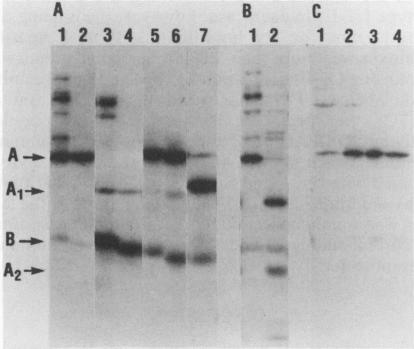
Type II heat-labile enterotoxin (LT-II) from Escherichia coli 41 was purified and compared with prototype LT-II encoded by genes from E. coli SA53. Both toxins were oligomeric proteins consisting of polypeptides A (Mr, 28,000) and B (Mr, 11,800). The A polypeptides were cleaved by trypsin into fragments A1 (Mr, 21,000) and A2 (Mr, about 7,000). These two toxins were shown to belong to two different subclasses of LT-II. We propose to designate the prototype toxin LT-IIa and the new variant LT-IIb. The pI of LT-IIb was between 5.2 and 5.6, significantly lower than the pI of 6.8 for LT-IIa, and the behavior of LT-IIb during purification differed significantly from that of LT-IIa. The toxic dose of unnicked LT-IIb in the Y1 adrenal-cell assay was 94 pg, but trypsin-treated, nicked LT-IIb was toxic at about 3 pg. In contrast, the toxic dose of LT-IIa was previously shown to be 0.5 to 1 pg for several preparations that varied from unnicked to partially nicked, and treatment with trypsin was not required for full toxicity. The titer of LT-II antiserum in neutralization tests was 100-fold greater against LT-IIa than against LT-IIb. In immunodiffusion tests, LT-IIa and LT-IIb gave a reaction of partial identity. In a radioimmunobinding assay, the titer of LT-IIa antiserum against homologous LT-IIa was approximately 10-fold greater than against LT-IIb. The cholera-E. coli family of heat-labile enterotoxins has been divided into serogroup I, which includes cholera toxin and the antigenic variants of E. coli heat-labile toxin designated LTh-I and LTp-I, and serogroup II, which includes LT-IIa and LT-IIb. The type I and type II toxins do not cross-react in neutralization or immunodiffusion tests. By using very sensitive radioimmunobinding assays, it was possible to demonstrate common antigenic determinants between the type I and type II toxins. However, the titers of antibodies in hyperimmune sera that recognized these common determinants were very low.
对来自大肠杆菌41的II型热不稳定肠毒素(LT-II)进行了纯化,并与大肠杆菌SA53基因编码的原型LT-II进行了比较。两种毒素均为寡聚蛋白,由多肽A(Mr,28,000)和B(Mr,11,800)组成。A多肽被胰蛋白酶切割成片段A1(Mr,21,000)和A2(Mr,约7,000)。这两种毒素被证明属于LT-II的两个不同亚类。我们建议将原型毒素命名为LT-IIa,新变体命名为LT-IIb。LT-IIb的pI在5.2至5.6之间,明显低于LT-IIa的pI 6.8,并且LT-IIb在纯化过程中的行为与LT-IIa有显著差异。在Y1肾上腺细胞试验中,未切割的LT-IIb的毒性剂量为94 pg,但经胰蛋白酶处理的切割型LT-IIb在约3 pg时具有毒性。相比之下,先前显示几种制剂中LT-IIa的毒性剂量为0.5至1 pg,这些制剂从不切割到部分切割不等,并且完全毒性不需要胰蛋白酶处理。在中和试验中,LT-II抗血清对LT-IIa的效价比LT-IIb高100倍。在免疫扩散试验中,LT-IIa和LT-IIb产生部分相同反应。在放射免疫结合试验中,LT-IIa抗血清对同源LT-IIa的效价比LT-IIb高约10倍。霍乱-大肠杆菌热不稳定肠毒素家族已分为血清群I,其中包括霍乱毒素和指定为LTh-I和LTp-I的大肠杆菌热不稳定毒素的抗原变体,以及血清群II,其中包括LT-IIa和LT-IIb。I型和II型毒素在中和或免疫扩散试验中不发生交叉反应。通过使用非常灵敏的放射免疫结合试验,有可能证明I型和II型毒素之间存在共同的抗原决定簇。然而,识别这些共同决定簇的超免疫血清中的抗体效价非常低。