Pandey Pratima, Mersha Mahlet D, Dhillon Harbinder S
Department of Biological Sciences, Center for Neuroscience Research, Delaware State University, Dover, DE 19901, USA.
J Mol Signal. 2013 Dec 5;8(1):13. doi: 10.1186/1750-2187-8-13.
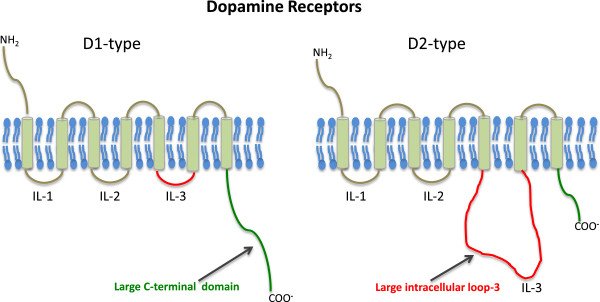
The importance of the neurotransmitter dopamine (DA) in the nervous system is underscored by its role in a wide variety of physiological and neural functions in both vertebrates and invertebrates. Binding of dopamine to its membrane receptors initiates precise signaling cascades that result in specific cellular responses. Dopamine receptors belong to a super-family of G-protein coupled receptors (GPCRs) that are characterized by seven trans-membrane domains. In mammals, five dopamine receptors have been identified which are grouped into two different categories D1- and D2-like receptors. The interactions of DA receptors with other proteins including specific Gα subunits are critical in deciding the fate of downstream molecular events carried out by effector proteins. In this mini-review we provide a synopsis of known protein-protein interactions of DA receptors and a perspective on the potential synergistic utility of Caenorhabditis elegans as a model eukaryote with a comparatively simpler nervous system to gain insight on the neuronal and behavioral consequences of the receptor interactions.
神经递质多巴胺(DA)在脊椎动物和无脊椎动物的多种生理和神经功能中发挥作用,这凸显了其在神经系统中的重要性。多巴胺与其膜受体的结合引发精确的信号级联反应,从而导致特定的细胞反应。多巴胺受体属于G蛋白偶联受体(GPCRs)超家族,其特征是具有七个跨膜结构域。在哺乳动物中,已鉴定出五种多巴胺受体,它们被分为两类不同的受体,即D1样受体和D2样受体。多巴胺受体与包括特定Gα亚基在内的其他蛋白质的相互作用,对于决定效应蛋白所执行的下游分子事件的结果至关重要。在这篇小型综述中,我们概述了已知的多巴胺受体蛋白质-蛋白质相互作用,并探讨了秀丽隐杆线虫作为一种具有相对简单神经系统的模式真核生物,在深入了解受体相互作用的神经元和行为后果方面的潜在协同效用。