Division of Surgery, Saitama Social Insurance Hospital, Saitama, Japan.
J Surg Oncol. 2014 May;109(6):612-5. doi: 10.1002/jso.23528. Epub 2013 Dec 6.
Axillary reverse mapping (ARM) is a novel technique for preserving the upper extremity lymphatic pathways during axillary lymph node surgery. However, there is no evidence of the usefulness of ARM for patients undergoing sentinel lymph node biopsy (SNB).
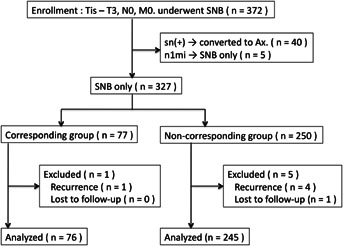
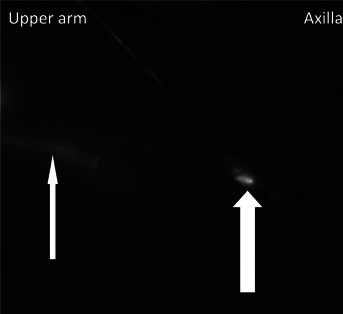
Between August 2009 and July 2012, 372 patients who underwent the SNB procedure for breast cancer were enrolled in this study. Using the indocyanine green fluorescence technique and indigocarmine blue dye method, we studied the relationship between the upper extremity lymphatic flow and breast sentinel node (SN). Our aim of this study was the probability of postoperative lymphedema with respect to whether the upper extremity lymphatics corresponded to the breast SN.
Among the 327 patients who underwent the SNB procedure, the upper extremity lymphatics drainage into the breast SN in 76 (23.2%; corresponding group), and only 5 patients in this group developed lymphedema. In contrast, none of the patients in the noncorresponding group developed lymphedema.
ARM during SN biopsy can identify the group of patients who are at high risk for developing lymphedema. More risk-focused guidance should be used for these patients.
腋窝反向映射(ARM)是一种在腋窝淋巴结清扫术中保留上肢淋巴通路的新技术。然而,目前尚无证据表明 ARM 对接受前哨淋巴结活检(SNB)的患者有用。
在 2009 年 8 月至 2012 年 7 月期间,我们共纳入 372 例接受 SNB 治疗乳腺癌的患者。我们使用吲哚菁绿荧光技术和靛胭脂蓝染料法,研究上肢淋巴流动与乳房前哨淋巴结(SN)之间的关系。本研究的目的是评估上肢淋巴与乳房 SN 是否一致与术后淋巴水肿发生的概率之间的关系。
在 327 例行 SNB 手术的患者中,上肢淋巴液引流至乳房 SN 的有 76 例(23.2%,对应组),而在这组中只有 5 例患者发生淋巴水肿。相比之下,非对应组的患者均未发生淋巴水肿。
在 SN 活检期间进行 ARM 可以确定发生淋巴水肿风险较高的患者群体。对这些患者应采用更有针对性的风险指导。