Weide Benjamin, Richter Sabina, Büttner Petra, Leiter Ulrike, Forschner Andrea, Bauer Jürgen, Held Laura, Eigentler Thomas Kurt, Meier Friedegund, Garbe Claus
Department of Dermatology, University Medical Center, Tübingen, Germany ; German Cancer Research Center (DKFZ), Heidelberg, Germany ; German Cancer Consortium (DKTK), Heidelberg, Germany.
PLoS One. 2013 Nov 28;8(11):e81624. doi: 10.1371/journal.pone.0081624. eCollection 2013.
Prognostic factors of melanoma with distant metastasis and systemic treatment are only poorly established. This study aimed to analyse the impact of S100B, lactate dehydrogenase (LDH) and the type of treatment on survival in advanced patients receiving systemic treatment.
We analysed overall survival of 499 patients from the university department of dermatology in Tuebingen, Germany, with unresectable melanoma at the time point of initiation of first-line systemic therapy. Only patients who started treatment between the years 2000 and 2010 were included. Disease-specific survival was calculated by bivariate Kaplan Meier survival probabilities and multivariate Cox hazard regression analysis.
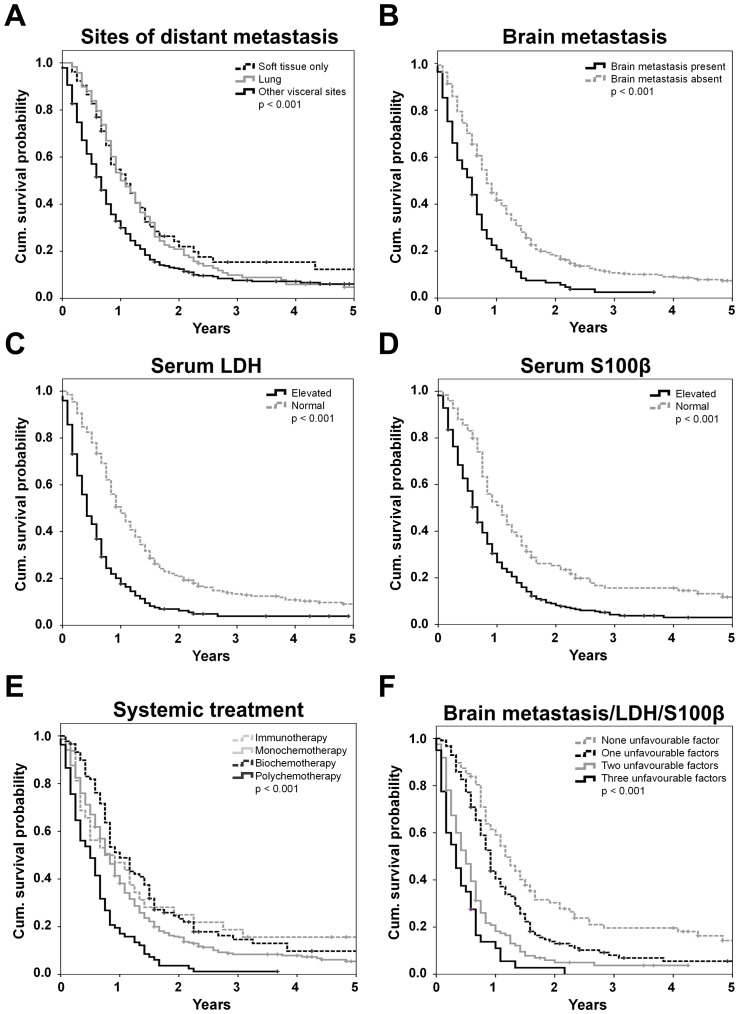
In univariate analysis LDH, S100B, the site of distant metastasis (soft tissue vs. lung vs. other visceral), the presence of brain metastases and the type of treatment (monochemotherapy, polychemotherapy, immunotherapy or biochemotherapy) were associated with overall survival (all p<0.001). In multivariate analysis LDH (Hazard ratio [HR] 1.6 [1.3-2.1]; p<0.001), S100B (HR 1.6 [1.2-2.1]; p<0.001) and the presence of brain metastases (HR 1.5 [1.1-1.9]; p = 0.009), but not the type of treatment had significant independent impact. Among those factors normal S100B was the best indicator of long-term survival, which was 12.3% after 5 years for this subgroup.
Serum S100B is a prognostic marker predicting survival at the time of initiation of first-line treatment in unresectable melanoma patients. Compared to the other independent factors LDH and the presence of brain metastases it is most appropriate to predict long-term survival and requires further prospective investigation in patients treated with new and more potent drugs in metastatic melanoma.
远处转移黑色素瘤的预后因素及系统治疗方法尚未完全明确。本研究旨在分析S100B、乳酸脱氢酶(LDH)及治疗类型对接受系统治疗的晚期患者生存情况的影响。
我们分析了德国图宾根大学皮肤科499例患者的总生存期,这些患者在一线系统治疗开始时患有不可切除的黑色素瘤。仅纳入2000年至2010年间开始治疗的患者。通过双变量Kaplan Meier生存概率和多变量Cox风险回归分析计算疾病特异性生存期。
单变量分析中,LDH、S100B、远处转移部位(软组织、肺、其他内脏)、脑转移的存在及治疗类型(单药化疗、联合化疗、免疫治疗或生物化疗)均与总生存期相关(均p<0.001)。多变量分析中,LDH(风险比[HR] 1.6 [1.3 - 2.1];p<0.001)、S100B(HR 1.6 [1.2 - 2.1];p<0.001)及脑转移的存在(HR 1.5 [1.1 - 1.9];p = 0.009)对生存期有显著独立影响,而治疗类型无此影响。在这些因素中,S100B正常是长期生存的最佳指标,该亚组5年后的长期生存率为12.3%。
血清S100B是不可切除黑色素瘤患者一线治疗开始时预测生存的预后标志物。与其他独立因素LDH和脑转移的存在相比,它最适合预测长期生存,并且需要在接受新型更强效药物治疗的转移性黑色素瘤患者中进行进一步的前瞻性研究。