Department of Neuroscience, Psychology, Drug Research and Child Health, Section of Pharmacology and Toxicology, University of Florence, Florence, Italy.
PLoS One. 2013 Nov 29;8(11):e82180. doi: 10.1371/journal.pone.0082180. eCollection 2013.
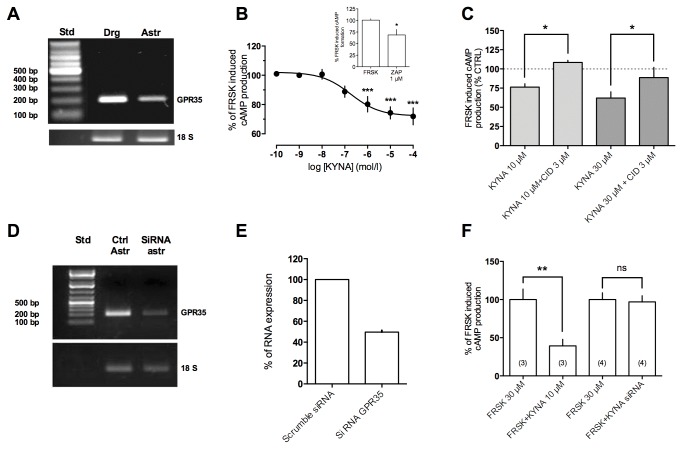
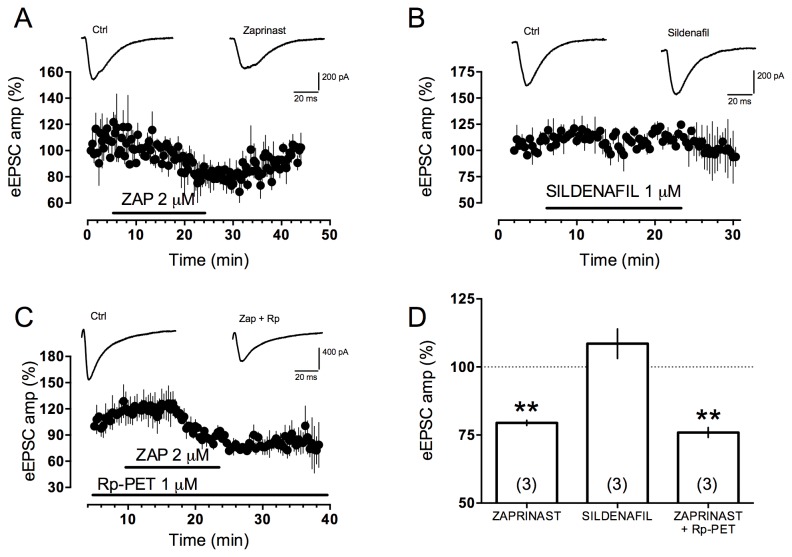
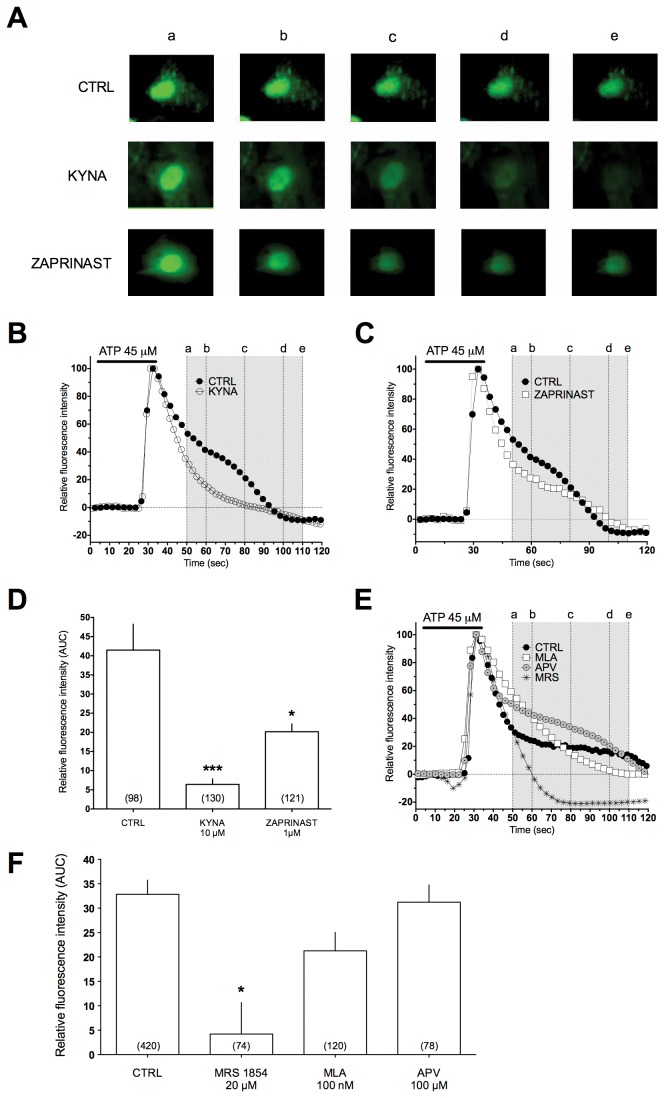
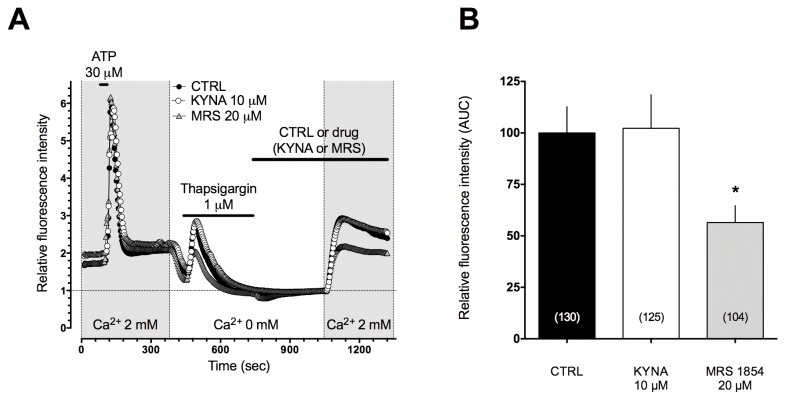
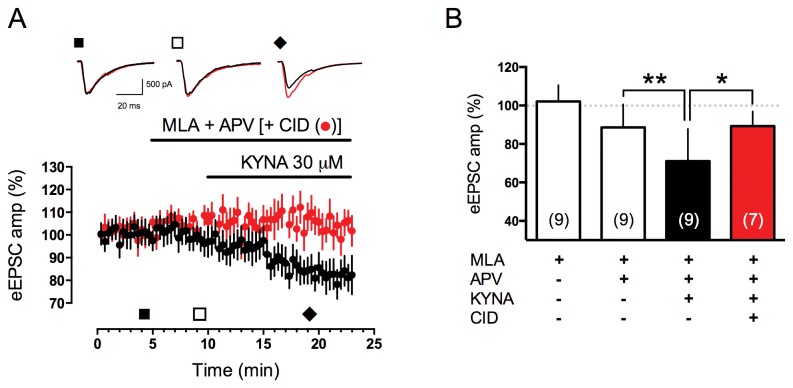
Limited information is available on the brain expression and role of GPR35, a Gi/o coupled receptor activated by kynurenic acid (KYNA). In mouse cultured astrocytes, we detected GPR35 transcript using RT-PCR and we found that KYNA (0.1 to 100 µM) decreased forskolin (FRSK)-induced cAMP production (p<0.05). Both CID2745687 (3 µM, CID), a recently described GPR35 antagonist, and GPR35 gene silencing significantly prevented the action of KYNA on FRSK-induced cAMP production. In these cultures, we then evaluated whether GPR35 activation was able to modulate intracellular Ca(2+) concentration ([Ca(2+)]i ) and [Ca(2+)]i fluxes. We found that both KYNA and zaprinast, a phosphodiesterase (PDE) inhibitor and GPR35 agonist, did not modify either basal or peaks of [Ca(2+)]i induced by challenging the cells with ATP (30 µM). However, the [Ca(2+)]i plateau phase following peak was significantly attenuated by these compounds in a store-operated Ca(2+) channel (SOC)-independent manner. The activation of GPR35 by KYNA and zaprinast was also studied at the CA3-CA1 synapse in the rat hippocampus. Evoked excitatory post synaptic currents (eEPSCs) were recorded from CA1 pyramidal neurons in acute brain slices. The action of KYNA on GPR35 was pharmacologically isolated by using NMDA and α7 nicotinic receptor blockers and resulted in a significant reduction of eEPSC amplitude. This effect was prevented in the presence of CID. Moreover, zaprinast reduced eEPSC amplitude in a PDE5- and cGMP-independent mechanism, thus suggesting that glutamatergic transmission in this area is modulated by GPR35. In conclusion, GPR35 is expressed in cultured astrocytes and its activation modulates cAMP production and [Ca(2+)]i. GPR35 activation may contribute to KYNA effects on the previously reported decrease of brain extracellular glutamate levels and reduction of excitatory transmission.
关于 GPR35 的脑表达和作用的信息有限,GPR35 是一种被犬尿酸(KYNA)激活的 Gi/o 偶联受体。在培养的小鼠星形胶质细胞中,我们使用 RT-PCR 检测到 GPR35 转录物,并且发现 KYNA(0.1 至 100µM)降低了 forskolin(FRSK)诱导的 cAMP 产生(p<0.05)。最近描述的 GPR35 拮抗剂 CID2745687(3µM,CID)和 GPR35 基因沉默均显著阻止了 KYNA 对 FRSK 诱导的 cAMP 产生的作用。在这些培养物中,我们然后评估了 GPR35 激活是否能够调节细胞内 Ca(2+)浓度([Ca(2+)]i)和[Ca(2+)]i 通量。我们发现,KYNA 和 zaprinast(一种磷酸二酯酶(PDE)抑制剂和 GPR35 激动剂)均未修饰用 ATP(30µM)刺激细胞时诱导的基础或峰值[Ca(2+)]i。然而,这些化合物以 SOC 独立的方式显著减弱了峰值后的[Ca(2+)]i 平台期。在大鼠海马 CA3-CA1 突触中也研究了 KYNA 和 zaprinast 对 GPR35 的激活。在急性脑切片中从 CA1 锥体神经元记录诱发性兴奋性突触后电流(eEPSC)。通过使用 NMDA 和 α7 烟碱型乙酰胆碱受体阻断剂将 KYNA 对 GPR35 的作用在药理学上分离出来,导致 eEPSC 幅度显著降低。在 CID 的存在下,这种作用被阻止。此外,zaprinast 以 PDE5 和 cGMP 独立的机制降低 eEPSC 幅度,因此表明该区域的谷氨酸能传递受 GPR35 调节。总之,GPR35 在培养的星形胶质细胞中表达,其激活调节 cAMP 产生和[Ca(2+)]i。GPR35 的激活可能有助于 KYNA 对先前报道的脑细胞外谷氨酸水平降低和兴奋性传递减少的作用。