Uchida Shinichi, Sohara Eisei, Rai Tatemitsu, Sasaki Sei
Department of Nephrology, Graduate School of Medical and Dental Sciences, Tokyo Medical and Dental University, 1-5-45 Yushima, Bunkyo-ku, Tokyo, 113-8519, Japan.
Biol Cell. 2014 Feb;106(2):45-56. doi: 10.1111/boc.201300069. Epub 2014 Jan 10.
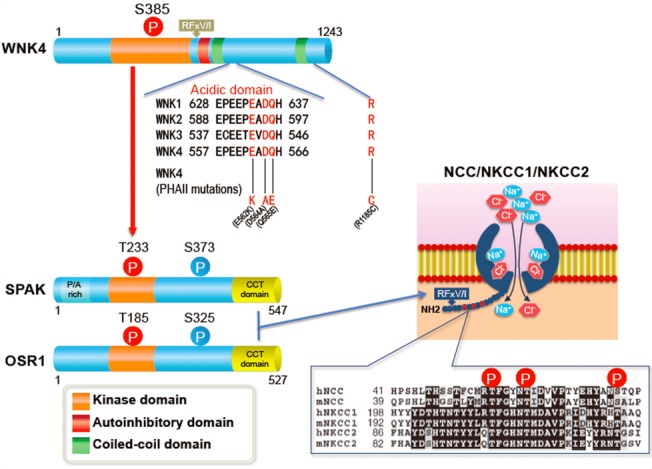
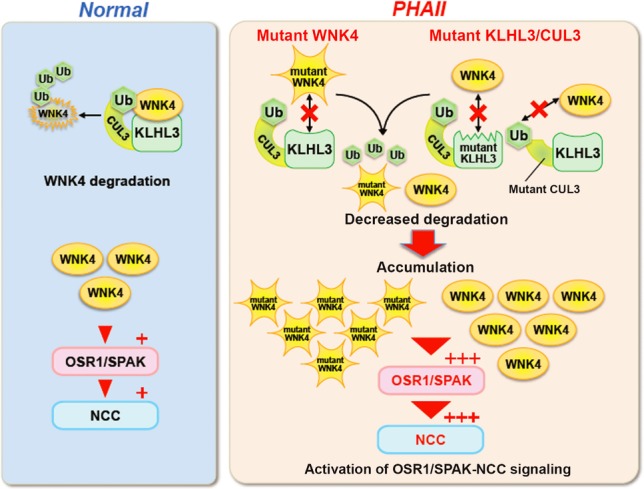
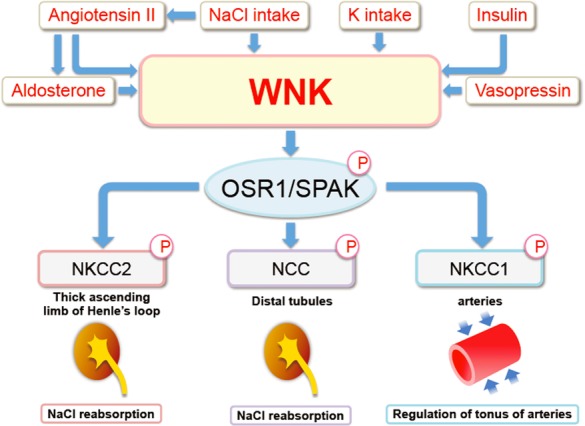
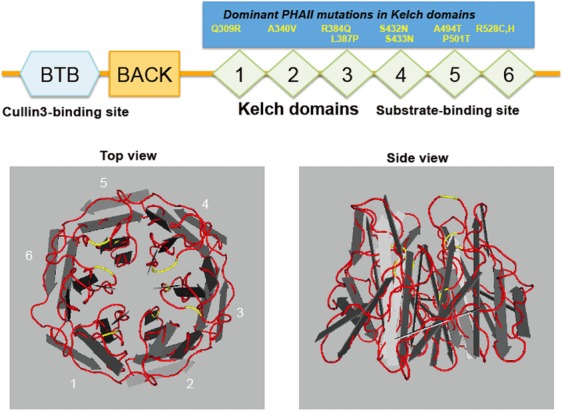
In 2001, with-no-lysine (WNK) kinases were identified as the genes responsible for the human hereditary hypertensive disease pseudohypoaldosteronism type II (PHAII). It took a further 6 years to clarify that WNK kinases participate in a signaling cascade with oxidative stress-responsive gene 1 (OSR1), Ste20-related proline-alanine-rich kinase (SPAK), and thiazide-sensitive NaCl cotransporter (NCC) in the kidney and the constitutive activation of this signaling cascade is the molecular basis of PHAII. Since this discovery, the WNK-OSR1/SPAK-NCC signaling cascade has been shown to be involved not only in PHAII but also in the regulation of blood pressure under normal and pathogenic conditions, such as hyperinsulinemia. However, the molecular mechanisms of WNK kinase regulation by dietary and hormonal factors and by PHAII-causing mutations remain poorly understood. In 2012, two additional genes responsible for PHAII, Kelch-like 3 (KLHL3) and Cullin3, were identified. At the time of their discovery, the molecular mechanisms underlying the interaction between these genes and their involvement in PHAII were unknown. Here we review the pathophysiological roles of the WNK signaling cascade clarified to date and introduce a new mechanism of WNK kinase regulation by KLHL3 and Cullin3, which provides insight on previously unknown mechanisms of WNK kinase regulation.
2001年,无赖氨酸(WNK)激酶被确定为导致人类遗传性高血压疾病II型假性醛固酮增多症(PHAII)的基因。又过了6年才明确,WNK激酶在肾脏中与氧化应激反应基因1(OSR1)、Ste20相关富含脯氨酸-丙氨酸激酶(SPAK)和噻嗪类敏感的NaCl共转运体(NCC)参与一个信号级联反应,而该信号级联反应的组成性激活是PHAII的分子基础。自这一发现以来,WNK-OSR1/SPAK-NCC信号级联反应已被证明不仅与PHAII有关,而且在正常和致病条件下(如高胰岛素血症)的血压调节中也发挥作用。然而,饮食和激素因素以及导致PHAII的突变对WNK激酶的调节分子机制仍知之甚少。2012年,另外两个导致PHAII的基因,即类Kelch 3(KLHL3)和Cullin3被确定。在它们被发现时,这些基因之间相互作用的分子机制及其在PHAII中的作用尚不清楚。在此,我们综述了迄今为止已阐明的WNK信号级联反应的病理生理作用,并介绍了KLHL3和Cullin3对WNK激酶调节的新机制,这为WNK激酶调节的先前未知机制提供了见解。