Institut National de la Recherche Agronomique, UMR441, Laboratoire des Interactions Plantes-Microorganismes Castanet-Tolosan, France ; Centre National de la Recherche Scientifique, UMR2594, Laboratoire des Interactions Plantes-Microorganismes Castanet-Tolosan, France.
Front Plant Sci. 2013 Nov 22;4:435. doi: 10.3389/fpls.2013.00435.
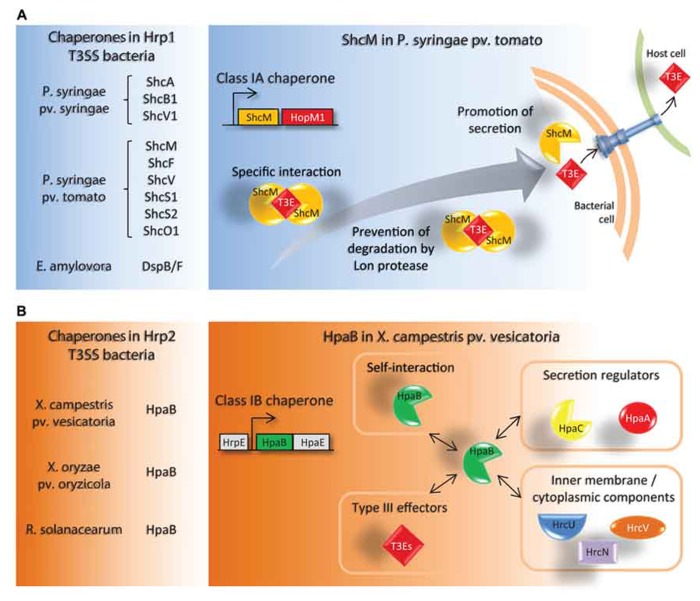
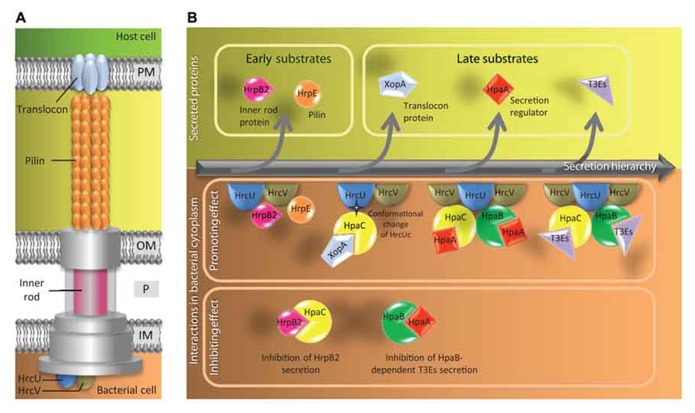
Gram-negative plant pathogenic bacteria possess a type III secretion system (T3SS) to inject bacterial proteins, called type III effectors (T3Es), into host cells through a specialized syringe structure. T3Es are virulence factors that can suppress plant immunity but they can also conversely be recognized by the plant and trigger specific resistance mechanisms. The T3SS and injected T3Es play a central role in determining the outcome of a host-pathogen interaction. Still little is known in plant pathogens on the assembly of the T3SS and the regulatory mechanisms involved in the temporal control of its biosynthesis and T3E translocation. However, recent insights point out the role of several proteins as prime candidates in the role of regulators of the type III secretion (T3S) process. In this review we report on the most recent advances on the regulation of the T3S by focusing on protein players involved in secretion/translocation regulations, including type III chaperones (T3Cs), type III secretion substrate specificity switch (T3S4) proteins and other T3S orchestrators.
革兰氏阴性植物病原细菌拥有一种 III 型分泌系统(T3SS),通过一种特殊的注射器结构将称为 III 型效应器(T3E)的细菌蛋白注入宿主细胞。T3E 是毒力因子,可以抑制植物免疫,但也可以被植物识别并触发特定的抗性机制。T3SS 和注入的 T3E 在决定宿主-病原体相互作用的结果方面起着核心作用。然而,人们对植物病原体中 T3SS 的组装以及其生物合成和 T3E 易位的时间控制所涉及的调节机制知之甚少。然而,最近的研究结果指出,几种蛋白质作为 III 型分泌(T3S)过程调节剂的主要候选蛋白。在这篇综述中,我们报告了 T3S 调节的最新进展,重点关注参与分泌/易位调节的蛋白,包括 III 型伴侣蛋白(T3C)、III 型分泌底物特异性开关(T3S4)蛋白和其他 T3S 协调蛋白。