Rossi Pellegrino, Dolci Susanna
Dipartimento di Biomedicina e Prevenzione, Università degli Studi di Roma Tor Vergata , Rome , Italy.
Front Endocrinol (Lausanne). 2013 Nov 26;4:181. doi: 10.3389/fendo.2013.00181.
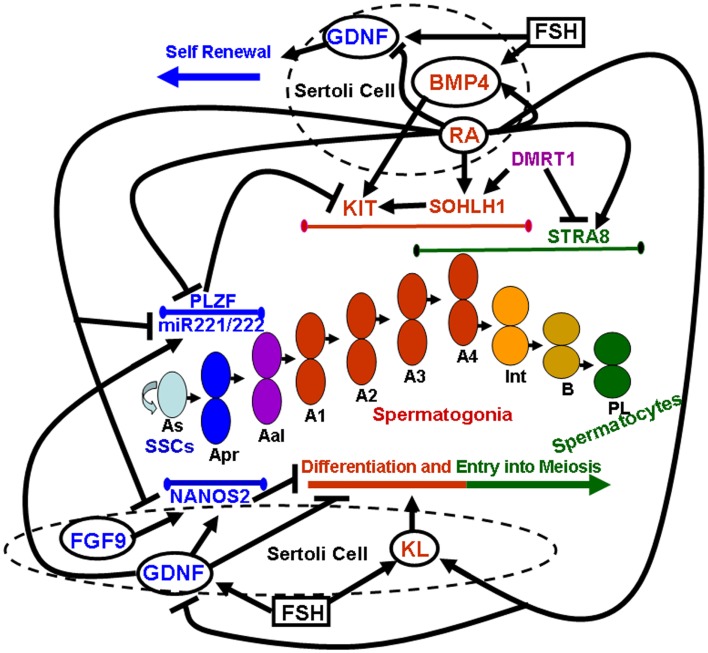
Within the testis, Sertoli-cell is the primary target of pituitary FSH. Several growth factors have been described to be produced specifically by Sertoli cells and modulate male germ cell development through paracrine mechanisms. Some have been shown to act directly on spermatogonia such as GDNF, which acts on self-renewal of spermatogonial stem cells (SSCs) while inhibiting their differentiation; BMP4, which has both a proliferative and differentiative effect on these cells, and KIT ligand (KL), which stimulates the KIT tyrosine-kinase receptor expressed by differentiating spermatogonia (but not by SSCs). KL not only controls the proliferative cycles of KIT-positive spermatogonia, but it also stimulates the expression of genes that are specific of the early phases of meiosis, whereas the expression of typical spermatogonial markers is down-regulated. On the contrary, FGF9 acts as a meiotic inhibiting substance both in fetal gonocytes and in post-natal spermatogonia through the induction of the RNA-binding protein NANOS2. Vitamin A, which is metabolized to Retinoic Acid in Sertoli cells, controls both SSCs differentiation through KIT induction and NANOS2 inhibition, and meiotic entry of differentiating spermatogonia through STRA8 upregulation.
在睾丸内,支持细胞是垂体促卵泡激素(FSH)的主要靶细胞。已有多种生长因子被描述为由支持细胞特异性产生,并通过旁分泌机制调节雄性生殖细胞的发育。一些生长因子已被证明可直接作用于精原细胞,如胶质细胞源性神经营养因子(GDNF),它作用于精原干细胞(SSCs)的自我更新,同时抑制其分化;骨形态发生蛋白4(BMP4),对这些细胞具有增殖和分化作用;以及KIT配体(KL),它刺激分化中的精原细胞(而非SSCs)表达的KIT酪氨酸激酶受体。KL不仅控制KIT阳性精原细胞的增殖周期,还刺激减数分裂早期阶段特异性基因的表达,而典型精原细胞标志物的表达则下调。相反,成纤维细胞生长因子9(FGF9)通过诱导RNA结合蛋白NANOS2,在胎儿生殖细胞和出生后精原细胞中均作为减数分裂抑制物质发挥作用。在支持细胞中代谢为视黄酸的维生素A,通过诱导KIT和抑制NANOS2来控制SSCs的分化,并通过上调STRA8来控制分化中精原细胞的减数分裂进入。