
马赛沿海地区(地中海西北部)三维物理-生物地球化学耦合模型的开发:沿海区域需要何种复杂性?
Development of a 3D coupled physical-biogeochemical model for the Marseille coastal area (NW Mediterranean Sea): what complexity is required in the coastal zone?
作者信息
Fraysse Marion, Pinazo Christel, Faure Vincent Martin, Fuchs Rosalie, Lazzari Paolo, Raimbault Patrick, Pairaud Ivane
机构信息
IFREMER, Laboratoire Environnement Ressources Provence Azur Corse, La Seyne sur Mer, France ; Aix Marseille Université, CNRS/INSU, IRD, Mediterranean Institute of Oceanography (MIO), UM 110, Marseille, France ; Université de Toulon, CNRS/INSU, IRD, Mediterranean Institute of Oceanography (MIO), UM 110, La Garde, France.
出版信息
PLoS One. 2013 Dec 4;8(12):e80012. doi: 10.1371/journal.pone.0080012. eCollection 2013.
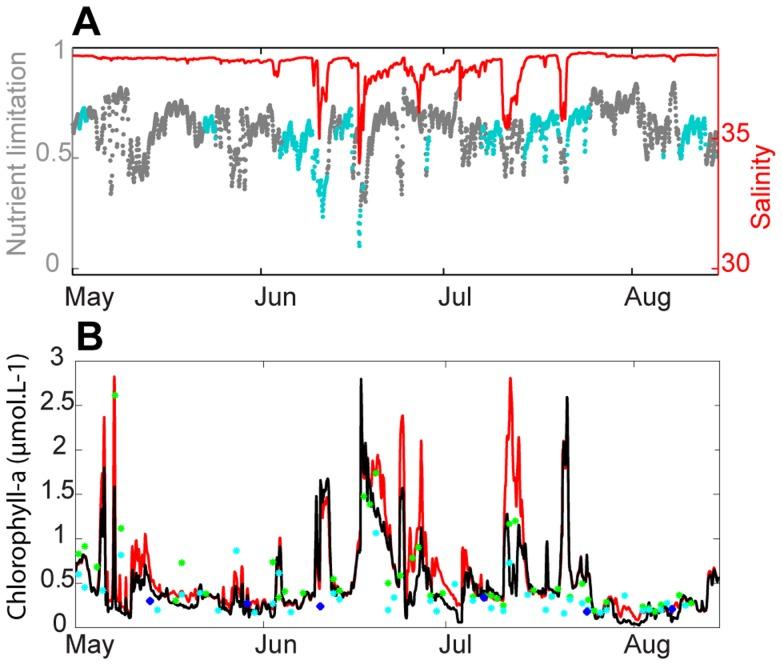
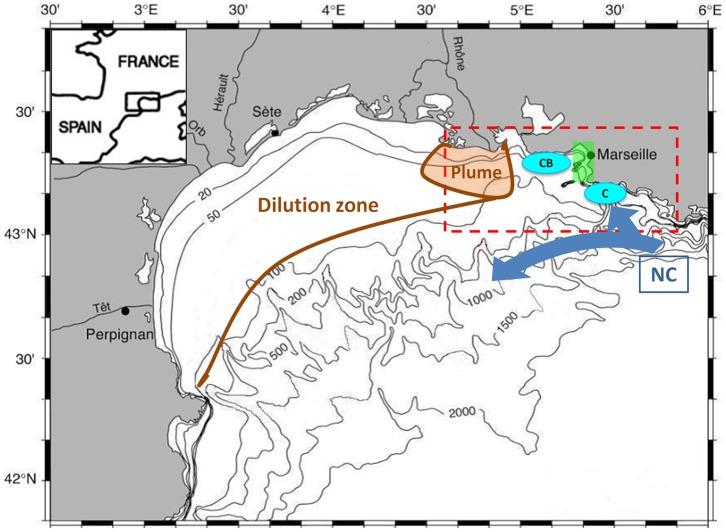
Terrestrial inputs (natural and anthropogenic) from rivers, the atmosphere and physical processes strongly impact the functioning of coastal pelagic ecosystems. The objective of this study was to develop a tool for the examination of these impacts on the Marseille coastal area, which experiences inputs from the Rhone River and high rates of atmospheric deposition. Therefore, a new 3D coupled physical/biogeochemical model was developed. Two versions of the biogeochemical model were tested, one model considering only the carbon (C) and nitrogen (N) cycles and a second model that also considers the phosphorus (P) cycle. Realistic simulations were performed for a period of 5 years (2007-2011). The model accuracy assessment showed that both versions of the model were able of capturing the seasonal changes and spatial characteristics of the ecosystem. The model also reproduced upwelling events and the intrusion of Rhone River water into the Bay of Marseille well. Those processes appeared to greatly impact this coastal oligotrophic area because they induced strong increases in chlorophyll-a concentrations in the surface layer. The model with the C, N and P cycles better reproduced the chlorophyll-a concentrations at the surface than did the model without the P cycle, especially for the Rhone River water. Nevertheless, the chlorophyll-a concentrations at depth were better represented by the model without the P cycle. Therefore, the complexity of the biogeochemical model introduced errors into the model results, but it also improved model results during specific events. Finally, this study suggested that in coastal oligotrophic areas, improvements in the description and quantification of the hydrodynamics and the terrestrial inputs should be preferred over increasing the complexity of the biogeochemical model.
来自河流、大气和物理过程的陆地输入(自然和人为的)对沿海中上层生态系统的功能产生强烈影响。本研究的目的是开发一种工具,用于研究这些影响对马赛沿海地区的作用,该地区受到罗纳河的输入以及高大气沉降率的影响。因此,开发了一种新的三维物理/生物地球化学耦合模型。对生物地球化学模型的两个版本进行了测试,一个模型仅考虑碳(C)和氮(N)循环,另一个模型还考虑磷(P)循环。进行了为期5年(2007 - 2011年)的实际模拟。模型准确性评估表明,两个版本的模型都能够捕捉生态系统的季节变化和空间特征。该模型还很好地再现了上升流事件以及罗纳河河水侵入马赛湾的情况。这些过程似乎对这个沿海贫营养区域产生了重大影响,因为它们导致表层叶绿素a浓度大幅增加。包含碳、氮和磷循环的模型比不包含磷循环的模型能更好地再现表层的叶绿素a浓度,特别是对于罗纳河河水。然而,不包含磷循环的模型能更好地表示深层的叶绿素a浓度。因此,生物地球化学模型的复杂性给模型结果带来了误差,但在特定事件期间也改善了模型结果。最后,本研究表明,在沿海贫营养区域,相比于增加生物地球化学模型的复杂性,优先改进水动力和陆地输入的描述与量化更为可取。


 Zotero 插件