Kuo Sung-Hsin, Yang Shi-Yi, Lien Huang-Chun, Lo Chiao, Lin Ching-Hung, Lu Yen-Sen, Cheng Ann-Lii, Chang King-Jeng, Huang Chiun-Sheng
Department of Oncology, National Taiwan University Hospital and National Taiwan University College of Medicine, Taipei, Taiwan ; Department of Internal Medicine, National Taiwan University Hospital and National Taiwan University College of Medicine, Taipei, Taiwan ; Graduate Institute of Oncology, National Taiwan University College of Medicine, Taipei, Taiwan.
Biomed Res Int. 2013;2013:562197. doi: 10.1155/2013/562197. Epub 2013 Nov 14.
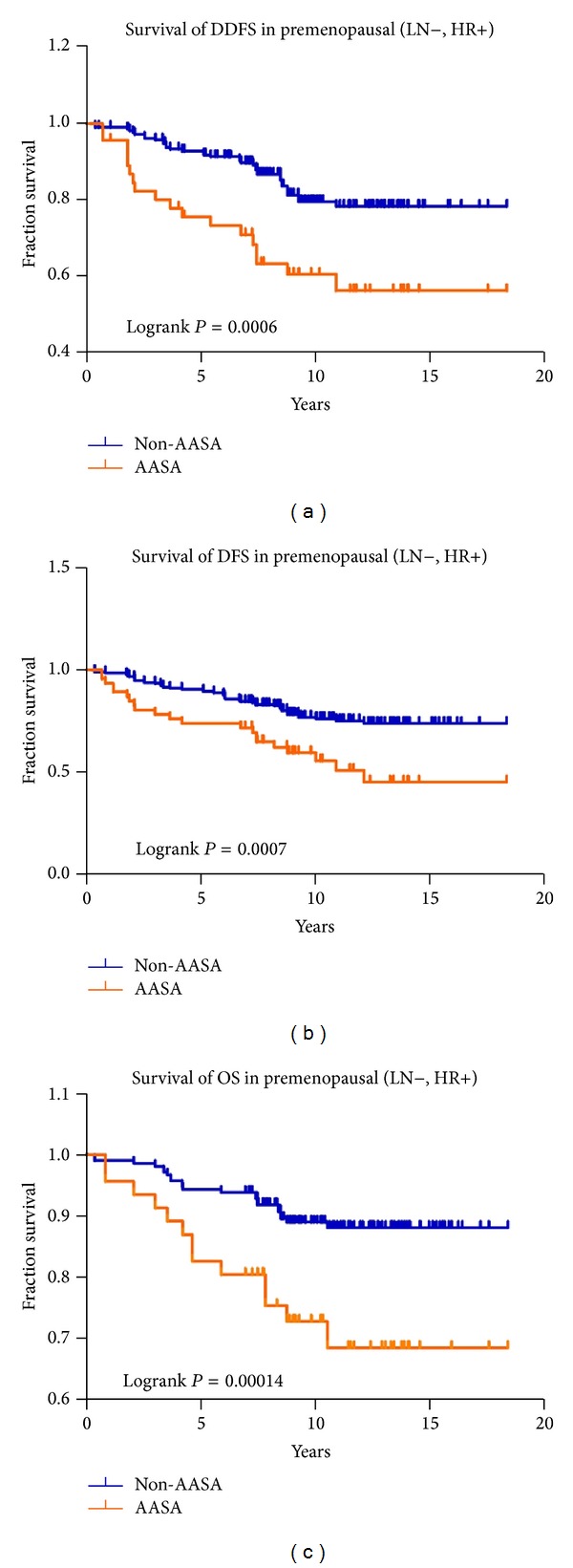
Given the critical role of CYP19 in estrogen synthesis, we investigated the influence of CYP19 gene polymorphisms on the clinical outcome of lymph node- (LN-) negative, hormone receptor- (HR-) positive early breast cancers. Genotyping for the CYP19 polymorphisms rs4646 (A/C), rs1065779 (A/C), CYP19 (TTTA)n (short allele/long (S/L) allele using the 7 TTTA repeat polymorphism as the cut-off), and rs1870050 (A/C) was performed on 296 patients with LN-negative, HR-positive breast cancers. All patients received adjuvant hormonal therapy. Associations were examined between these 4 genotypes and 6 common haplotypes of CYP19 and distant disease-free survival (DDFS), disease-free survival (DFS), and overall survival (OS). Patients were divided into the 6 subhaplotypes of CCLA (41.1%), AASA (17.1%), CASA (11.9%), CCLC (8.9%), CCSA (7.5%), AASC (8.9%), and others (4.6%). In premenopausal patients, haplotype AASA was significantly associated with a poor DDFS (adjusted hazard ratio (aHR), 3.3; P = 0.001), DFS (aHR, 2.5; P = 0.0008), and OS (aHR, 2.9; P = 0.0004) after adjusting for age, tumor size, tumor grade, estrogen receptor status, progesterone receptor status, chemotherapy, pathology, adjuvant hormone therapy, menopausal status, and radiotherapy. Furthermore, haplotype AASA remained a negative prognostic factor for premenopausal patients receiving adjuvant chemotherapy in terms of DDFS (aHR, 4.5; P = 0.0005), DFS (HR, 3.2; P = 0.003), and OS (HR, 6.4; P = 0.0009). However, in postmenopausal patients, haplotype AASA was not associated with a poor prognosis, whereas the AASC haplotype was significantly associated with a poor DFS (aHR, 3.1; P = 0.03) and OS (aHR, 4.4; P = 0.01). Our results indicate that, in patients with LN-negative, HR-positive breast cancers, genetic polymorphism haplotype AASA is associated with poor survival of premenopausal women but does not affect survival of postmenopausal women.
鉴于细胞色素P450 19(CYP19)在雌激素合成中的关键作用,我们研究了CYP19基因多态性对淋巴结(LN)阴性、激素受体(HR)阳性早期乳腺癌临床结局的影响。对296例LN阴性、HR阳性乳腺癌患者进行了CYP19多态性rs4646(A/C)、rs1065779(A/C)、CYP19(TTTA)n(以7个TTTA重复多态性为界分为短等位基因/长(S/L)等位基因)和rs1870050(A/C)的基因分型。所有患者均接受辅助激素治疗。研究了这4种基因型和CYP19的6种常见单倍型与远处无病生存期(DDFS)、无病生存期(DFS)和总生存期(OS)之间的关联。患者被分为CCLA(41.1%)、AASA(17.1%)、CASA(11.9%)、CCLC(8.9%)、CCSA(7.5%)、AASC(8.9%)和其他(4.6%)6种单倍型。在绝经前患者中,调整年龄、肿瘤大小、肿瘤分级、雌激素受体状态、孕激素受体状态、化疗、病理、辅助激素治疗、绝经状态和放疗后,单倍型AASA与较差的DDFS(调整后风险比(aHR),3.3;P = 0.001)、DFS(aHR,2.5;P = 0.0008)和OS(aHR,2.9;P = 0.0004)显著相关。此外,就DDFS(aHR,4.5;P = 0.0005)、DFS(HR,3.2;P = 0.003)和OS(HR,6.4;P = 0.0009)而言,单倍型AASA仍然是接受辅助化疗的绝经前患者的不良预后因素。然而,在绝经后患者中,单倍型AASA与不良预后无关,而单倍型AASC与较差的DDFS(aHR,3.1;P = 0.03)和OS(aHR,4.4;P = 0.01)显著相关。我们的结果表明,在LN阴性、HR阳性乳腺癌患者中,基因多态性单倍型AASA与绝经前女性的不良生存相关,但不影响绝经后女性的生存。