Institute of Veterinary Disease Biology and Sino-Danish Breast Cancer Research Centre, Faculty of Health and Medical Sciences, University of Copenhagen, Strandboulevarden 49, DK-2100 Copenhagen, Denmark.
BMC Cancer. 2013 Dec 13;13:598. doi: 10.1186/1471-2407-13-598.
Worldwide more than one million women are annually diagnosed with breast cancer. A considerable fraction of these women receive systemic adjuvant therapy; however, some are cured by primary surgery and radiotherapy alone. Prognostic biomarkers guide stratification of patients into different risk groups and hence improve management of breast cancer patients. Plasma levels of Matrix Metalloproteinase-9 (MMP-9) and its natural inhibitor Tissue inhibitor of metalloproteinase-1 (TIMP-1) have previously been associated with poor patient outcome and resistance to certain forms of chemotherapy. To pursue additional prognostic information from MMP-9 and TIMP-1, the level of the MMP-9 and TIMP-1 complex (MMP-9:TIMP-1) was investigated in plasma from breast cancer patients.
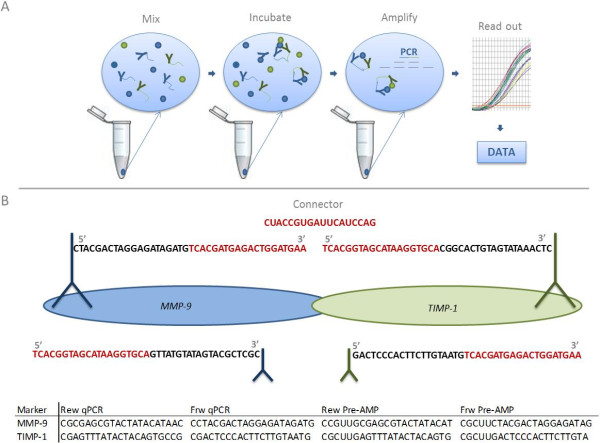
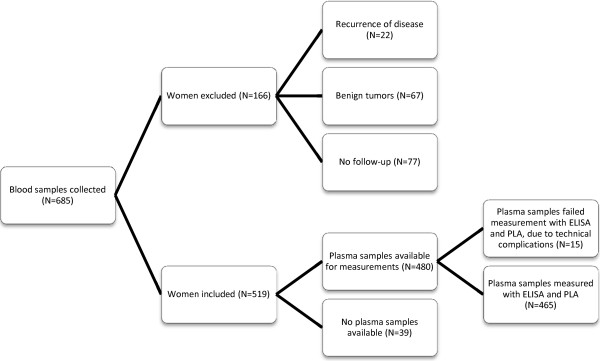
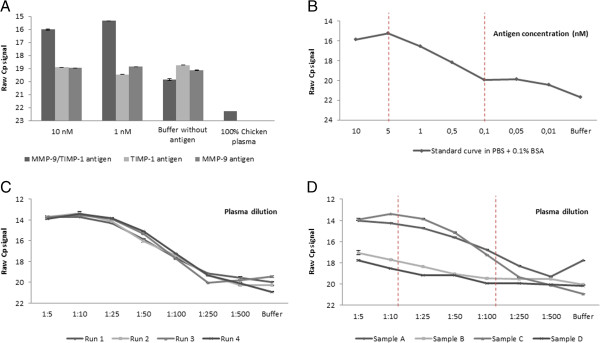
Detection of protein:protein complexes in plasma was performed using a commercially available ELISA kit and, for the first time, the highly sensitive in-solution proximity ligation assay (PLA). We screened plasma from 465 patients with primary breast cancer for prognostic value of the MMP-9:TIMP-1 complex. Both assays were validated and applied for quantification of MMP-9:TIMP-1 concentration. In this retrospective study, we analyzed the association between the concentration of the MMP-9:TIMP-1 complex and clinicopathological data and disease free survival (DFS) in univariate and multivariate survival analyses.
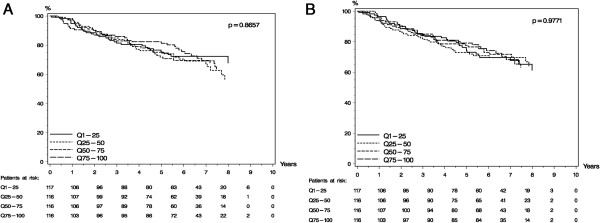
Following successful validation both assays were applied for MMP-9:TIMP-1 measurements. Of the clinicopathological parameters, only menopausal status demonstrated significant association with the MMP-9:TIMP-1 complex; P = 0.03 and P = 0.028 for the ELISA and PLA measurements, respectively. We found no correlation between the MMP-9:TIMP-1 protein complex and DFS neither in univariate nor in multivariate survival analyses.
Despite earlier reports linking MMP-9 and TIMP-1 with prognosis in breast cancer patients, we here demonstrate that plasma levels of the MMP-9:TIMP-1 protein complex hold no prognostic information in primary breast cancer as a stand-alone marker. We demonstrate that the highly sensitive in-solution PLA can be employed for measurements of protein:protein complexes in plasma.
全球每年有超过 100 万女性被诊断患有乳腺癌。这些女性中有相当一部分接受了全身性辅助治疗;然而,有些仅通过手术和放疗就被治愈。预后生物标志物指导患者分层为不同的风险组,从而改善乳腺癌患者的管理。血浆中基质金属蛋白酶-9(MMP-9)及其天然抑制剂金属蛋白酶组织抑制剂-1(TIMP-1)的水平先前与患者预后不良和对某些形式的化疗耐药有关。为了从 MMP-9 和 TIMP-1 中获得更多的预后信息,研究了乳腺癌患者血浆中 MMP-9 和 TIMP-1 复合物(MMP-9:TIMP-1)的水平。
使用市售的 ELISA 试剂盒首次应用高灵敏度的溶液内接近连接检测(PLA)检测血浆中的蛋白:蛋白复合物。我们筛选了 465 例原发性乳腺癌患者的血浆,以评估 MMP-9:TIMP-1 复合物的预后价值。两种检测方法均经过验证并用于定量 MMP-9:TIMP-1 浓度。在这项回顾性研究中,我们分析了 MMP-9:TIMP-1 复合物的浓度与临床病理数据之间的关系,并进行了单变量和多变量生存分析以评估无病生存(DFS)。
两种检测方法均成功验证后,均用于 MMP-9:TIMP-1 测量。在临床病理参数中,仅绝经状态与 MMP-9:TIMP-1 复合物显著相关;ELISA 和 PLA 检测的 P 值分别为 0.03 和 0.028。我们在单变量和多变量生存分析中均未发现 MMP-9:TIMP-1 蛋白复合物与 DFS 之间存在相关性。
尽管先前有报道称 MMP-9 和 TIMP-1 与乳腺癌患者的预后有关,但我们在此证明,作为独立标志物,原发性乳腺癌患者血浆中 MMP-9:TIMP-1 蛋白复合物水平没有预后信息。我们证明,高灵敏度的溶液内 PLA 可用于测量血浆中的蛋白:蛋白复合物。