Sheinerman Kira S, Tsivinsky Vladimir G, Umansky Samuil R
DiamiR, LLC, 11 Deer Park Drive, Suite 102G, Monmouth Junction, NJ 08852, USA.
J Transl Med. 2013 Dec 11;11:304. doi: 10.1186/1479-5876-11-304.
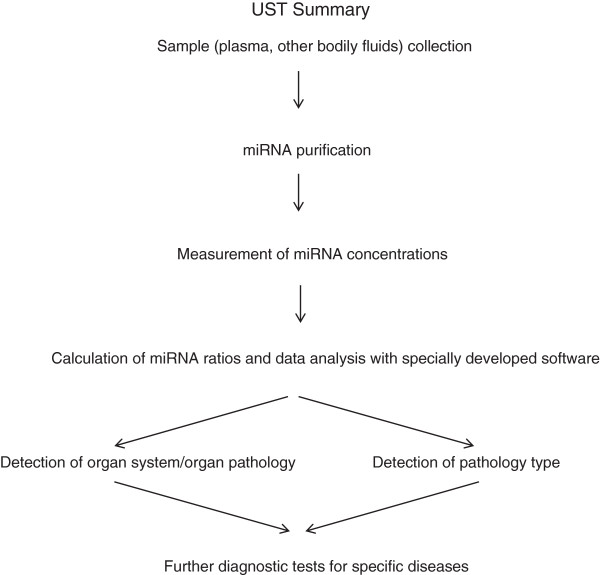
Early disease detection with a minimally invasive screening test will significantly increase effectiveness and decrease the cost of treatment. Here we propose a framework of a novel approach - Universal Screening Test (UST) for the detection of pathological processes in a particular organ system, organ, or tissue by RT-qPCR analysis of circulating cell-free miRNAs in plasma. As the first step towards assessing the feasibility of this concept, the present study was designed to analyze whether the same microRNAs (miRNAs) can detect various diseases of a particular organ system.
RNA was extracted from plasma using Trizol treatment and silica binding. Levels of miRNAs were measured by single target RT-qPCR. The following innovations have been tested and proven effective: (i) the use of organ system/organ/tissue-enriched miRNAs; (ii) the use of miRNAs associated with broad disease categories, such as cancer and inflammation, in combination with the organ-enriched miRNAs; and (iii) the use of "miRNA pairs" for selecting miRNA combinations with the highest sensitivity and specificity.
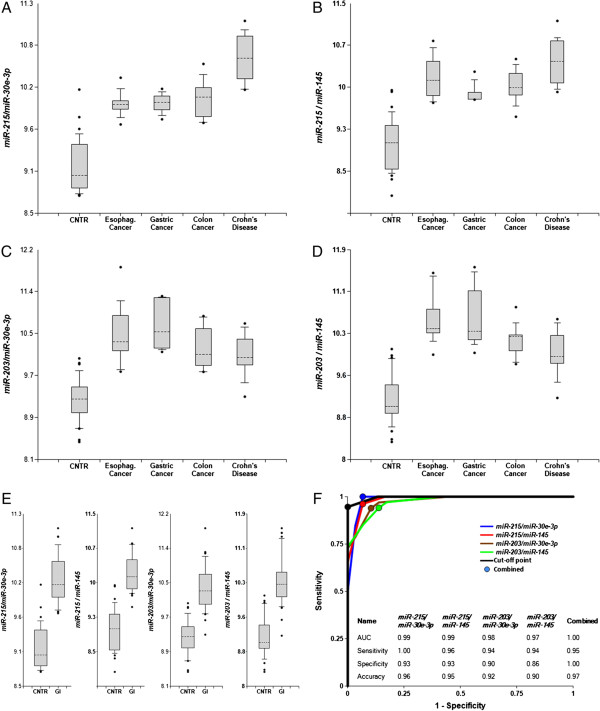
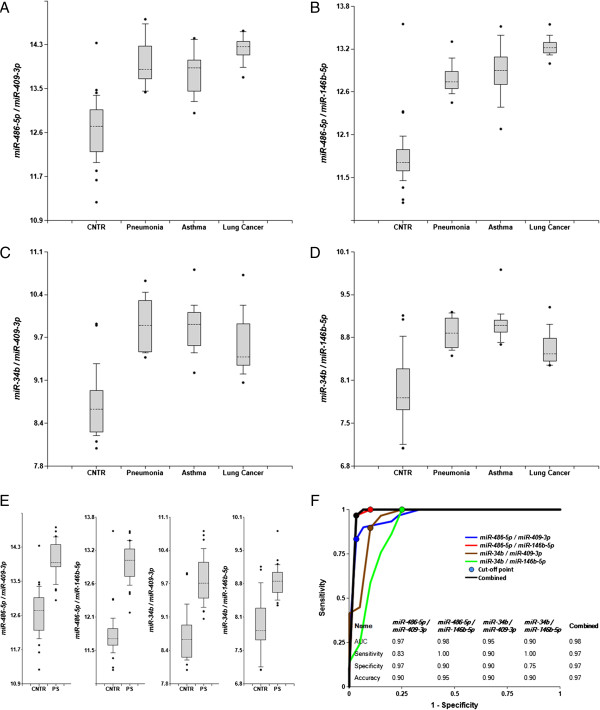
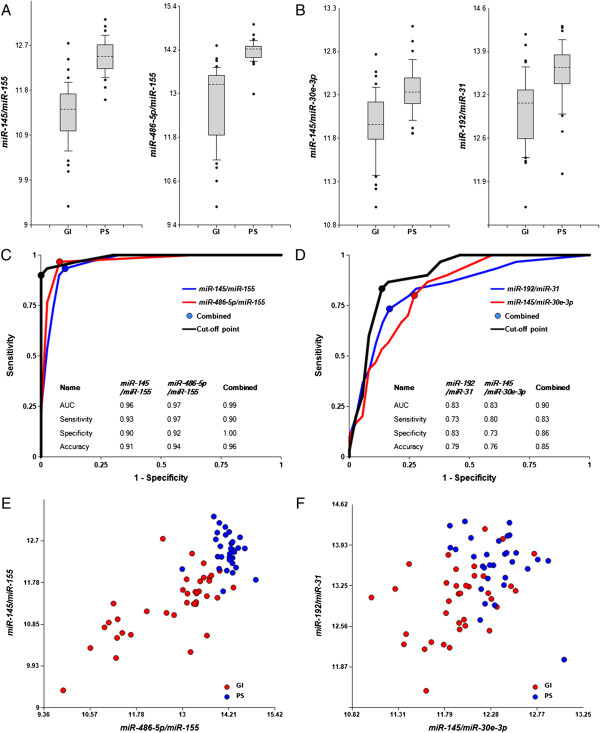
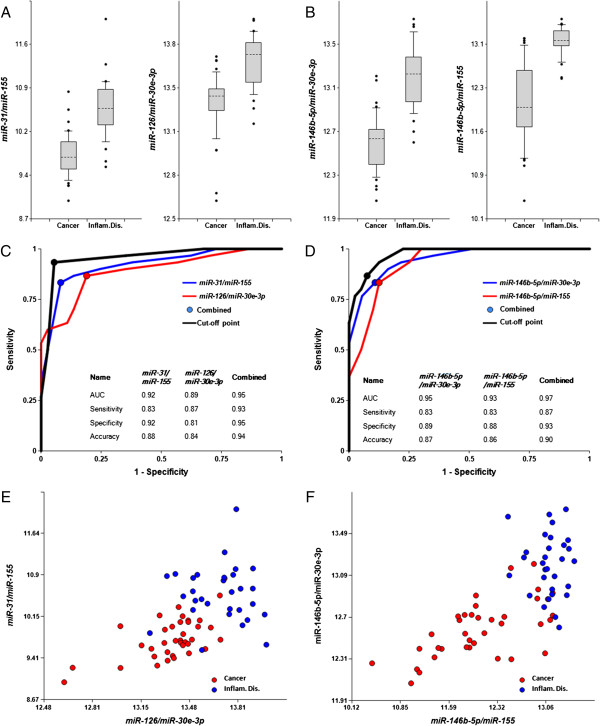
Here we report biomarker miRNA pairs effectively differentiating (i) patients with pulmonary system diseases (asthma, pneumonia and non-small cell lung cancer) and gastrointestinal (GI) system diseases (Crohn's disease, stages I/II esophageal, gastric and colon cancers) from controls, each with 95% accuracy; (ii) patients with a pathology of the pulmonary system from patients with a pathology of the GI system with 94% accuracy; and (iii) cancer patients (stages I/II esophageal, gastric, colon cancers, or non-small cell lung cancer) from patients with inflammatory diseases (asthma, pneumonia, or Crohn's disease) with 93%-95% accuracy.
The results obtained in the present study, along with the data reported by us and others previously, are encouraging and lay the ground for further investigation of the described approach for UST development.
通过微创筛查测试进行疾病早期检测将显著提高治疗效果并降低治疗成本。在此,我们提出一种新方法的框架——通用筛查测试(UST),通过对血浆中循环无细胞微小RNA(miRNA)进行逆转录定量聚合酶链反应(RT-qPCR)分析,来检测特定器官系统、器官或组织中的病理过程。作为评估这一概念可行性的第一步,本研究旨在分析相同的微小RNA(miRNA)是否能够检测特定器官系统的各种疾病。
使用Trizol处理和硅胶结合从血浆中提取RNA。通过单靶点RT-qPCR测量miRNA水平。以下创新方法已经过测试并证明有效:(i)使用器官系统/器官/组织富集的miRNA;(ii)将与广泛疾病类别(如癌症和炎症)相关的miRNA与器官富集的miRNA联合使用;(iii)使用“miRNA对”来选择具有最高灵敏度和特异性的miRNA组合。
在此我们报告了生物标志物miRNA对,其能够有效区分:(i)患有肺部系统疾病(哮喘、肺炎和非小细胞肺癌)和胃肠道(GI)系统疾病(克罗恩病、I/II期食管癌、胃癌和结肠癌)的患者与对照组,准确率均为95%;(ii)患有肺部系统疾病的患者与患有GI系统疾病的患者,准确率为94%;(iii)癌症患者(I/II期食管癌、胃癌、结肠癌或非小细胞肺癌)与炎症性疾病患者(哮喘、肺炎或克罗恩病),准确率为93%-95%。
本研究获得的结果,连同我们之前以及其他人报告的数据,令人鼓舞,并为进一步研究所述的UST开发方法奠定了基础。