Pheromone Group, Department of Biology, Lund University, Lund, Sweden.
Microb Cell Fact. 2013 Dec 13;12:125. doi: 10.1186/1475-2859-12-125.
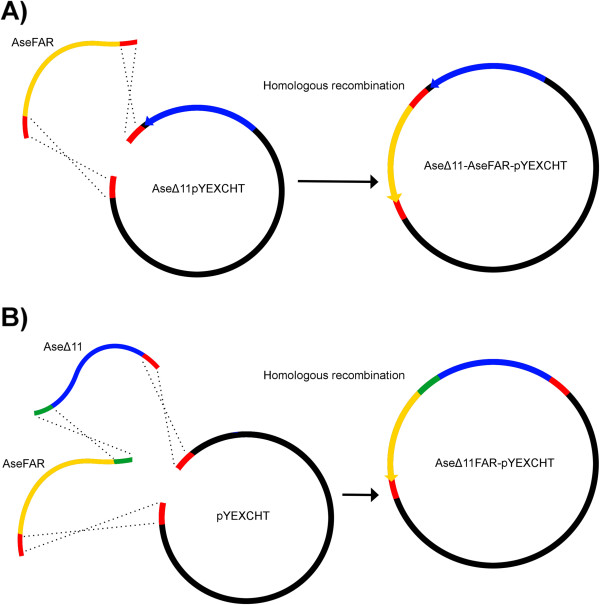
Moths (Lepidoptera) are highly dependent on chemical communication to find a mate. Compared to conventional unselective insecticides, synthetic pheromones have successfully served to lure male moths as a specific and environmentally friendly way to control important pest species. However, the chemical synthesis and purification of the sex pheromone components in large amounts is a difficult and costly task. The repertoire of enzymes involved in moth pheromone biosynthesis in insecta can be seen as a library of specific catalysts that can be used to facilitate the synthesis of a particular chemical component. In this study, we present a novel approach to effectively aid in the preparation of semi-synthetic pheromone components using an engineered vector co-expressing two key biosynthetic enzymes in a simple yeast cell factory.
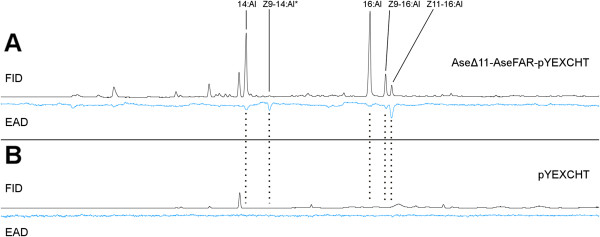
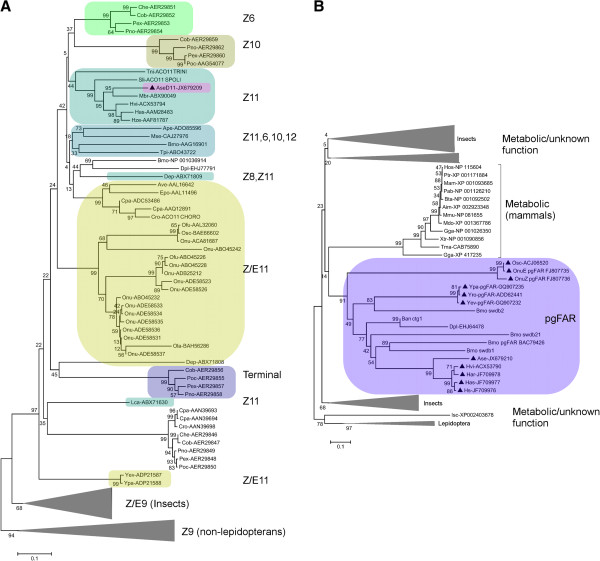
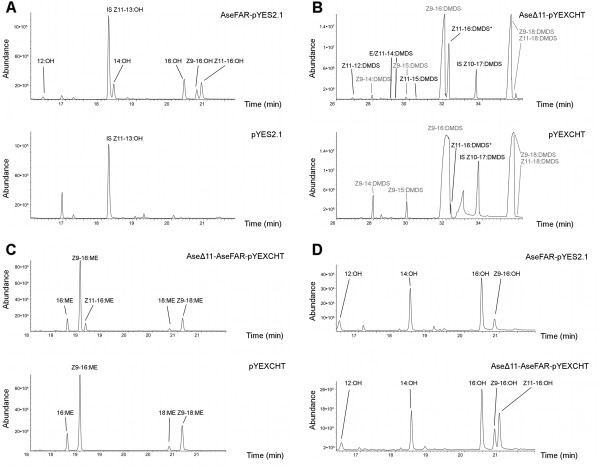
We first identified and functionally characterized a ∆11 Fatty-Acyl Desaturase and a Fatty-Acyl Reductase from the Turnip moth, Agrotis segetum. The ∆11-desaturase produced predominantly Z11-16:acyl, a common pheromone component precursor, from the abundant yeast palmitic acid and the FAR transformed a series of saturated and unsaturated fatty acids into their corresponding alcohols which may serve as pheromone components in many moth species. Secondly, when we co-expressed the genes in the Brewer's yeast Saccharomyces cerevisiae, a set of long-chain fatty acids and alcohols that are not naturally occurring in yeast were produced from inherent yeast fatty acids, and the presence of (Z)-11-hexadecenol (Z11-16:OH), demonstrated that both heterologous enzymes were active in concert. A 100 ml batch yeast culture produced on average 19.5 μg Z11-16:OH. Finally, we demonstrated that oxidized extracts from the yeast cells containing (Z)-11-hexadecenal and other aldehyde pheromone compounds elicited specific electrophysiological activity from male antennae of the Tobacco budworm, Heliothis virescens, supporting the idea that genes from different species can be used as a molecular toolbox to produce pheromone components or pheromone component precursors of potential use for control of a variety of moths.
This study is a first proof-of-principle that it is possible to "brew" biologically active moth pheromone components through in vitro co-expression of pheromone biosynthetic enzymes, without having to provide supplementary precursors. Substrates present in the yeast alone appear to be sufficient.
鳞翅目昆虫(鳞翅目)高度依赖化学通讯来寻找配偶。与传统的非选择性杀虫剂相比,合成信息素已成功地作为一种特定的、环保的方式来控制重要的害虫物种。然而,大量合成性信息素成分的化学合成和纯化是一项困难且昂贵的任务。鳞翅目昆虫中参与信息素生物合成的酶谱可以被视为一组特定催化剂的文库,这些催化剂可以用来促进特定化学成分的合成。在这项研究中,我们提出了一种新的方法,使用共表达两种关键生物合成酶的工程载体,在简单的酵母细胞工厂中有效地辅助半合成信息素成分的制备。
我们首先从芜菁夜蛾(Agrotis segetum)中鉴定并功能表征了一种 ∆11 脂肪酸去饱和酶和一种脂肪酸还原酶。∆11-去饱和酶主要从丰富的酵母棕榈酸中产生 Z11-16:酰基,这是一种常见的信息素成分前体,而 FAR 将一系列饱和和不饱和脂肪酸转化为相应的醇,这些醇可能作为许多鳞翅目昆虫的信息素成分。其次,当我们在酿酒酵母(Saccharomyces cerevisiae)中共同表达这些基因时,从固有酵母脂肪酸中产生了一组在酵母中不存在的长链脂肪酸和醇,(Z)-11-十六烯醇(Z11-16:OH)的存在表明两种异源酶协同作用。100ml 批次酵母培养物平均产生 19.5μg Z11-16:OH。最后,我们证明了含有(Z)-11-十六烯醛和其他醛类信息素化合物的酵母细胞氧化提取物能从烟草夜蛾(Heliothis virescens)的雄性触角中诱发出特定的电生理活性,这支持了这样一种观点,即来自不同物种的基因可以作为分子工具包,用于产生潜在用于控制各种鳞翅目昆虫的信息素成分或信息素成分前体。
这项研究首次证明,通过体外共表达信息素生物合成酶,可以“酿造”具有生物活性的鳞翅目昆虫信息素成分,而无需提供补充前体。酵母中存在的底物似乎就足够了。