Pandit Awadh Kishor, Ihtisham Kavish, Garg Ajay, Gulati Sheffali, Padma Madakasira Vasantha, Tripathi Manjari
Department of Neurology, All India Institute of Medical Sciences, New Delhi, India.
Ann Indian Acad Neurol. 2013 Oct;16(4):577-84. doi: 10.4103/0972-2327.120476.
To review clinical characteristics and response to immunomodulation therapy in autoimmune encephalitis presenting with status epilepticus (SE), epilepsy, and cognitive decline.
Observational, prospective case series.
All India Institute of Medical Sciences, New Delhi, India.
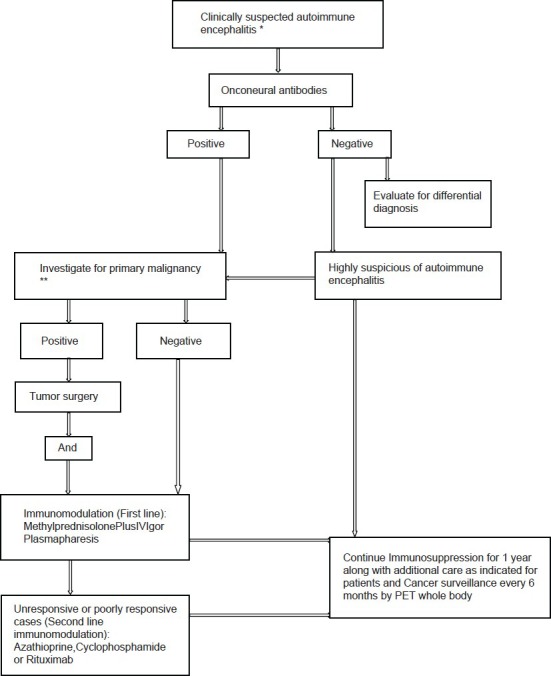
Prospective analysis of 15 patients, who presented with SE, epilepsy, cognitive decline, and other neurological symptoms with positive autoantibodies. Demographic and clinical characteristics were recorded. Brain magnetic resonance imaging (MRI), cerebrospinal-fluid analysis (CSF), and tumor screening were done periodically. Treatment received and responses (categorized as per patients and treating doctor's information) were noted.
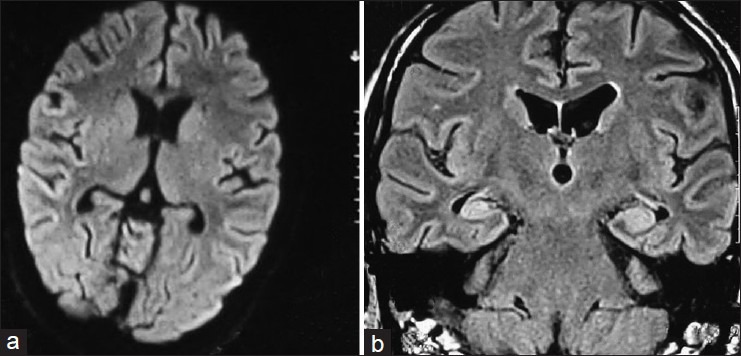
There were 15 (males = 10) patients of autoimmune encephalitis. The mean age of presentation was 24 years (range: 2-64 years). The most common onset was subacute (64%) and four (29%) patients presented as SE. Predominant clinical presentations were seizures (100%) almost of every semiology. CSF was done in 10 patients; it was normal in 60%. Brain MRI was done in all patients, in six (40%) it was normal, six (40%) showed T2W and FLAIR hyperintensities in bilateral limbic areas. Antibodies found were the N-methyl-D-aspartate receptor antibody in seven (50%), voltage-gated potassium channel antibody in five (36%), two of antiglutamic acid decarboxylase, and one patient with double stranded DNA (dsDNA) antibodies. None showed evidence of malignancy. Patients received immunotherapy, either steroids, intravenous immunoglobulin, or both. Follow-up showed significant improvement in majority of cases, neither further seizures nor relapse in nine (67%) cases. One death occurred, due to delayed presentation.
Uncommon but potentially reversible causes of SE, epilepsy, and cognitive decline may be immune-related and high index of suspicion will prevent missing the diagnosis.
回顾以癫痫持续状态(SE)、癫痫和认知功能减退为表现的自身免疫性脑炎的临床特征及对免疫调节治疗的反应。
观察性前瞻性病例系列研究。
印度新德里全印医学科学研究所。
对15例出现SE、癫痫、认知功能减退及其他伴有自身抗体阳性的神经症状的患者进行前瞻性分析。记录人口统计学和临床特征。定期进行脑磁共振成像(MRI)、脑脊液分析(CSF)及肿瘤筛查。记录所接受的治疗及反应(根据患者和治疗医生的信息分类)。
有15例自身免疫性脑炎患者(男性10例)。平均发病年龄为24岁(范围:2 - 64岁)。最常见的起病方式为亚急性(64%),4例(29%)患者以SE起病。主要临床表现为癫痫发作(100%),几乎涵盖各种发作形式。10例患者进行了CSF检查,60%结果正常。所有患者均进行了脑MRI检查,6例(40%)结果正常,6例(40%)在双侧边缘区域显示T2加权像和液体衰减反转恢复序列高信号。发现的抗体包括7例(50%)患者的N - 甲基 - D - 天冬氨酸受体抗体、5例(36%)患者的电压门控钾通道抗体、2例抗谷氨酸脱羧酶抗体及1例双链DNA(dsDNA)抗体患者。均未发现恶性肿瘤证据。患者接受了免疫治疗,包括类固醇、静脉注射免疫球蛋白或两者兼用。随访显示大多数病例有显著改善,9例(67%)病例未再出现癫痫发作或复发。1例患者因就诊延迟死亡。
SE、癫痫和认知功能减退不常见但可能可逆的病因可能与免疫相关,高度怀疑可避免漏诊。