Castillo-Lozano Romualdo, Cuesta-Vargas Antonio Ignacio
Faculty of Health Sciences at Malaga University, Malaga, Spain.
BMC Sports Sci Med Rehabil. 2013 Dec 16;5(1):28. doi: 10.1186/2052-1847-5-28.
The aim of this study was to compare through surface electromyographic (sEMG) recordings of the maximum voluntary contraction (MVC) on dry land and in water by manual muscle test (MMT).
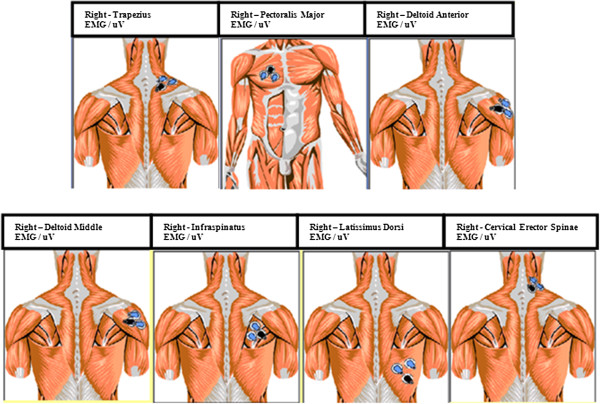
Sixteen healthy right-handed subjects (8 males and 8 females) participated in measurement of muscle activation of the right shoulder. The selected muscles were the cervical erector spinae, trapezius, pectoralis, anterior deltoid, middle deltoid, infraspinatus and latissimus dorsi. The MVC test conditions were random with respect to the order on the land/in water.
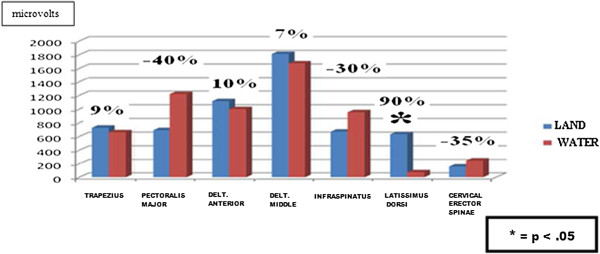
For each muscle, the MVC test was performed and measured through sEMG to determine differences in muscle activation in both conditions. For all muscles except the latissimus dorsi, no significant differences were observed between land and water MVC scores (p = 0.063-0.679) and precision (%Diff = 7-10%) were observed between MVC conditions in the muscles trapezius, anterior deltoid and middle deltoid.
If the procedure for data collection is optimal, under MMT conditions it appears that comparable MVC sEMG values were achieved on land and in water and the integrity of the EMG recordings were maintained during wáter immersion.
本研究的目的是通过手动肌力测试(MMT),比较在陆地和水中进行最大自主收缩(MVC)时的表面肌电图(sEMG)记录。
16名健康的右利手受试者(8名男性和8名女性)参与了右肩部肌肉激活的测量。所选肌肉为颈竖脊肌、斜方肌、胸大肌、三角肌前束、三角肌中束、冈下肌和背阔肌。MVC测试条件在陆地/水中的顺序方面是随机的。
对于每块肌肉,均通过sEMG进行MVC测试并测量,以确定两种条件下肌肉激活的差异。除背阔肌外,所有肌肉在陆地和水中的MVC评分之间均未观察到显著差异(p = 0.063 - 0.679),并且在斜方肌、三角肌前束和三角肌中束的MVC条件之间观察到了精度(%差异 = 7 - 10%)。
如果数据收集程序是最佳的,在MMT条件下,似乎在陆地和水中可获得相当的MVC sEMG值,并且在水浸期间肌电图记录的完整性得以维持。