Monteiro Pedro, Rossé Carine, Castro-Castro Antonio, Irondelle Marie, Lagoutte Emilie, Paul-Gilloteaux Perrine, Desnos Claire, Formstecher Etienne, Darchen François, Perrais David, Gautreau Alexis, Hertzog Maud, Chavrier Philippe
J Cell Biol. 2013 Dec 23;203(6):1063-79. doi: 10.1083/jcb.201306162.
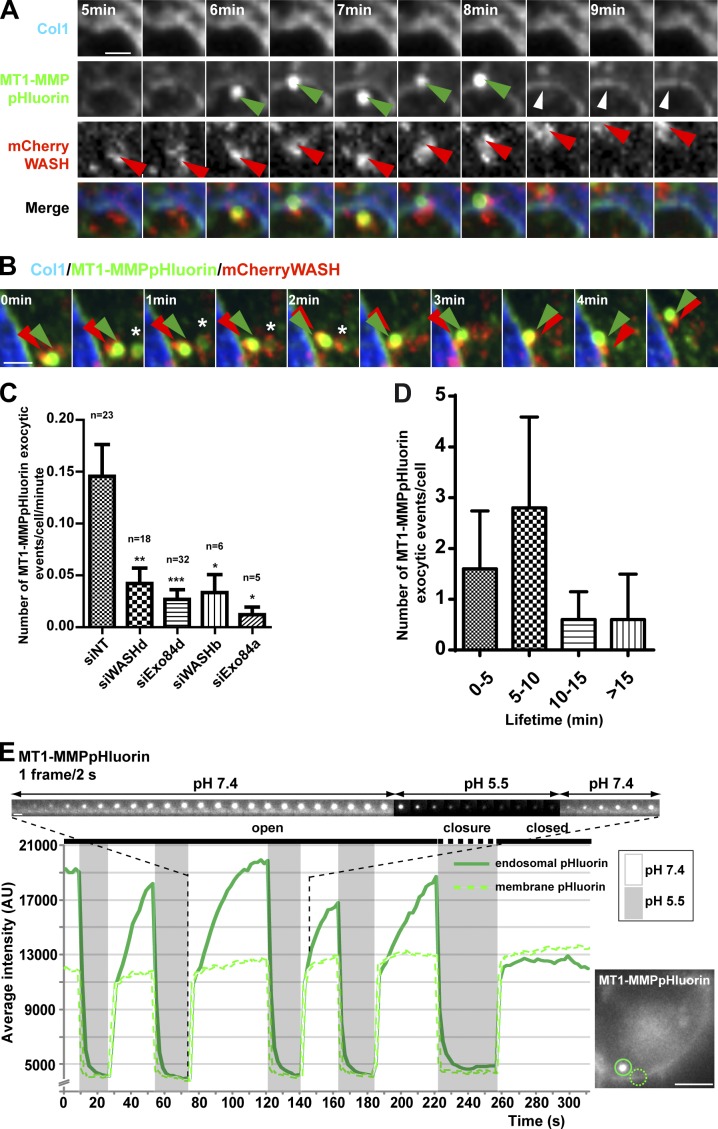
Remodeling of the extracellular matrix by carcinoma cells during metastatic dissemination requires formation of actin-based protrusions of the plasma membrane called invadopodia, where the trans-membrane type 1 matrix metalloproteinase (MT1-MMP) accumulates. Here, we describe an interaction between the exocyst complex and the endosomal Arp2/3 activator Wiskott-Aldrich syndrome protein and Scar homolog (WASH) on MT1-MMP–containing late endosomes in invasive breast carcinoma cells. We found that WASH and exocyst are required for matrix degradation by an exocytic mechanism that involves tubular connections between MT1-MMP–positive late endosomes and the plasma membrane in contact with the matrix. This ensures focal delivery of MT1-MMP and supports pericellular matrix degradation and tumor cell invasion into different pathologically relevant matrix environments. Our data suggest a general mechanism used by tumor cells to breach the basement membrane and for invasive migration through fibrous collagen-enriched tissues surrounding the tumor.
癌细胞在转移扩散过程中对细胞外基质的重塑需要形成基于肌动蛋白的质膜突起,即侵袭伪足,跨膜1型基质金属蛋白酶(MT1-MMP)在其中积累。在此,我们描述了侵袭性乳腺癌细胞中,外泌体复合物与含MT1-MMP晚期内体上的内体Arp2/3激活剂威斯科特-奥尔德里奇综合征蛋白和伤疤同源物(WASH)之间的相互作用。我们发现,WASH和外泌体对于通过一种胞吐机制进行的基质降解是必需的,该机制涉及MT1-MMP阳性晚期内体与接触基质的质膜之间的管状连接。这确保了MT1-MMP的局部递送,并支持细胞周围基质降解以及肿瘤细胞侵入不同的病理相关基质环境。我们的数据表明,肿瘤细胞用于突破基底膜并通过肿瘤周围富含纤维胶原蛋白的组织进行侵袭性迁移的一种普遍机制。