Institute of Molecular Physiology and Biotechnology of Plants, University of Bonn Bonn, Germany ; Department of Life Sciences, School of Basic and Applied Sciences, Central University of Tamil Nadu Thiruvarur, India.
Institute of Molecular Physiology and Biotechnology of Plants, University of Bonn Bonn, Germany.
Front Plant Sci. 2013 Nov 28;4:482. doi: 10.3389/fpls.2013.00482. eCollection 2013.
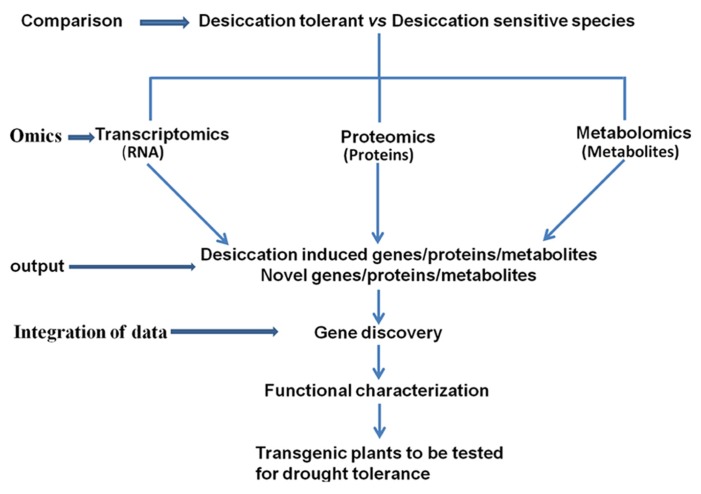
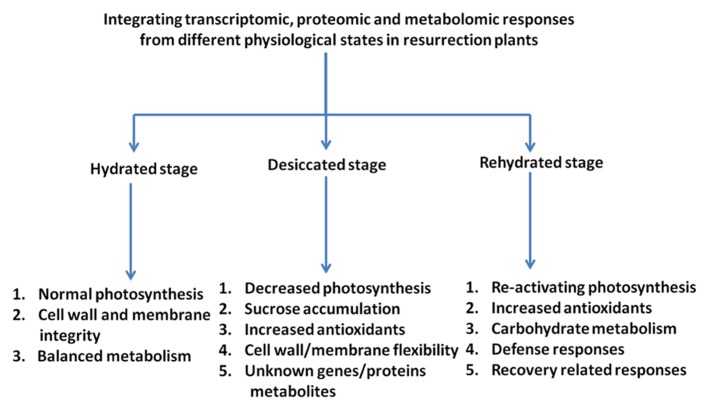
Most higher plants are unable to survive desiccation to an air-dried state. An exception is a small group of vascular angiosperm plants, termed resurrection plants. They have evolved unique mechanisms of desiccation tolerance and thus can tolerate severe water loss, and mostly adjust their water content with the relative humidity in the environment. Desiccation tolerance is a complex phenomenon and depends on the regulated expression of numerous genes during dehydration and subsequent rehydration. Most of the resurrection plants have a large genome and are difficult to transform which makes them unsuitable for genetic approaches. However, technical advances have made it possible to analyze changes in gene expression on a large-scale. These approaches together with comparative studies with non-desiccation tolerant plants provide novel insights into the molecular processes required for desiccation tolerance and will shed light on identification of orphan genes with unknown functions. Here, we review large-scale recent transcriptomic, proteomic, and metabolomic studies that have been performed in desiccation tolerant plants and discuss how these studies contribute to understanding the molecular basis of desiccation tolerance.
大多数高等植物无法在干燥的空气中存活。但有一小部分维管被子植物是例外,它们被称为复苏植物。它们已经进化出独特的耐旱机制,因此能够耐受严重的水分流失,并根据环境中的相对湿度来调节自身的含水量。耐旱性是一种复杂的现象,取决于脱水和随后再水合过程中众多基因的调控表达。大多数复苏植物的基因组较大,且难以转化,这使得它们不适合进行遗传方法的研究。然而,技术的进步使得在大规模上分析基因表达变化成为可能。这些方法以及与非耐旱植物的比较研究,为耐旱性所需的分子过程提供了新的见解,并将有助于鉴定具有未知功能的孤儿基因。在这里,我们回顾了在耐旱植物中进行的大规模转录组、蛋白质组和代谢组学研究,并讨论了这些研究如何有助于理解耐旱性的分子基础。