Hwang Eun Young, Jeong Mi Suk, Park So Young, Jang Se Bok
Department of Molecular Biology, College of Natural Sciences, Pusan National University, Busan 609-735, Korea.
BMB Rep. 2014 Sep;47(9):488-93. doi: 10.5483/bmbrep.2014.47.9.239.
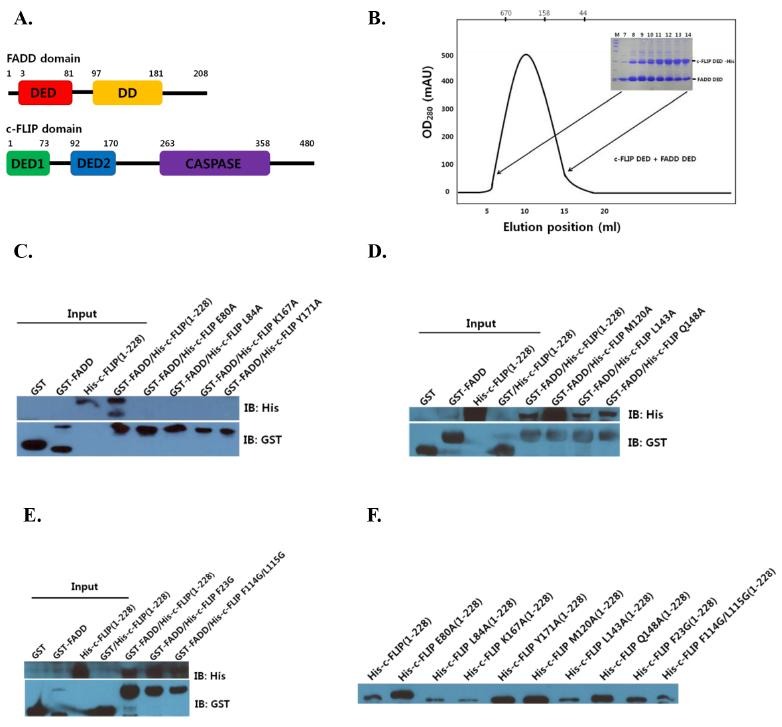
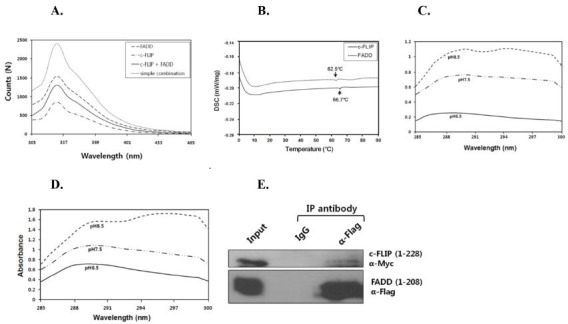
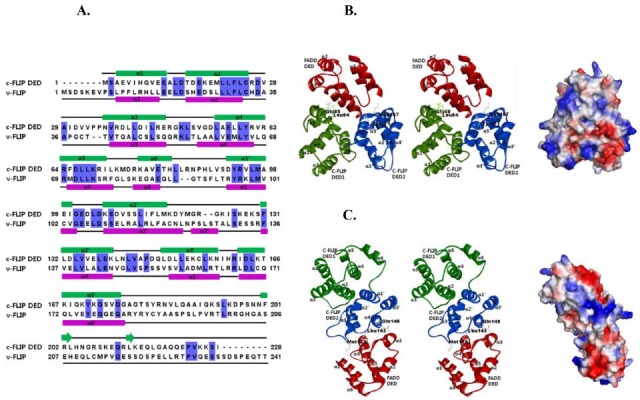
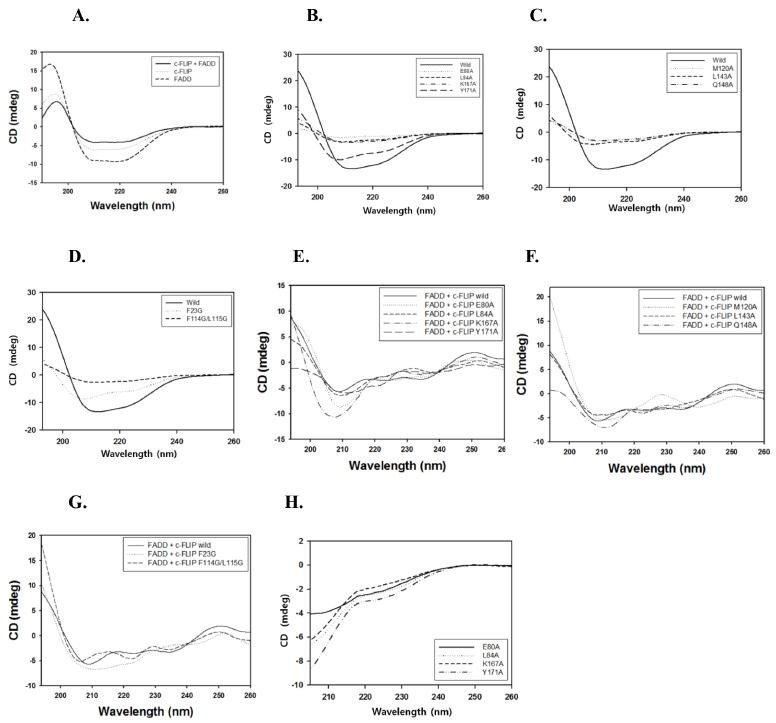
Adaptor protein FADD forms the death inducing signaling complex (DISC) by recruiting the initiating caspases-8 and -10 through homotypic death effector domain (DED) interactions. Cellular FLICE-inhibitory protein (c-FLIP) is an inhibitor of death ligand-induced apoptosis downstream of death receptors, and FADD competes with procaspase-8/10 for recruitment for DISC. However, the mechanism of action of FADD and c-FLIP proteins remain poorly understood at the molecular level. In this study, we provide evidence indicating that the death effector domain (DED) of FADD interacts directly with the death effector domain of human c-FLIP. In addition, we use homology modeling to develop a molecular docking model of FADD and c-FLIP proteins. We also find that four structure-based mutants (E80A, L84A, K169A and Y171A) of c-FLIP DEDs disturb the interaction with FADD DED, and that these mutations lower the stability of the c-FLIP DED.
衔接蛋白FADD通过同型死亡效应结构域(DED)相互作用募集起始半胱天冬酶-8和-10,从而形成死亡诱导信号复合物(DISC)。细胞FLICE抑制蛋白(c-FLIP)是死亡受体下游死亡配体诱导的细胞凋亡的抑制剂,并且FADD与前体半胱天冬酶-8/10竞争募集到DISC中。然而,FADD和c-FLIP蛋白的作用机制在分子水平上仍知之甚少。在本研究中,我们提供的证据表明,FADD的死亡效应结构域(DED)与人c-FLIP的死亡效应结构域直接相互作用。此外,我们使用同源建模来构建FADD和c-FLIP蛋白的分子对接模型。我们还发现,c-FLIP DED的四个基于结构的突变体(E80A、L84A、K169A和Y171A)扰乱了与FADD DED的相互作用,并且这些突变降低了c-FLIP DED的稳定性。