Conrad Willliam, Major Michael B, Cleary Michele A, Ferrer Marc, Roberts Brian, Marine Shane, Chung Namjin, Arthur William T, Moon Randall T, Berndt Jason D, Chien Andy J
The Howard Hughes Medical Institute, Seattle WA, 98195, USA ; Department of Pharmacology, University of Washington School of Medicine, Seattle WA, 98195, USA.
The Howard Hughes Medical Institute, Seattle WA, 98195, USA ; Department of Cell Biology and Physiology, UNC Lineberger Comprehensive Cancer Center, University of North Carolina at Chapel Hill, Chapel Hill NC, 27599-7295, USA.
F1000Res. 2013 May 31;2:134. doi: 10.12688/f1000research.2-134.v2. eCollection 2013.
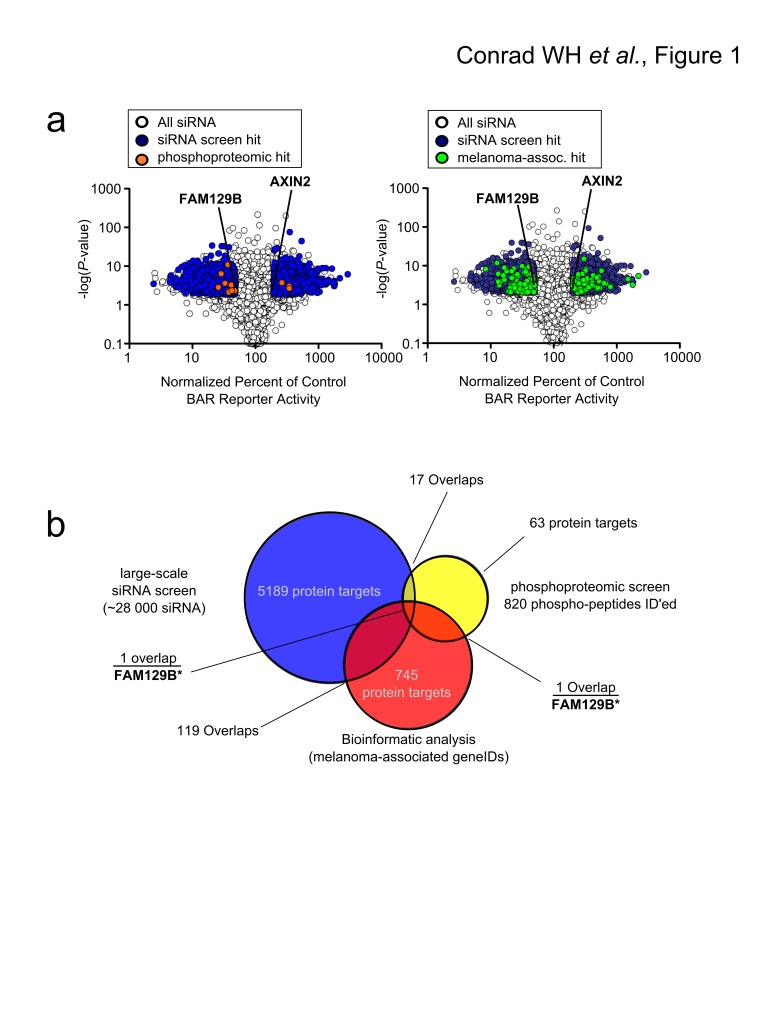
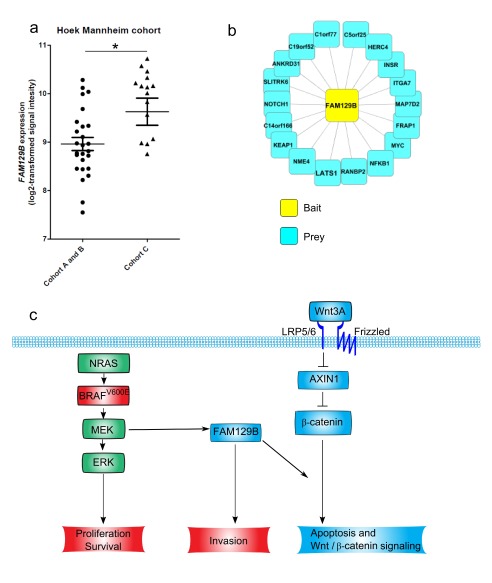
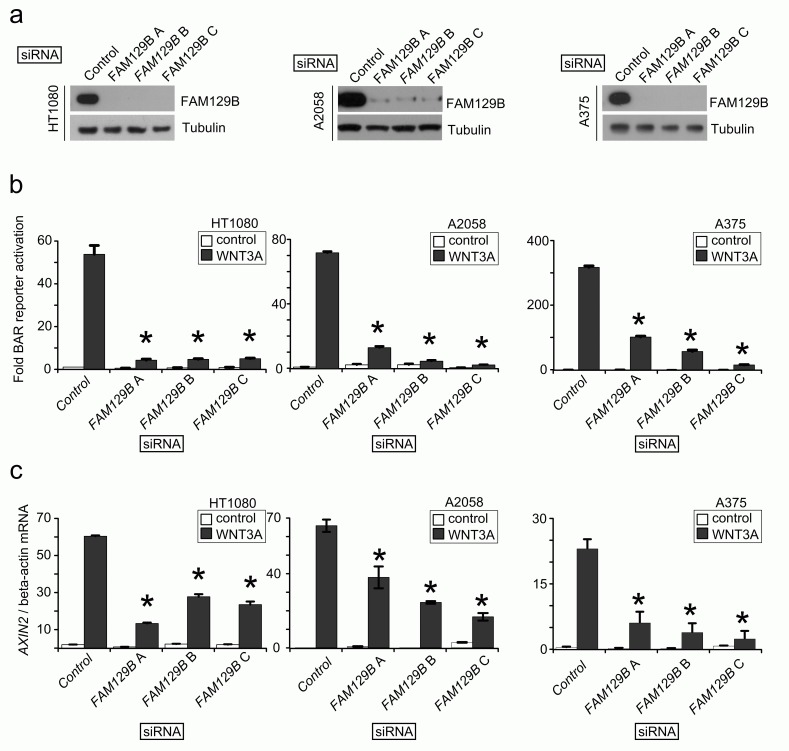
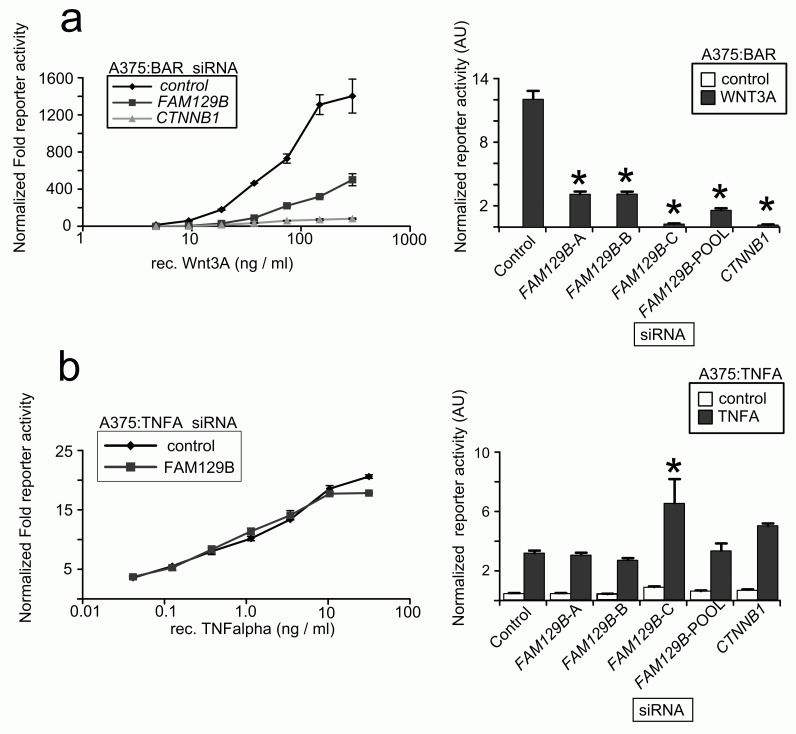
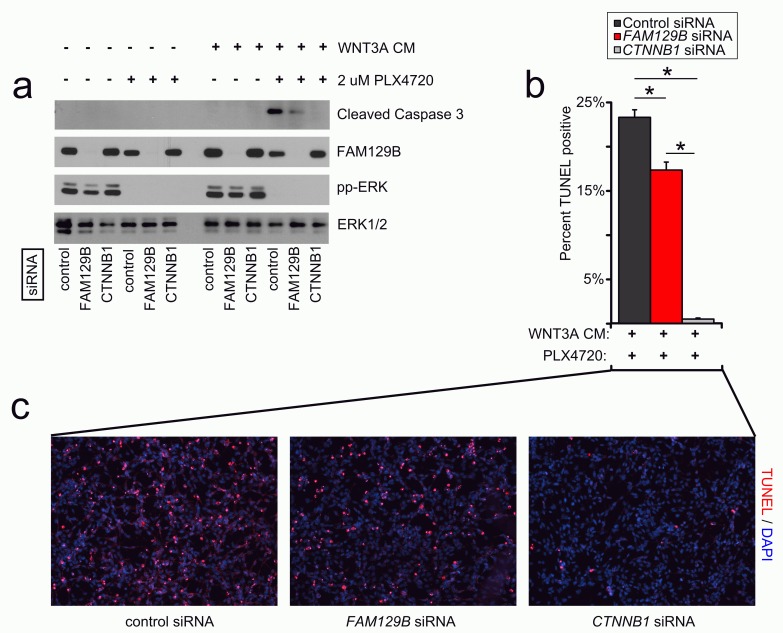
The inability of targeted BRAF inhibitors to produce long-lasting improvement in the clinical outcome of melanoma highlights a need to identify additional approaches to inhibit melanoma growth. Recent studies have shown that activation of the Wnt/β-catenin pathway decreases tumor growth and cooperates with ERK/MAPK pathway inhibitors to promote apoptosis in melanoma. Therefore, the identification of Wnt/β-catenin regulators may advance the development of new approaches to treat this disease. In order to move towards this goal we performed a large scale small-interfering RNA (siRNA) screen for regulators of β-catenin activated reporter activity in human HT1080 fibrosarcoma cells. Integrating large scale siRNA screen data with phosphoproteomic data and bioinformatics enrichment identified a protein, FAM129B, as a potential regulator of Wnt/β-catenin signaling. Functionally, we demonstrated that siRNA-mediated knockdown of FAM129B in A375 and A2058 melanoma cell lines inhibits WNT3A-mediated activation of a β-catenin-responsive luciferase reporter and inhibits expression of the endogenous Wnt/β-catenin target gene, AXIN2. We also demonstrate that FAM129B knockdown inhibits apoptosis in melanoma cells treated with WNT3A. These experiments support a role for FAM129B in linking Wnt/β-catenin signaling to apoptosis in melanoma.
靶向BRAF抑制剂无法在黑色素瘤的临床治疗结果上产生持久改善,这凸显了识别其他抑制黑色素瘤生长方法的必要性。最近的研究表明,Wnt/β-连环蛋白信号通路的激活可降低肿瘤生长,并与ERK/MAPK信号通路抑制剂协同作用,促进黑色素瘤细胞凋亡。因此,识别Wnt/β-连环蛋白调节剂可能会推动治疗该疾病新方法的发展。为了朝着这个目标迈进,我们在人HT1080纤维肉瘤细胞中进行了大规模小干扰RNA(siRNA)筛选,以寻找β-连环蛋白激活报告基因活性的调节剂。将大规模siRNA筛选数据与磷酸化蛋白质组学数据及生物信息学富集分析相结合,确定了一种名为FAM129B的蛋白质,它是Wnt/β-连环蛋白信号通路的潜在调节剂。在功能上,我们证明在A375和A2058黑色素瘤细胞系中,siRNA介导的FAM129B敲低可抑制WNT3A介导的β-连环蛋白反应性荧光素酶报告基因的激活,并抑制内源性Wnt/β-连环蛋白靶基因AXIN2的表达。我们还证明,FAM129B敲低可抑制用WNT3A处理的黑色素瘤细胞的凋亡。这些实验支持了FAM129B在将Wnt/β-连环蛋白信号通路与黑色素瘤细胞凋亡联系起来方面所起的作用。