Department of Psychology, Arizona State University.
Department of Psychology, San Francisco State University.
Dev Psychol. 2014 Apr;50(4):1208-18. doi: 10.1037/a0035327. Epub 2013 Dec 23.
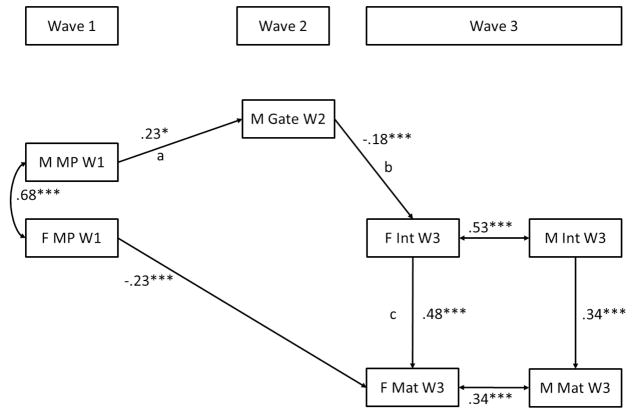
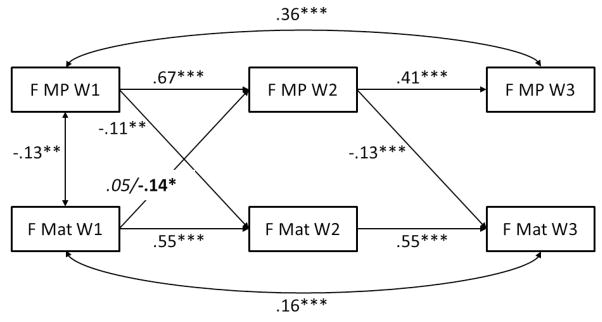
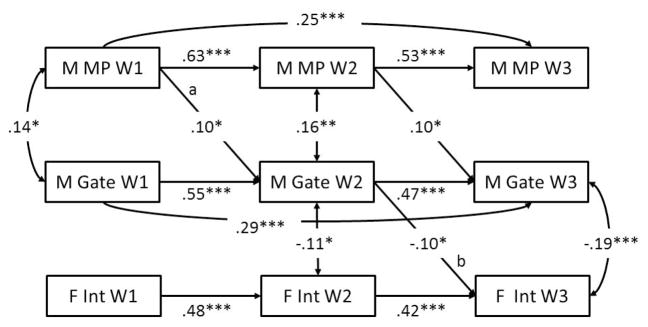
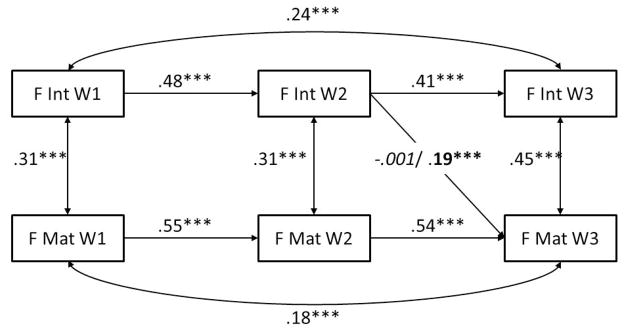
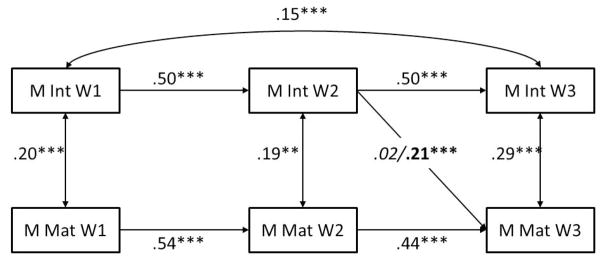
We evaluated maternal gatekeeping attitudes as a mediator of the relation between marital problems and father-child relationships in 3 waves when children were in Grades 7-10. We assessed each parent's contribution to the marital problems experienced by the couple. Findings from mediational and cross-lagged structural equation models revealed that increased marital problem behaviors on the part of mothers at Wave 1 predicted increased maternal gatekeeping attitudes at Wave 2, which in turn predicted decreased amounts of father-adolescent interaction at Wave 3. Decreased amounts of interaction with either parent were associated within each wave with adolescents' perceptions that they mattered less to that parent. Amount of interaction with fathers at Wave 2 positively predicted changes in boys' perceptions of how much they mattered to their fathers at Wave 3, and amount of interaction with mothers at Wave 2 positively predicted changes in girls' perceptions of how much they mattered to their mothers at Wave 3. The findings did not differ for European American versus Mexican American families or for biological fathers versus step-fathers.
我们评估了母亲的育儿控制态度,作为婚姻问题与父母与孩子关系之间关系的中介,在孩子处于 7-10 年级的 3 个阶段进行评估。我们评估了父母双方对夫妻双方婚姻问题的贡献。中介和交叉滞后结构方程模型的研究结果表明,母亲在第 1 波婚姻问题行为的增加预测了母亲在第 2 波育儿控制态度的增加,这反过来又预测了第 3 波青少年与父亲的互动减少。在每一波中,与父母任何一方的互动减少都与青少年的看法有关,即他们对该父母的重要性降低。第 2 波与父亲的互动量正向预测男孩对他们在第 3 波对父亲重要性的看法的变化,而第 2 波与母亲的互动量正向预测女孩对她们在第 3 波对母亲重要性的看法的变化。这些发现对于欧洲裔美国人和墨西哥裔美国家庭或亲生父亲与继父之间没有差异。