aInstitute of Medical Biochemistry bPaulo Goés Microbiology Institute, Federal University of Rio de Janeiro, Rio de Janeiro, Brazil cEdward A. Doisy Department of Biochemistry and Molecular Biology, St Louis University School of Medicine, St Louis, Missouri, USA.
Melanoma Res. 2014 Feb;24(1):11-9. doi: 10.1097/CMR.0000000000000035.
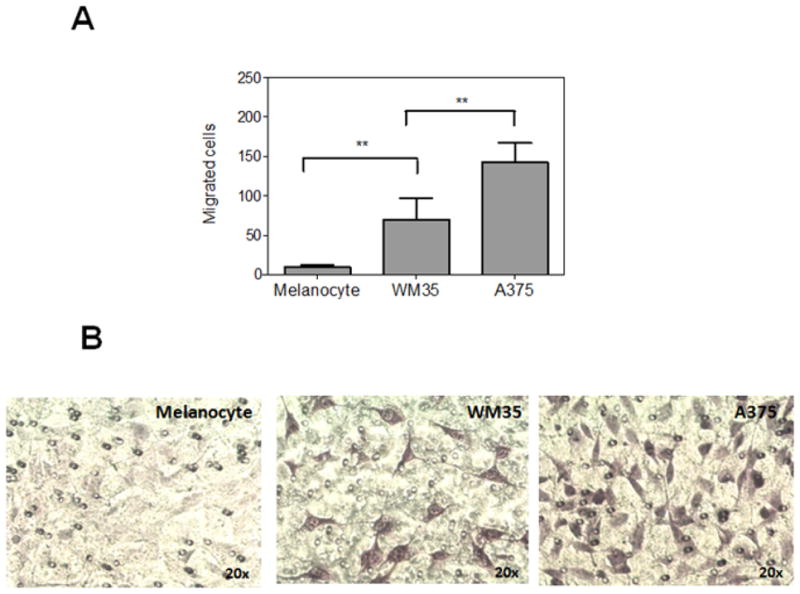
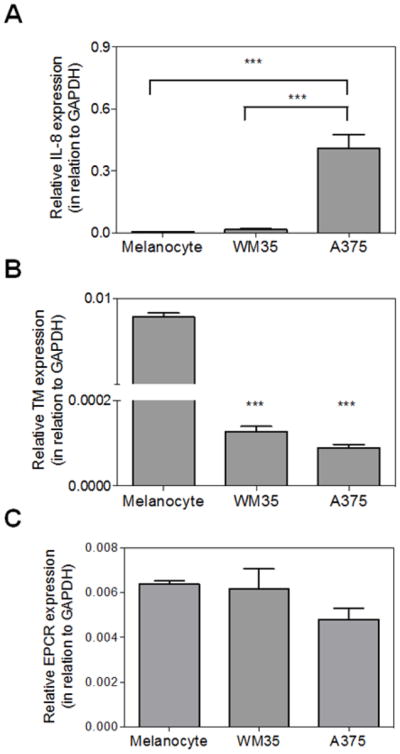
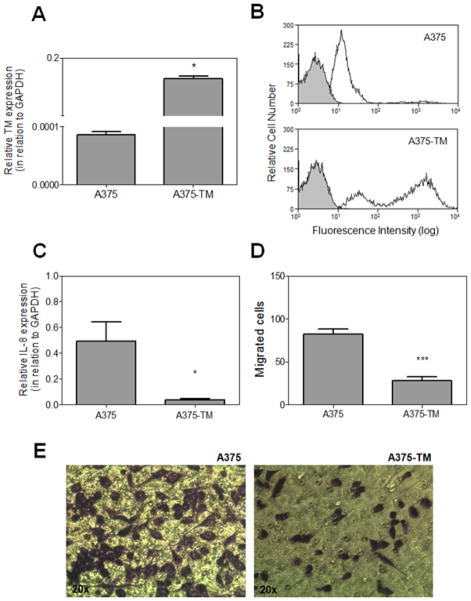
Malignant melanoma cells are known to have altered expressions of growth factors as compared with normal melanocytes. Thrombomodulin (TM) is a thrombin receptor on endothelial cells that converts thrombin from a procoagulant to an anticoagulant enzyme. TM expression is downregulated in tumor cells, and this phenomenon correlates with tumor cell invasiveness and a poor prognosis in patients with cancer. In this study, we evaluated TM expression in two human melanoma cell lines that are known to have either low (WM35) or high (A375) aggressive phenotypes. Analysis by quantitative real-time PCR (qPCR) showed that the mRNA expression of TM is modestly (WM35) or dramatically (A375) downregulated in melanoma cells, as compared with human primary melanocytes. TM expression levels inversely correlated with in-vitro migration properties of tumor cells. In addition, interleukin-8 expression also correlated with the degree of aggressiveness, as indicated by high expression levels of this cytokine in A375 cells. Overexpression of TM in A375 cells by transient transfection reversed their aggressive phenotype and dramatically decreased interleukin-8 expression by these cells. Taken together, these results suggest that downregulation of TM plays a crucial role in melanocyte transformation and melanoma progression.
与正常黑素细胞相比,恶性黑素瘤细胞的生长因子表达发生改变。血栓调节蛋白(TM)是内皮细胞上的凝血酶受体,可将凝血酶从促凝酶转变为抗凝酶。TM 在肿瘤细胞中的表达下调,这一现象与肿瘤细胞的侵袭性和癌症患者的预后不良相关。在这项研究中,我们评估了两种已知具有低(WM35)或高(A375)侵袭表型的人黑素瘤细胞系中 TM 的表达。通过定量实时 PCR(qPCR)分析表明,与原代黑素细胞相比,TM 的 mRNA 表达在黑素瘤细胞中适度(WM35)或显著(A375)下调。TM 表达水平与肿瘤细胞体外迁移特性呈负相关。此外,白细胞介素-8 的表达也与侵袭性程度相关,A375 细胞中这种细胞因子的高表达表明其侵袭性高。瞬时转染过表达 TM 可逆转 A375 细胞的侵袭表型,并显著降低这些细胞中白细胞介素-8 的表达。综上所述,这些结果表明 TM 的下调在黑素细胞转化和黑色素瘤进展中起着关键作用。