Endocrinology Unit, Maggiore-Bellaria Hospital, Bologna, Italy.
Endocrine Unit, "Center for Research, Transfer and High Education on Chronic, Inflammatory, Degenerative and Neoplastic Disorders for the Development of Novel Therapies" (DENOThe), Dept. of Experimental and Clinical Biomedical Sciences, University of Florence, Careggi Hospital, Florence, Italy.
PLoS One. 2013 Dec 18;8(12):e80451. doi: 10.1371/journal.pone.0080451. eCollection 2013.
Hyponatremia is the most common electrolyte disorder in clinical practice, and evidence to date indicates that severe hyponatremia is associated with increased morbidity and mortality. The aim of our study was to perform a meta-analysis that included the published studies that compared mortality rates in subjects with or without hyponatremia of any degree.
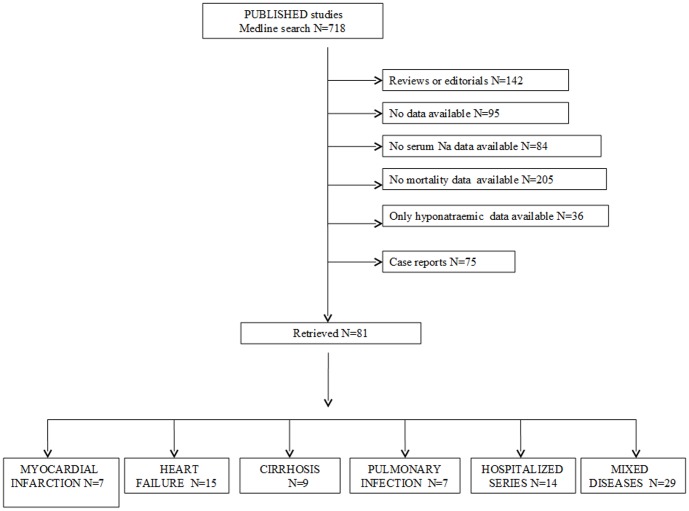
An extensive Medline, Embase and Cochrane search was performed to retrieve the studies published up to October 1st 2012, using the following words: "hyponatremia" and "mortality". Eighty-one studies satisfied inclusion criteria encompassing a total of 850222 patients, of whom 17.4% were hyponatremic. The identification of relevant abstracts, the selection of studies and the subsequent data extraction were performed independently by two of the authors, and conflicts resolved by a third investigator. Across all 81 studies, hyponatremia was significantly associated with an increased risk of overall mortality (RR = 2.60[2.31-2.93]). Hyponatremia was also associated with an increased risk of mortality in patients with myocardial infarction (RR = 2.83[2.23-3.58]), heart failure (RR = 2.47[2.09-2.92]), cirrhosis (RR = 3.34[1.91-5.83]), pulmonary infections (RR = 2.49[1.44-4.30]), mixed diseases (RR = 2.59[1.97-3.40]), and in hospitalized patients (RR = 2.48[2.09-2.95]). A mean difference of serum [Na(+)] of 4.8 mmol/L was found in subjects who died compared to survivors (130.1 ± 5.6 vs 134.9 ± 5.1 mmol/L). A meta-regression analysis showed that the hyponatremia-related risk of overall mortality was inversely correlated with serum [Na(+)]. This association was confirmed in a multiple regression model after adjusting for age, gender, and diabetes mellitus as an associated morbidity.
This meta-analysis shows for the first time that even a moderate serum [Na(+)] decrease is associated with an increased risk of mortality in commonly observed clinical conditions across large numbers of patients.
低钠血症是临床实践中最常见的电解质紊乱,现有证据表明严重低钠血症与发病率和死亡率的增加有关。我们的研究目的是进行一项荟萃分析,包括比较任何程度低钠血症患者和无低钠血症患者死亡率的已发表研究。
使用“低钠血症”和“死亡率”等词,对截至 2012 年 10 月 1 日的 Medline、Embase 和 Cochrane 进行了广泛的检索,以检索已发表的研究。81 项研究符合纳入标准,共纳入 850222 例患者,其中 17.4%为低钠血症患者。两名作者独立识别相关摘要,选择研究,随后提取数据,由第三位研究者解决冲突。在所有 81 项研究中,低钠血症与全因死亡率增加显著相关(RR=2.60[2.31-2.93])。低钠血症与心肌梗死(RR=2.83[2.23-3.58])、心力衰竭(RR=2.47[2.09-2.92])、肝硬化(RR=3.34[1.91-5.83])、肺部感染(RR=2.49[1.44-4.30])、混合疾病(RR=2.59[1.97-3.40])以及住院患者(RR=2.48[2.09-2.95])的死亡率增加也显著相关。与幸存者相比,死亡患者的血清[Na(+)]平均差异为 4.8mmol/L(130.1±5.6 vs 134.9±5.1mmol/L)。荟萃回归分析表明,全因死亡率与低钠血症相关的风险与血清[Na(+)]呈负相关。在调整年龄、性别和糖尿病作为相关合并症后,该关联在多元回归模型中得到证实。
这项荟萃分析首次表明,即使是血清[Na(+)]的适度降低也与大量患者常见临床情况下的死亡率增加相关。