Choi Pil Jo, Jeong Sang Seok, Yoon Sung Sil
Department of Thoracic and Cardiovascular Surgery, Dong-A University College of Medicine, Korea.
Korean J Thorac Cardiovasc Surg. 2013 Dec;46(6):449-56. doi: 10.5090/kjtcs.2013.46.6.449. Epub 2013 Dec 6.
Tumor recurrence is the most common cause of treatment failure, even after complete resection of early-stage non-small cell lung cancer (NSCLC). In this study, we investigated the prognosis of patients with early recurrence in order to identify independent risk factors related to early recurrence.
Between February 1995 and December 2012, 242 patients who underwent surgical resection for stage I NSCLC at Dong-A University Hospital were reviewed. The factors predicting overall survival (OS) and early recurrence were investigated. We also investigated the relationship between the patterns and period of recurrence and clinicopathological factors.
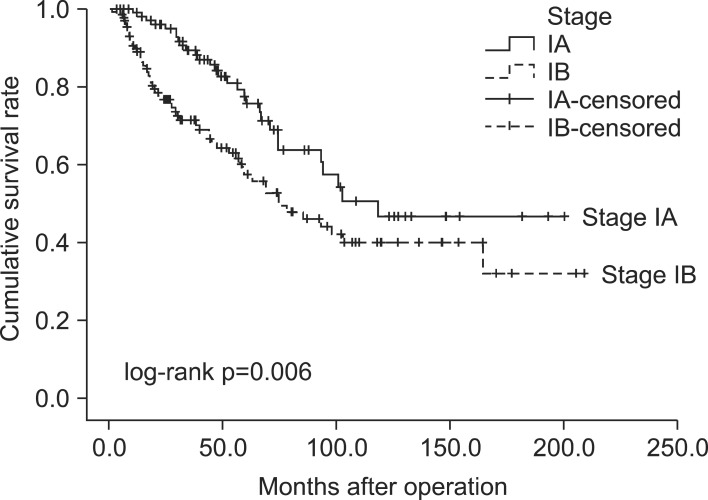
For patients with stage IA and IB NSCLC, the 5-year OS rate was 75.7% and 57.3% (p=0.006), respectively. A multivariate Cox proportional hazards model demonstrated that gender (p=0.004), comorbidity number (p=0.038), resection type (p=0.002), and tumor size (p=0.022) were the statistically significant predictors of OS. Moreover, the multivariate analysis revealed that smoking history (p=0.023) and histologic grade (p=0.012) were the independent predictors of early recurrence. Additionally, only histologic grade (poor differentiation) was found to be significantly associated with a higher frequency of distant metastasis; there was no relationship between the patterns and period of recurrence and clinicopathological factors.
The present study demonstrated that smoking history and histologic grade were independent prognostic factors for early recurrence within two years in patients with early-stage NSCLC. Patients with these predictive factors may be good candidates for adjuvant therapy.
肿瘤复发是治疗失败的最常见原因,即使是早期非小细胞肺癌(NSCLC)完全切除术后也是如此。在本研究中,我们调查了早期复发患者的预后,以确定与早期复发相关的独立危险因素。
回顾了1995年2月至2012年12月期间在东亚大学医院接受I期NSCLC手术切除的242例患者。研究了预测总生存期(OS)和早期复发的因素。我们还研究了复发模式和时期与临床病理因素之间的关系。
对于IA期和IB期NSCLC患者,5年总生存率分别为75.7%和57.3%(p=0.006)。多变量Cox比例风险模型显示,性别(p=0.004)、合并症数量(p=0.038)、切除类型(p=0.002)和肿瘤大小(p=0.022)是OS的统计学显著预测因素。此外,多变量分析显示,吸烟史(p=0.023)和组织学分级(p=0.012)是早期复发的独立预测因素。此外,仅发现组织学分级(低分化)与远处转移频率较高显著相关;复发模式和时期与临床病理因素之间无相关性。
本研究表明,吸烟史和组织学分级是早期NSCLC患者两年内早期复发的独立预后因素。具有这些预测因素的患者可能是辅助治疗的良好候选者。