Marconato L, Zorzan E, Giantin M, Di Palma S, Cancedda S, Dacasto M
Centro Oncologico Veterinario, Sasso Marconi, Bologna, Italy.
J Vet Intern Med. 2014 Mar-Apr;28(2):547-53. doi: 10.1111/jvim.12266. Epub 2013 Dec 26.
Mutation analysis of proto-oncogene c-kit (c-kit) is advisable before starting treatment with tyrosine kinase inhibitors in dogs with mast cell tumor (MCT), including those with metastatic disease. Testing is usually performed on primary tumors, assuming that c-kit mutation status does not change in metastasis.
HYPOTHESIS/OBJECTIVES: To give an insight into the mutational processes and to make a recommendation on the use of c-kit mutational analysis in the clinical setting.
Twenty-one client-owned dogs with metastatic MCT.
Dogs undergoing resection or biopsy for both primary and matched metastatic MCT were prospectively enrolled. Total RNA or DNA was extracted from primary MCT and corresponding metastases. Exons 8, 9, and 11 were amplified by PCR and sequenced. Genetic features between primary MCT and metastases were compared. Their correlation with clinicopathologic features was investigated.
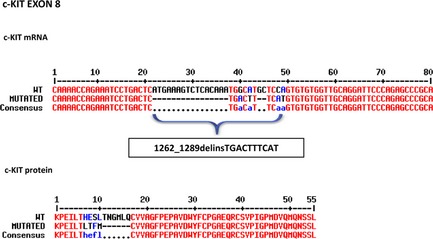
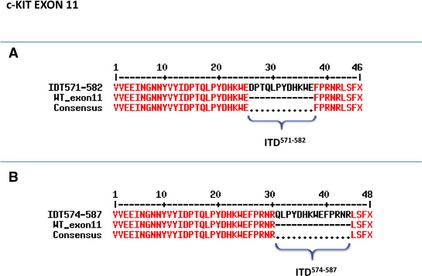
Concordance (mutated or wild-type) of mutational status, evaluable in 21 primary and matched metastatic (20 nodal and 1 splenic) MCTs, was 100%. Three new c-kit mutations were identified. No significant correlation was detected between c-kit mutation and clinicopathologic features.
Proto-oncogene c-kit mutational status is conserved between any primary and its matched secondary tumor, suggesting that both can be used for c-kit mutational testing. Targeted therapies might be also used to treat metastatic disease.
对于患有肥大细胞瘤(MCT)的犬,包括那些患有转移性疾病的犬,在开始使用酪氨酸激酶抑制剂治疗之前,建议进行原癌基因c-kit(c-kit)的突变分析。检测通常在原发性肿瘤上进行,假设c-kit突变状态在转移过程中不会改变。
假设/目的:深入了解突变过程,并就临床环境中c-kit突变分析的使用提出建议。
21只客户拥有的患有转移性MCT的犬。
前瞻性纳入接受原发性和匹配转移性MCT切除或活检的犬。从原发性MCT和相应转移灶中提取总RNA或DNA。通过PCR扩增外显子8、9和11并进行测序。比较原发性MCT和转移灶之间的遗传特征。研究它们与临床病理特征的相关性。
在21例原发性和匹配的转移性(20例淋巴结转移和1例脾脏转移)MCT中可评估的突变状态一致性(突变或野生型)为100%。鉴定出3种新的c-kit突变。未检测到c-kit突变与临床病理特征之间的显著相关性。
原癌基因c-kit突变状态在任何原发性肿瘤与其匹配的继发性肿瘤之间是保守的,这表明两者均可用于c-kit突变检测。靶向治疗也可用于治疗转移性疾病。