Giovannoni Gavin, Radue Ernst-Wilhelm, Havrdova Eva, Riester Katherine, Greenberg Steven, Mehta Lahar, Elkins Jacob
Queen Mary University of London, Blizard Institute, Barts and The London School of Medicine and Dentistry, 4 Newark Street, London, E1 2AT, UK,
J Neurol. 2014 Feb;261(2):316-23. doi: 10.1007/s00415-013-7196-4. Epub 2013 Dec 29.
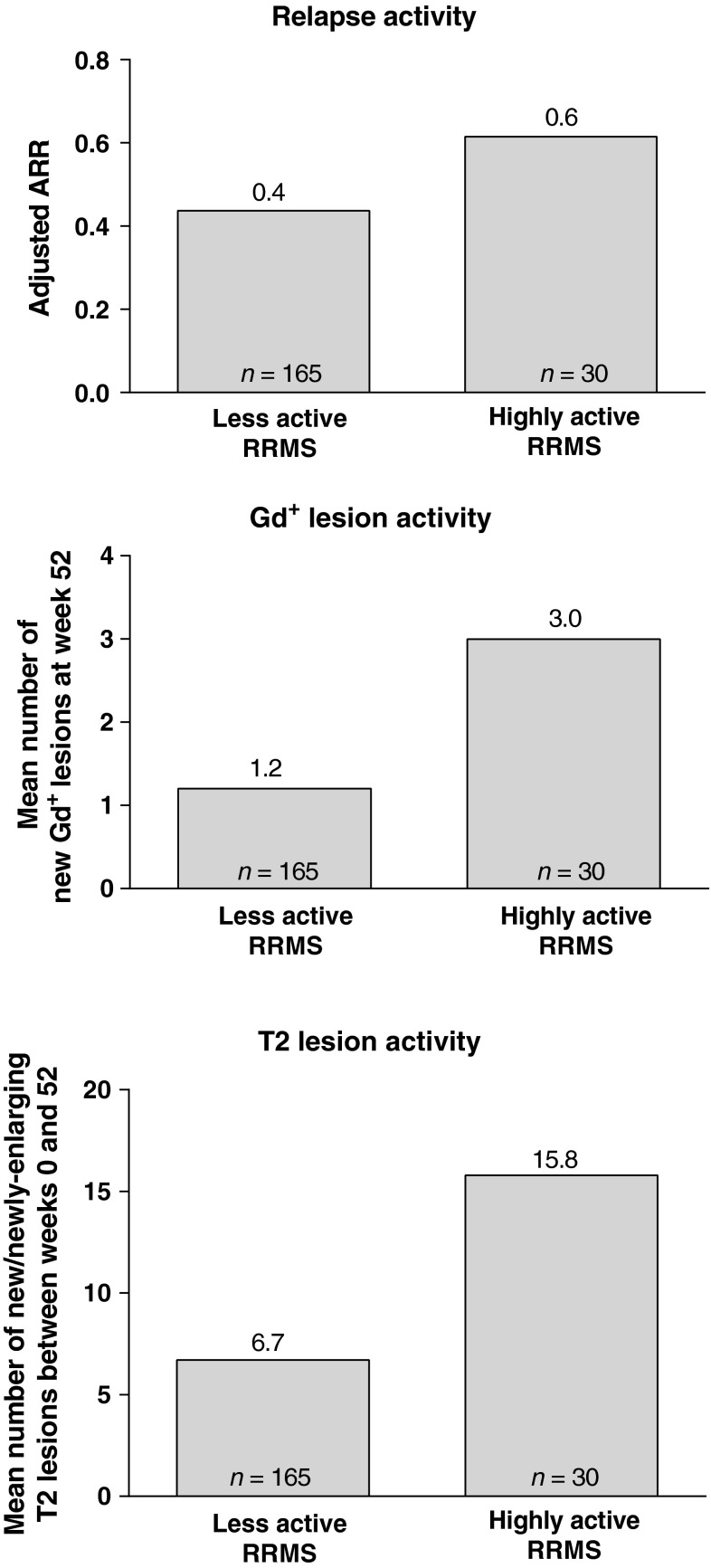
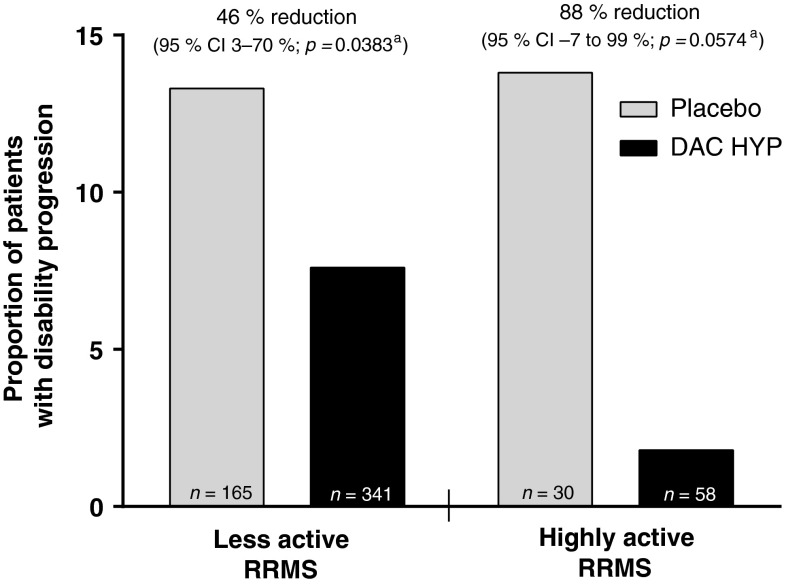
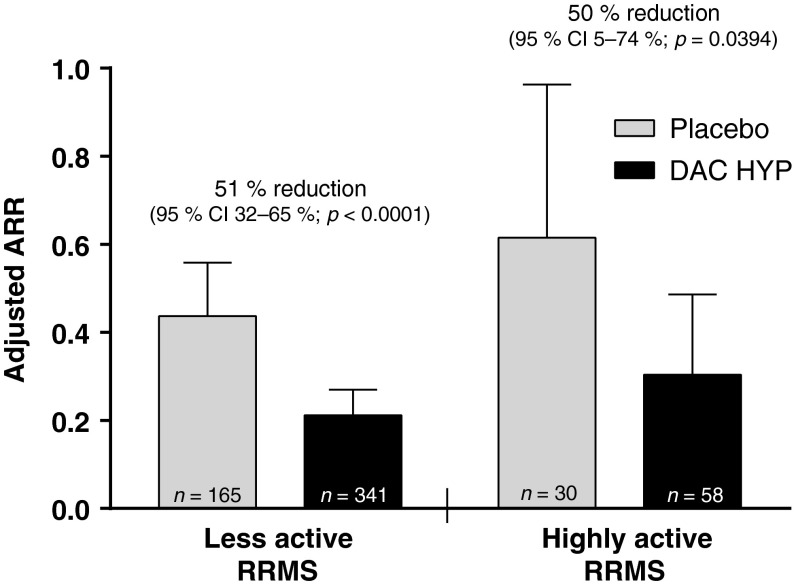
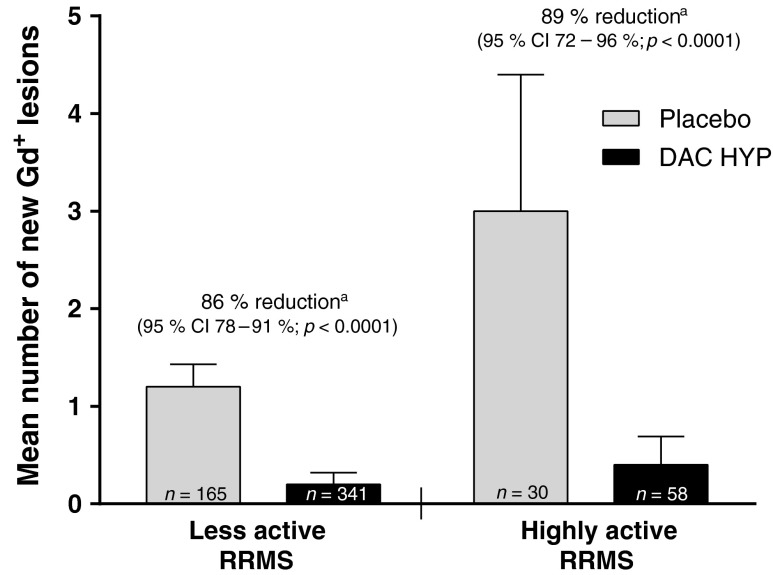
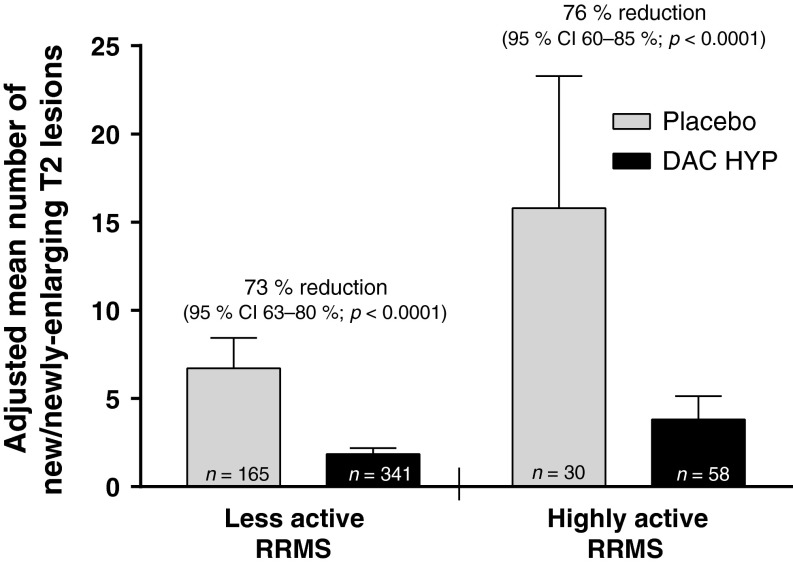
Patients with highly active relapsing-remitting multiple sclerosis (RRMS) are at greater risk for disease progression and may respond differently to MS therapeutics than those with less active disease. The current post hoc analysis evaluated the effects of daclizumab high-yield process (DAC HYP) vs. placebo in patients with highly active RRMS in the SELECT study. Highly active RRMS was defined as patients with ≥2 relapses in the year before randomization and ≥1 gadolinium-enhancing (Gd(+)) lesion at baseline. Because results were similar in the DAC HYP dose groups, data from the DAC HYP arms were pooled for analysis. Treatment with DAC HYP resulted in similar effects in highly active (n = 88) and less active (n = 506) RRMS patients. DAC HYP reduced the annualized relapse rate by 50 % and 51 % in the highly active (p = 0.0394) and less active (p < 0.0001) groups vs. placebo, respectively (interaction p = 0.82). DAC HYP reduced new/newly-enlarging T2 lesions (highly active RRMS 76 % reduction, p < 0.0001; less active RRMS 73 % reduction, p < 0.0001; interaction p = 0.18), the risk of having more Gd(+) lesions (highly active RRMS 89 % reduction, p < 0.0001; less active RRMS 86 % reduction, p < 0.0001; interaction p = 0.46), and sustained disability progression (highly active RRMS 88 % reduction, p = 0.0574; less active RRMS 46 % reduction, p = 0.0383; interaction p = 0.22) vs. placebo. DAC HYP efficacy was similar across the spectrum of MS disease activity as assessed prior to treatment initiation.
与疾病活动度较低的复发缓解型多发性硬化症(RRMS)患者相比,疾病活动度高的RRMS患者疾病进展风险更高,对MS治疗药物的反应可能也有所不同。当前的这项事后分析评估了在SELECT研究中,与安慰剂相比,高产量过程的达利珠单抗(DAC HYP)对疾病活动度高的RRMS患者的疗效。疾病活动度高的RRMS定义为随机分组前一年有≥2次复发且基线时有≥1个钆增强(Gd(+))病灶的患者。由于DAC HYP各剂量组的结果相似,因此将DAC HYP各治疗组的数据合并进行分析。在疾病活动度高(n = 88)和疾病活动度较低(n = 506)的RRMS患者中,DAC HYP治疗产生了相似的效果。与安慰剂相比,DAC HYP在疾病活动度高的组(p = 0.0394)和疾病活动度较低的组(p < 0.0001)中分别使年化复发率降低了50%和51%(交互作用p = 0.82)。DAC HYP减少了新出现/新增大的T2病灶(疾病活动度高的RRMS减少76%,p < 0.0001;疾病活动度较低的RRMS减少73%,p < 0.0001;交互作用p = 0.18)、出现更多Gd(+)病灶的风险(疾病活动度高的RRMS减少89%,p < 0.0001;疾病活动度较低的RRMS减少86%,p < 0.0001;交互作用p = 0.46)以及持续残疾进展(疾病活动度高的RRMS减少88%,p = 0.0574;疾病活动度较低的RRMS减少46%,p = 0.0383;交互作用p = 0.22)。在开始治疗前评估的MS疾病活动度范围内,DAC HYP的疗效相似。