Perception and Eye Movement Laboratory, Departments of Neurology and Clinical Research, Inselspital, Bern University Hospital, and University of Bern, Bern, Switzerland.
Perception and Eye Movement Laboratory, Departments of Neurology and Clinical Research, Inselspital, Bern University Hospital, and University of Bern, Bern, Switzerland ; Nuffield Department of Clinical Neurosciences, University of Oxford, John Radcliffe Hospital, Oxford, United Kingdom.
PLoS One. 2013 Dec 20;8(12):e83297. doi: 10.1371/journal.pone.0083297. eCollection 2013.
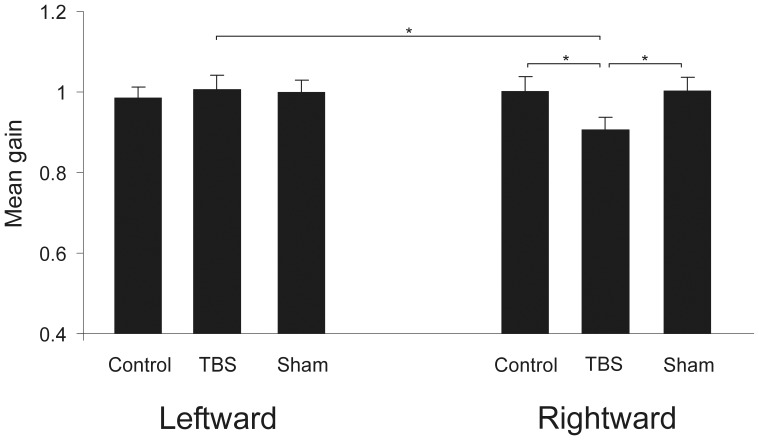
In the antisaccade task, subjects are requested to suppress a reflexive saccade towards a visual target and to perform a saccade towards the opposite side. In addition, in order to reproduce an accurate saccadic amplitude, the visual saccade vector (i.e., the distance between a central fixation point and the peripheral target) must be exactly inverted from one visual hemifield to the other. Results from recent studies using a correlational approach (i.e., fMRI, MEG) suggest that not only the posterior parietal cortex (PPC) but also the frontal eye field (FEF) might play an important role in such a visual vector inversion process. In order to assess whether the FEF contributes to visual vector inversion, we applied an interference approach with continuous theta burst stimulation (cTBS) during a memory-guided antisaccade task. In 10 healthy subjects, one train of cTBS was applied over the right FEF prior to a memory-guided antisaccade task. In comparison to the performance without stimulation or with sham stimulation, cTBS over the right FEF induced a hypometric gain for rightward but not leftward antisaccades. These results obtained with an interference approach confirm that the FEF is also involved in the process of visual vector inversion.
在反扫视任务中,要求被试抑制对视觉目标的反射性扫视,并向相反方向进行扫视。此外,为了重现准确的扫视幅度,视觉扫视矢量(即,从中央注视点到外周目标的距离)必须从一个视觉半视野精确地反转到另一个视觉半视野。最近使用相关方法(即 fMRI、MEG)进行的研究结果表明,不仅顶后皮质(PPC),而且额眼区(FEF)在这种视觉矢量反转过程中可能发挥重要作用。为了评估 FEF 是否有助于视觉矢量反转,我们在记忆引导的反扫视任务期间应用了连续 theta 爆发刺激(cTBS)的干扰方法。在 10 名健康受试者中,在进行记忆引导的反扫视任务之前,在右侧 FEF 上施加了一整串 cTBS。与无刺激或假刺激相比,cTBS 对右侧 FEF 的刺激导致向右的扫视增益降低,但向左的扫视增益没有降低。通过干扰方法获得的这些结果证实 FEF 也参与了视觉矢量反转的过程。