Beleoken Elvire, Leh Hervé, Arnoux Armelle, Ducot Béatrice, Nogues Claude, De Martin Eleonora, Johanet Catherine, Samuel Didier, Mustafa Mohammad Zahid, Duclos-Vallée Jean-Charles, Buckle Malcolm, Ballot Eric
Research Unit 785, Inserm, Villejuif, France ; Faculte de Medecine, University Paris-Sud, Villejuif, France.
Laboratoire de Biologie et de Pharmacologie Appliquée, ENS Cachan - CNRS, Cachan, France.
PLoS One. 2013 Dec 20;8(12):e84600. doi: 10.1371/journal.pone.0084600. eCollection 2013.
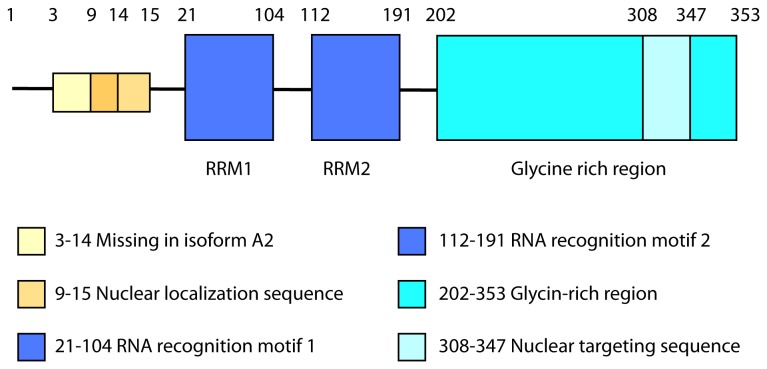
Heterogeneous nuclear ribonucleoprotein (hnRNP) A2/B1 is a target for antinuclear autoantibodies in systemic Lupus erythematosus (SLE), rheumatoid arthritis (RA), and autoimmune hepatitis (AIH).
To monitor molecular interactions between peptides spanning the entire sequence of hnRNP A2/B1 and sera from patients and healthy controls.
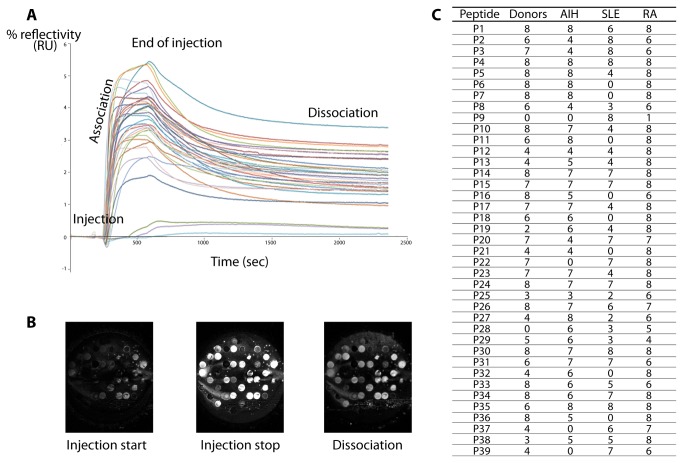
Sera from 8 patients from each pathology and controls were passed across a surface plasmon resonance Imagery (SPRi) surface containing 39 overlapping peptides of 17 mers covering the human hnRNP B1. Interactions involving the immobilised peptides were followed in real time and dissociation rate constants k(off) for each interaction were calculated.
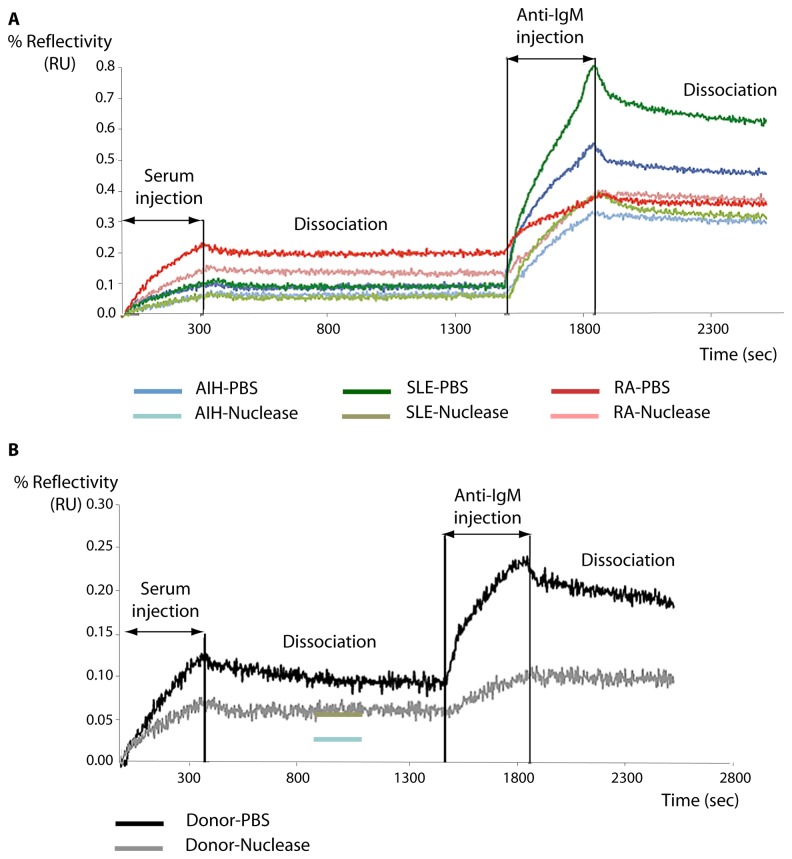
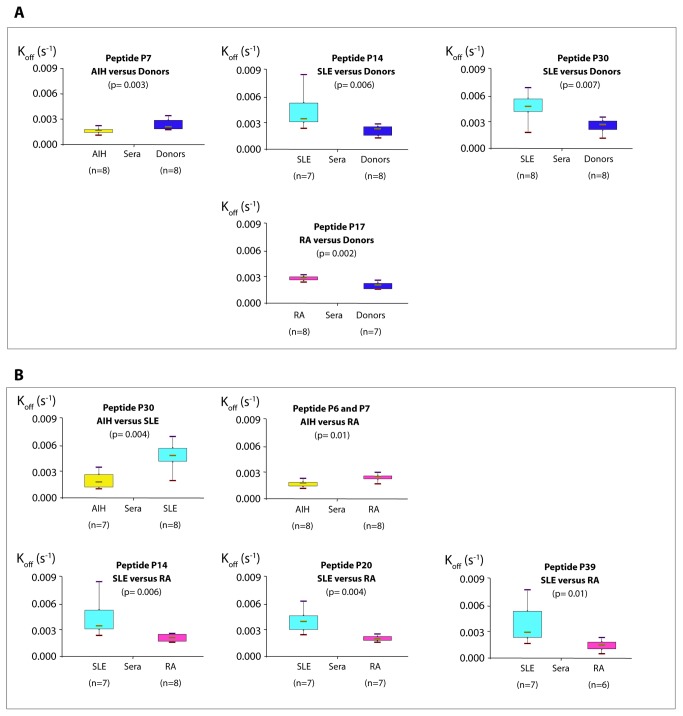
Several significant interactions were observed: i) high stability (lower k(off) values) between P₅₅₋₇₀ and the AIH sera compared to controls (p= 0.003); ii) lower stability (higher k(off) values) between P₁₁₈₋₁₃₃ and P₂₆₂₋₂₇₇ and SLE sera, P₁₄₅₋₁₆₀ and RA sera compared to controls (p=0.006, p=0.002, p=0.007). The binding curves and k(off) values observed after the formation of complexes with anti-IgM and anti-IgG antibodies and after nuclease treatment of the serum indicate that i) IgM isotypes are prevalent and ii) nucleic acids participate in the interaction between anti-hnRNAP B1 and P₅₅₋₇₀ and also between controls and the peptides studied.
These results indicate that P₅₅₋₇₀ of hnRNP B1 is a potential biomarker for AIH in immunological tests and suggest the role of circulating nucleic acids, (eg miRNA), present or absent according to the autoimmune disorders and involved in antigen-antibody stability.
不均一核核糖核蛋白(hnRNP)A2/B1是系统性红斑狼疮(SLE)、类风湿关节炎(RA)和自身免疫性肝炎(AIH)中抗核自身抗体的靶标。
监测覆盖hnRNP A2/B1全序列的肽段与患者及健康对照血清之间的分子相互作用。
将来自每种疾病的8例患者和对照的血清通过含有覆盖人hnRNP B1的39个重叠的17肽的表面等离子体共振成像(SPRi)表面。实时跟踪涉及固定肽段的相互作用,并计算每次相互作用的解离速率常数k(off)。
观察到几种显著的相互作用:i)与对照相比,P₅₅₋₇₀与AIH血清之间具有高稳定性(较低的k(off)值)(p = 0.003);ii)与对照相比,P₁₁₈₋₁₃₃和P₂₆₂₋₂₇₇与SLE血清之间,以及P₁₄₅₋₁₆₀与RA血清之间具有较低稳定性(较高的k(off)值)(p = 0.006,p = 0.002,p = 0.007)。与抗IgM和抗IgG抗体形成复合物后以及血清经核酸酶处理后观察到的结合曲线和k(off)值表明:i)IgM同种型普遍存在;ii)核酸参与抗hnRNAP B1与P₅₅₋₇₀之间以及对照与所研究肽段之间的相互作用。
这些结果表明,hnRNP B1的P₅₅₋₇₀在免疫检测中是AIH的潜在生物标志物,并提示循环核酸(如miRNA)的作用,其根据自身免疫性疾病的存在或不存在而存在,并参与抗原 - 抗体稳定性。