• 文献检索
  • 文档翻译
  • 深度研究
  • 学术资讯
  • Suppr Zotero 插件Zotero 插件
  • 邀请有礼
  • 套餐&价格
  • 历史记录
应用&插件
Suppr Zotero 插件Zotero 插件浏览器插件Mac 客户端Windows 客户端微信小程序
定价
高级版会员购买积分包购买API积分包
服务
文献检索文档翻译深度研究API 文档MCP 服务
关于我们
关于 Suppr公司介绍联系我们用户协议隐私条款
关注我们

Suppr 超能文献

核心技术专利:CN118964589B侵权必究
粤ICP备2023148730 号-1Suppr @ 2026

文献检索

告别复杂PubMed语法,用中文像聊天一样搜索,搜遍4000万医学文献。AI智能推荐,让科研检索更轻松。

立即免费搜索

文件翻译

保留排版,准确专业,支持PDF/Word/PPT等文件格式,支持 12+语言互译。

免费翻译文档

深度研究

AI帮你快速写综述,25分钟生成高质量综述,智能提取关键信息,辅助科研写作。

立即免费体验

创伤后难治性颅内高压和脑疝综合征:减压性颅骨切除术前行脑血流动力学评估

Posttraumatic refractory intracranial hypertension and brain herniation syndrome: cerebral hemodynamic assessment before decompressive craniectomy.

作者信息

Bor-Seng-Shu Edson, Paiva Wellingson Silva, Figueiredo Eberval G, Fujimoto Yasunori, de Andrade Almir Ferreira, Fonoff Erich Talamoni, Teixeira Manoel Jacobsen

机构信息

Division of Neurological Surgery, Hospital das Clinicas, University of Sao Paulo, School of Medicine, 255 Eneas Aguiar Street, Office 4079, 05403010 Sao Paulo, SP, Brazil.

Department of Neurosurgery, Osaka University Graduate School of Medicine, Osaka, Japan.

出版信息

Biomed Res Int. 2013;2013:750809. doi: 10.1155/2013/750809. Epub 2013 Nov 27.

DOI:10.1155/2013/750809
PMID:24377095
原文链接:https://pmc.ncbi.nlm.nih.gov/articles/PMC3860083/
Abstract

BACKGROUND

The pathophysiology of traumatic brain swelling remains little understood. An improved understanding of intracranial circulatory process related to brain herniation may have treatment implications.

OBJECTIVE

To investigate the cerebral hemodynamic changes associated with brain herniation syndrome due to traumatic brain swelling.

METHODS

Nineteen head-injured patients with evidence of refractory intracranial hypertension and transtentorial herniation were prospectively studied. Cerebral hemodynamic assessment by transcranial Doppler (TCD) ultrasonography was performed prior to decompressive craniectomy. Patients and their cerebral hemispheres were classified according to TCD-hemodynamic patterns, and the data correlated with neurological status, midline shift on CT scan, and Glasgow outcome scale scores at 6 months after injury.

RESULTS

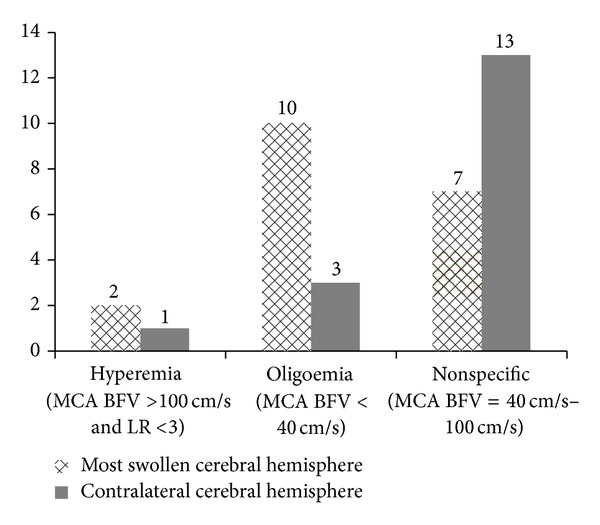
A wide variety of cerebral hemodynamic findings were observed. Ten patients (52.7%) presented with cerebral oligoemia, 3 patients (15.8%) with cerebral hyperemia, and 6 patients with nonspecific circulatory pattern. Circulatory disturbances were more frequently found in the side of maximal cerebral swelling than in the opposite side. Pulsatility index (PI) values suggested that ICP varied from acceptable to considerably high; patients with increased PI, indicating higher microvascular resistance. No correlation was found between cerebral hemodynamic findings and outcome.

CONCLUSIONS

There is a marked heterogeneity of cerebral hemodynamic disturbances among patients with brain herniation syndrome.

摘要

背景

创伤性脑肿胀的病理生理学仍知之甚少。更好地理解与脑疝相关的颅内循环过程可能对治疗有指导意义。

目的

研究创伤性脑肿胀所致脑疝综合征相关的脑血流动力学变化。

方法

前瞻性研究19例有难治性颅内高压和经天幕疝证据的颅脑损伤患者。在减压性颅骨切除术前,采用经颅多普勒(TCD)超声进行脑血流动力学评估。根据TCD血流动力学模式对患者及其大脑半球进行分类,并将数据与神经功能状态、CT扫描中线移位以及伤后6个月的格拉斯哥预后评分相关联。

结果

观察到多种脑血流动力学表现。10例患者(52.7%)表现为脑供血不足,3例患者(15.8%)表现为脑充血,6例患者表现为非特异性循环模式。循环障碍在脑肿胀最严重的一侧比在对侧更常见。搏动指数(PI)值表明颅内压从可接受水平到相当高的水平不等;PI升高的患者表明微血管阻力更高。脑血流动力学表现与预后之间未发现相关性。

结论

脑疝综合征患者的脑血流动力学障碍存在明显异质性。

https://cdn.ncbi.nlm.nih.gov/pmc/blobs/a504/3860083/ebf5edffbd57/BMRI2013-750809.001.jpg

相似文献

1
Posttraumatic refractory intracranial hypertension and brain herniation syndrome: cerebral hemodynamic assessment before decompressive craniectomy.创伤后难治性颅内高压和脑疝综合征:减压性颅骨切除术前行脑血流动力学评估
Biomed Res Int. 2013;2013:750809. doi: 10.1155/2013/750809. Epub 2013 Nov 27.
2
Cerebral hemodynamic changes gauged by transcranial Doppler ultrasonography in patients with posttraumatic brain swelling treated by surgical decompression.经颅多普勒超声测量手术减压治疗的创伤后脑肿胀患者的脑血流动力学变化。
J Neurosurg. 2006 Jan;104(1):93-100. doi: 10.3171/jns.2006.104.1.93.
3
Decompressive Craniectomy for Traumatic Brain Injury: Postoperative TCD Cerebral Hemodynamic Evaluation.创伤性脑损伤的去骨瓣减压术:术后经颅多普勒脑血流动力学评估
Front Neurol. 2019 Apr 12;10:354. doi: 10.3389/fneur.2019.00354. eCollection 2019.
4
Transcranial doppler sonography in two patients who underwent decompressive craniectomy for traumatic brain swelling: report of two cases.两例因创伤性脑肿胀接受去骨瓣减压术患者的经颅多普勒超声检查:两例报告
Arq Neuropsiquiatr. 2004 Sep;62(3A):715-21. doi: 10.1590/s0004-282x2004000400028. Epub 2004 Aug 24.
5
Noninvasive screening for intracranial hypertension in children with acute, severe traumatic brain injury.急性重度创伤性脑损伤患儿颅内高压的无创筛查
J Neurosurg Pediatr. 2015 Oct;16(4):420-5. doi: 10.3171/2015.3.PEDS14521. Epub 2015 Jul 3.
6
Outcome following decompressive craniectomy for malignant swelling due to severe head injury.严重颅脑损伤所致恶性肿胀行去骨瓣减压术后的结果
J Neurosurg. 2006 Apr;104(4):469-79. doi: 10.3171/jns.2006.104.4.469.
7
Role of Bedside Transcranial Ultrasonography in the Assessment of Cerebral Hemodynamics in Decompressive Craniectomy Patients with Cranioplasty: A Single Centre Experience.床旁经颅超声检查在颅骨修补减压性颅骨切除术患者脑血流动力学评估中的作用:单中心经验
Neurol India. 2022 Sep-Oct;70(5):1840-1845. doi: 10.4103/0028-3886.359228.
8
Transcranial Doppler Ultrasonography for the Management of Severe Traumatic Brain Injury After Decompressive Craniectomy.经颅多普勒超声在去骨瓣减压术后严重创伤性脑损伤管理中的应用。
World Neurosurg. 2019 Jun;126:e116-e124. doi: 10.1016/j.wneu.2019.02.005. Epub 2019 Feb 18.
9
Cerebral hemodynamic changes in severe head injury patients undergoing decompressive craniectomy.重型颅脑损伤患者去骨瓣减压术后脑血流动力学变化。
J Neurosurg Anesthesiol. 2009 Oct;21(4):339-45. doi: 10.1097/ANA.0b013e3181b1dbba.
10
Haemodynamic patterns in children with posttraumatic diffuse brain swelling. A preliminary study in 6 cases with neuroradiological features consistent with diffuse axonal injury.创伤后弥漫性脑肿胀患儿的血流动力学模式。对6例具有与弥漫性轴索损伤相符的神经放射学特征的患儿进行的初步研究。
Acta Neurochir (Wien). 2007;149(4):347-56. doi: 10.1007/s00701-006-1102-0. Epub 2007 Feb 16.

引用本文的文献

1
Extubation timing and risk of extubation failure in aneurysmal subarachnoid hemorrhage patients.动脉瘤性蛛网膜下腔出血患者的拔管时机与拔管失败风险
Chin Neurosurg J. 2024 Nov 20;10(1):32. doi: 10.1186/s41016-024-00384-1.
2
Assessing ultrasonographic optic nerve sheath diameter in animal model with anesthesia regimens.评估麻醉方案下动物模型的视神经鞘直径的超声测量。
Acta Cir Bras. 2022 Jun 15;37(3):e370308. doi: 10.1590/acb370308. eCollection 2022.
3
Decompressive Craniectomy for Traumatic Brain Injury: Postoperative TCD Cerebral Hemodynamic Evaluation.

本文引用的文献

1
Intracranial-pressure monitoring in traumatic brain injury.创伤性脑损伤中的颅内压监测
N Engl J Med. 2013 May 2;368(18):1751-2. doi: 10.1056/NEJMc1301076.
2
Decompressive craniectomy and head injury: brain morphometry, ICP, cerebral hemodynamics, cerebral microvascular reactivity, and neurochemistry.去骨瓣减压术与颅脑损伤:脑形态计量学、ICP、脑血流动力学、脑微血管反应性和神经化学。
Neurosurg Rev. 2013 Jul;36(3):361-70. doi: 10.1007/s10143-013-0453-2. Epub 2013 Feb 6.
3
Decompressive craniectomy: a meta-analysis of influences on intracranial pressure and cerebral perfusion pressure in the treatment of traumatic brain injury.
创伤性脑损伤的去骨瓣减压术:术后经颅多普勒脑血流动力学评估
Front Neurol. 2019 Apr 12;10:354. doi: 10.3389/fneur.2019.00354. eCollection 2019.
4
Predictable Values of Decompressive Craniectomy in Patients with Acute Subdural Hematoma: Comparison between Decompressive Craniectomy after Craniotomy Group and Craniotomy Only Group.急性硬膜下血肿患者去骨瓣减压术的可预测值:开颅术后去骨瓣减压术组与单纯开颅术组的比较
Korean J Neurotrauma. 2018 Apr;14(1):14-19. doi: 10.13004/kjnt.2018.14.1.14. Epub 2018 Apr 30.
5
Cardiac troponin and cerebral herniation in acute intracerebral hemorrhage.急性脑出血中心脏肌钙蛋白与脑疝。
Brain Behav. 2017 Apr 21;7(6):e00697. doi: 10.1002/brb3.697. eCollection 2017 Jun.
6
Central hyperventilation syndrome due to massive pneumocephalus after endoscopic third ventriculostomy: a case report.内镜下第三脑室造瘘术后大量气颅所致中枢性通气不足综合征:一例报告
Korean J Anesthesiol. 2016 Aug;69(4):409-12. doi: 10.4097/kjae.2016.69.4.409. Epub 2016 Jul 1.
7
Head computed tomographic measurement as a predictor of outcome in patients with subdural hematoma with cerebral edema.头部计算机断层扫描测量作为伴有脑水肿的硬膜下血肿患者预后的预测指标。
Scand J Trauma Resusc Emerg Med. 2016 Jun 7;24:83. doi: 10.1186/s13049-016-0271-y.
8
The effect of craniectomy size on mortality, outcome, and complications after decompressive craniectomy at a rural trauma center.农村创伤中心减压性颅骨切除术中颅骨切除大小对死亡率、预后及并发症的影响。
J Neurosci Rural Pract. 2014 Jul;5(3):212-7. doi: 10.4103/0976-3147.133555.
去骨瓣减压术:治疗创伤性脑损伤时颅内压和脑灌注压影响的荟萃分析。
J Neurosurg. 2012 Sep;117(3):589-96. doi: 10.3171/2012.6.JNS101400. Epub 2012 Jul 13.
4
Cerebral hemodynamics: concepts of clinical importance.脑血流动力学:具有临床重要性的概念
Arq Neuropsiquiatr. 2012 May;70(5):352-6. doi: 10.1590/s0004-282x2012000500010.
5
Decompressive craniectomy: surgical control of traumatic intracranial hypertension may improve outcome.去骨瓣减压术:外伤性颅内高压的手术治疗可能改善预后。
Injury. 2010 Sep;41(9):894-8. doi: 10.1016/j.injury.2010.02.023.
6
Decompressive craniectomy in diffuse traumatic brain injury.去骨瓣减压术在弥漫性创伤性脑损伤中的应用。
N Engl J Med. 2011 Apr 21;364(16):1493-502. doi: 10.1056/NEJMoa1102077. Epub 2011 Mar 25.
7
Continuous ventricular cerebrospinal fluid drainage with intracranial pressure monitoring for management of posttraumatic diffuse brain swelling.
Arq Neuropsiquiatr. 2011 Feb;69(1):79-84. doi: 10.1590/s0004-282x2011000100016.
8
Cerebral blood flow and metabolism following decompressive craniectomy for control of increased intracranial pressure.去骨瓣减压术控制颅内压增高后脑血流和代谢的变化。
Neurosurgery. 2010 Jul;67(1):65-72; discussion 72. doi: 10.1227/01.NEU.0000370604.30037.F5.
9
Traumatic brain injury and metabolism.创伤性脑损伤与代谢
J Neurosurg. 2010 Jun;112(6):1351-3. doi: 10.3171/2009.10.JNS091426.
10
Cerebral hemodynamic changes in severe head injury patients undergoing decompressive craniectomy.重型颅脑损伤患者去骨瓣减压术后脑血流动力学变化。
J Neurosurg Anesthesiol. 2009 Oct;21(4):339-45. doi: 10.1097/ANA.0b013e3181b1dbba.