Division of Cardiology, Department of Internal Medicine, Korea University Medical Center, Seoul, Korea.
Division of Cardiology, Department of Internal Medicine, Hanyang University Guri Hospital, Guri, Korea.
Korean Circ J. 2013 Dec;43(12):811-8. doi: 10.4070/kcj.2013.43.12.811. Epub 2013 Dec 20.
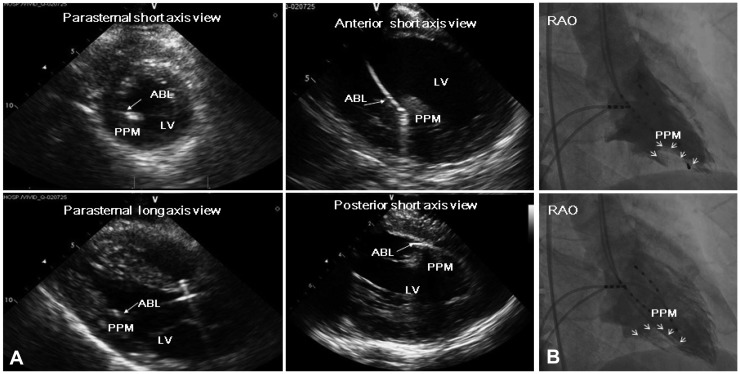
The electrophysiological properties associated with favorable outcome of radiofrequency catheter ablation (RFCA) for idiopathic ventricular arrhythmia (VA) originating from the papillary muscle (PM) remain unclear. The purpose of this study was to investigate the relationships of electrophysiological characteristics and predictors with the outcome of RFCA in patients with VAs originating from PM in the left ventricle (LV).
Twelve (4.2%) of 284 consecutive patients with idiopathic VAs originating from LV PM were assessed. The electrophysiological data were compared between the patients in the successful group and patients in the recurrence group after RFCA.
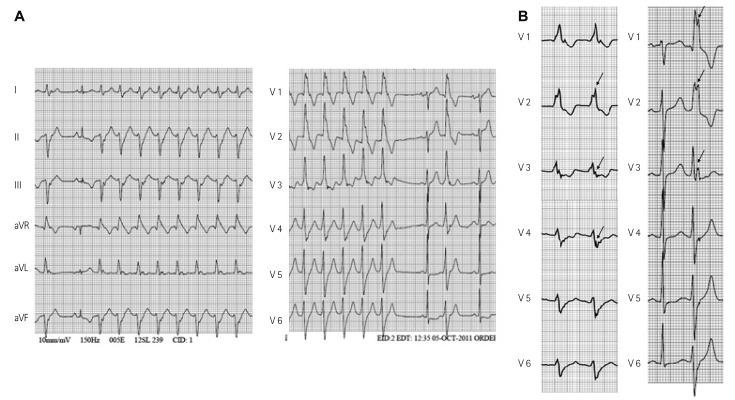
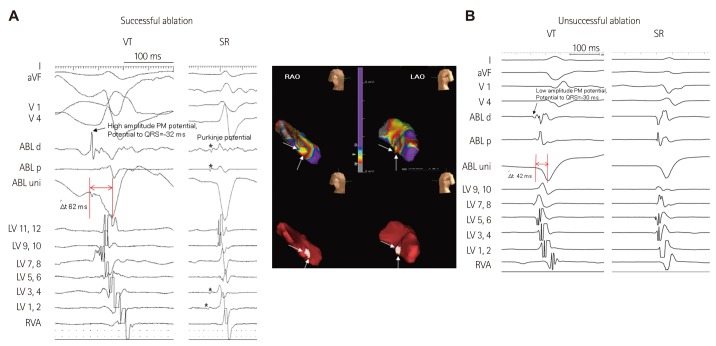
In 12 patients with PM VAs, non-sustained ventricular tachycardias (VTs, n=6), sustained VTs (n=4) and premature ventricular complexes (n=2) were identified as the presenting arrhythmias. Seven of eight patients showing high-amplitude discrete potentials at the ablation site had a successful outcome (85.7%), while the remaining four patients who showed low-amplitude fractionated potentials at the ablation site experienced VA recurrence. The mean duration from onset to peak downstroke (Δt) on the unipolar electrogram was significantly longer in the successful group than in the recurrence group (58±8 ms vs. 37±9 ms, p=0.04). A slow downstroke >50 ms of the initial Q wave on the unipolar electrogram at ablation sites was also significantly associated with successful outcome (85.7% vs. 25.0%, p=0.03).
In PM VAs, the high-amplitude discrete potentials before QRS and slow downstroke of the initial Q wave on the unipolar electrogram at ablation sites were related to favorable outcome after RFCA.
射频导管消融(RFCA)治疗起源于乳头肌(PM)的特发性室性心律失常(VA)的有利结果相关的电生理特性尚不清楚。本研究的目的是研究左心室(LV)起源于 PM 的 VA 患者的电生理特征和预测因素与 RFCA 结果之间的关系。
评估了 284 例连续特发性 LV PM 起源的 VA 患者中的 12 例(4.2%)。比较了 RFCA 后成功组和复发组患者的电生理数据。
在 12 例 PM VA 患者中,识别出非持续性室性心动过速(VT,n=6)、持续性 VT(n=4)和室性早搏(n=2)作为主要心律失常。在消融部位显示高振幅离散电位的 8 例患者中有 7 例(85.7%)获得成功结果,而在消融部位显示低振幅碎裂电位的 4 例患者则出现 VA 复发。单极电图上从起始到峰值下降的平均时间(Δt)在成功组明显长于复发组(58±8ms vs.37±9ms,p=0.04)。在消融部位的单极电图上,初始 Q 波的下降斜率>50ms 也与良好的结果显著相关(85.7%vs.25.0%,p=0.03)。
在 PM VA 中,QRS 前的高振幅离散电位和消融部位单极电图上初始 Q 波的下降斜率与 RFCA 后有利的结果相关。