
克氏原螯虾眼柄和大脑中的假定起搏器显示,甲壳类高血糖激素的mRNA水平存在昼夜节律振荡。
Putative pacemakers in the eyestalk and brain of the crayfish Procambarus clarkii show circadian oscillations in levels of mRNA for crustacean hyperglycemic hormone.
作者信息
Nelson-Mora Janikua, Prieto-Sagredo Julio, Loredo-Ranjel Rosaura, Fanjul-Moles María Luisa
机构信息
Laboratorio de Neurofisiología Comparada, Departamento de Ecología y Recursos Naturales, Facultad de Ciencias, Universidad Nacional Autónoma de México, Distrito Federal, México.
出版信息
PLoS One. 2013 Dec 31;8(12):e83937. doi: 10.1371/journal.pone.0083937. eCollection 2013.
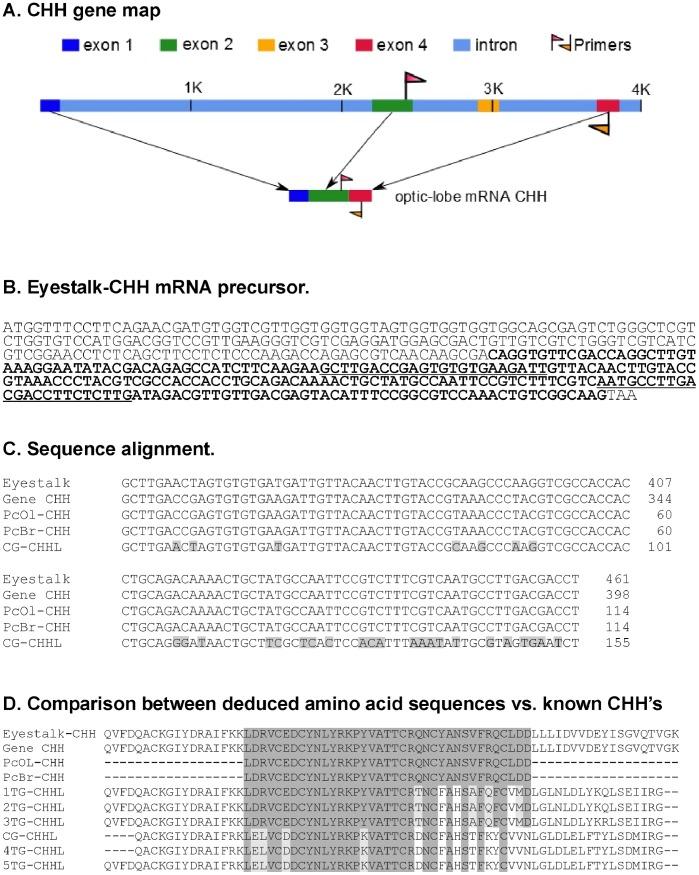
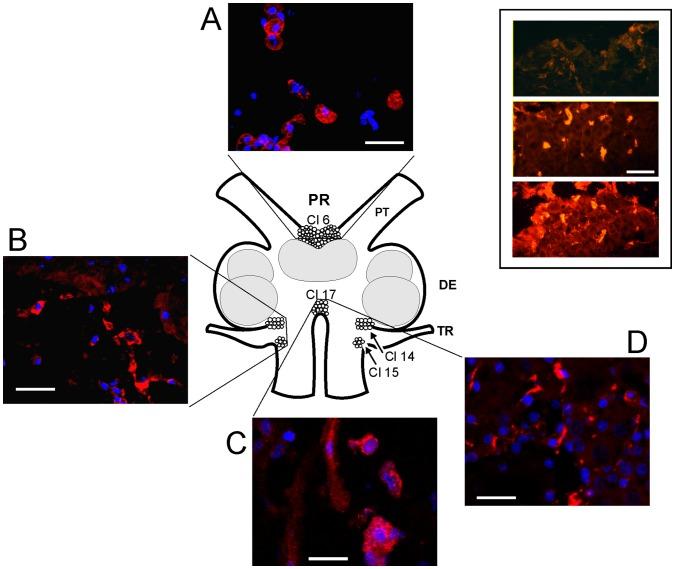
Crustacean hyperglycemic hormone (CHH) synthesizing cells in the optic lobe, one of the pacemakers of the circadian system, have been shown to be present in crayfish. However, the presence of CHH in the central brain, another putative pacemaker of the multi-oscillatory circadian system, of this decapod and its circadian transcription in the optic lobe and brain have yet to be explored. Therefore, using qualitative and quantitative PCR, we isolated and cloned a CHH mRNA fragment from two putative pacemakers of the multi-oscillatory circadian system of Procambarus clarkii, the optic lobe and the central brain. This CHH transcript synchronized to daily light-dark cycles and oscillated under dark, constant conditions demonstrating statistically significant daily and circadian rhythms in both structures. Furthermore, to investigate the presence of the peptide in the central brain of this decapod, we used immunohistochemical methods. Confocal microscopy revealed the presence of CHH-IR in fibers and cells of the protocerebral and tritocerebal clusters and neuropiles, particularly in some neurons located in clusters 6, 14, 15 and 17. The presence of CHH positive neurons in structures of P. clarkii where clock proteins have been reported suggests a relationship between the circadian clockwork and CHH. This work provides new insights into the circadian regulation of CHH, a pleiotropic hormone that regulates many physiological processes such as glucose metabolism and osmoregulatory responses to stress.
在小龙虾中,视叶(昼夜节律系统的起搏器之一)中的甲壳类高血糖激素(CHH)合成细胞已被证实存在。然而,这种十足目动物的中枢脑(多振荡昼夜节律系统的另一个假定起搏器)中CHH的存在及其在视叶和脑中的昼夜转录情况尚未得到研究。因此,我们利用定性和定量PCR技术,从小龙虾(克氏原螯虾)多振荡昼夜节律系统的两个假定起搏器——视叶和中枢脑中分离并克隆了一个CHH mRNA片段。该CHH转录本与每日的明暗周期同步,并在黑暗、恒定条件下振荡,表明在这两个结构中均存在具有统计学意义的每日和昼夜节律。此外,为了研究这种十足目动物中枢脑中该肽的存在情况,我们采用了免疫组织化学方法。共聚焦显微镜显示,在原脑和后脑神经节及神经纤维网的纤维和细胞中存在CHH免疫反应性,特别是在位于6、14、15和17神经节中的一些神经元中。在已报道存在时钟蛋白的克氏原螯虾结构中存在CHH阳性神经元,这表明昼夜节律机制与CHH之间存在关联。这项工作为CHH的昼夜调节提供了新的见解,CHH是一种多效激素,可调节许多生理过程,如葡萄糖代谢和对压力的渗透调节反应。


 Zotero 插件