
欧洲医院中社会资本与质量管理体系的关系:一项定量研究。
The relationship between social capital and quality management systems in European hospitals: a quantitative study.
作者信息
Hammer Antje, Arah Onyebuchi A, Dersarkissian Maral, Thompson Caroline A, Mannion Russell, Wagner Cordula, Ommen Oliver, Sunol Rosa, Pfaff Holger
机构信息
Institute for Medical Sociology, Health Services Research and Rehabilitation Science, Faculty of Human Science and Faculty of Medicine, University of Cologne, Cologne, Germany.
Department of Epidemiology, University of California Los Angeles Fielding School of Public Health, Los Angeles, California, United States of America ; University of California Los Angeles Center for Health Policy Research, Los Angeles, California, United States of America.
出版信息
PLoS One. 2013 Dec 31;8(12):e85662. doi: 10.1371/journal.pone.0085662. eCollection 2013.
BACKGROUND
Strategic leadership is an important organizational capability and is essential for quality improvement in hospital settings. Furthermore, the quality of leadership depends crucially on a common set of shared values and mutual trust between hospital management board members. According to the concept of social capital, these are essential requirements for successful cooperation and coordination within groups.
OBJECTIVES
We assume that social capital within hospital management boards is an important factor in the development of effective organizational systems for overseeing health care quality. We hypothesized that the degree of social capital within the hospital management board is associated with the effectiveness and maturity of the quality management system in European hospitals.
METHODS
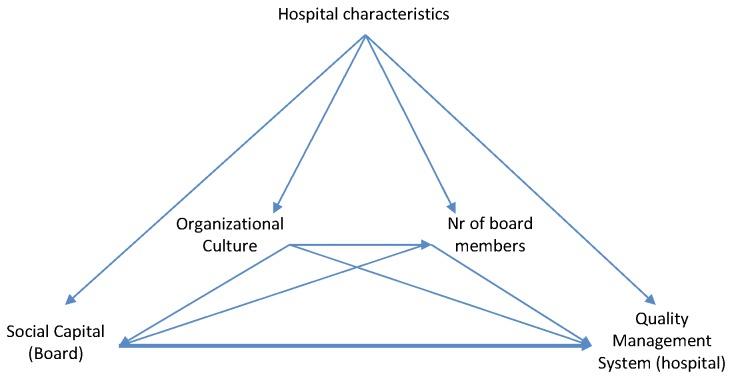
We used a mixed-method approach to data collection and measurement in 188 hospitals in 7 European countries. For this analysis, we used responses from hospital managers. To test our hypothesis, we conducted a multilevel linear regression analysis of the association between social capital and the quality management system score at the hospital level, controlling for hospital ownership, teaching status, number of beds, number of board members, organizational culture, and country clustering.
RESULTS
The average social capital score within a hospital management board was 3.3 (standard deviation: 0.5; range: 1-4) and the average hospital score for the quality management index was 19.2 (standard deviation: 4.5; range: 0-27). Higher social capital was associated with higher quality management system scores (regression coefficient: 1.41; standard error: 0.64, p=0.029).
CONCLUSION
The results suggest that a higher degree of social capital exists in hospitals that exhibit higher maturity in their quality management systems. Although uncontrolled confounding and reverse causation cannot be completely ruled out, our new findings, along with the results of previous research, could have important implications for the work of hospital managers and the design and evaluation of hospital quality management systems.
背景
战略领导力是一项重要的组织能力,对医院环境中的质量改进至关重要。此外,领导力的质量在很大程度上取决于医院管理委员会成员之间一套共同的共享价值观和相互信任。根据社会资本的概念,这些是群体内成功合作与协调的基本要求。
目的
我们假设医院管理委员会内部的社会资本是建立有效医疗质量监督组织系统的一个重要因素。我们推测欧洲医院管理委员会内部的社会资本程度与质量管理系统的有效性和成熟度相关。
方法
我们采用混合方法在欧洲7个国家的188家医院收集数据并进行测量。对于本分析,我们使用了医院管理者的回复。为检验我们的假设,我们对社会资本与医院层面质量管理系统得分之间的关联进行了多层次线性回归分析,同时控制医院所有权、教学地位、床位数量、委员会成员数量、组织文化和国家聚类情况。
结果
医院管理委员会内部的社会资本平均得分为3.3(标准差:0.5;范围:1 - 4),质量管理指数的医院平均得分为19.2(标准差:4.5;范围:0 - 27)。较高的社会资本与较高的质量管理系统得分相关(回归系数:1.41;标准误差:0.64,p = 0.029)。
结论
结果表明,质量管理系统成熟度较高的医院存在更高程度的社会资本。尽管无法完全排除未控制的混杂因素和反向因果关系,但我们的新发现以及先前研究的结果可能对医院管理者的工作以及医院质量管理系统的设计和评估具有重要意义。
 Zotero 插件