Schmidt Axel J, Falcato Luis, Zahno Benedikt, Burri Andrea, Regenass Stephan, Müllhaupt Beat, Bruggmann Philip
Checkpoint Zurich, Konradstrasse 1, 8005 Zurich, Switzerland.
BMC Public Health. 2014 Jan 6;14:3. doi: 10.1186/1471-2458-14-3.
While the numbers of hepatitis-C-virus (HCV) infections among men who have sex with men (MSM) who are co-infected with the human immunodeficiency virus (HIV) are on the rise, with vast evidence for sexual transmission of HCV in this population, concerns have also been raised regarding sexual HCV-transmission among MSM without HIV infection. Therefore, the aim of this study was to estimate the prevalence of hepatitis C among MSM without HIV diagnosis in Zurich (Switzerland).
Participants were recruited from a gay health centre and various locations such as dark rooms, saunas and cruising areas in Zurich. Participants self-completed a questionnaire assessing known and suspected risk factors for HCV-infection, and provided a blood sample for detection of past (antibodies) and present (core antigen, RNA) infections with HCV.
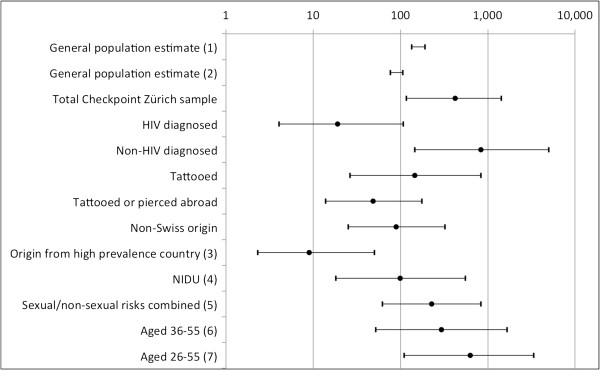
In total, 840 MSM aged 17-79 (median: 33 years) underwent HCV-testing and completed the questionnaire, among whom 19 reported living with HIV. Overall, seven tested positive for HCV-antibodies, and two were also positive for HCV core antigen and HCV-RNA-these two were immigrants, one from a country where HCV is endemic. None of the seven were aware of their infection. The seroprevalence of hepatitis C among the 821 non-HIV-diagnosed MSM was 0.37% (95%-CI: 0.12-1.69%), and one man harboured replicating virus (0.12%; 0.02-0.69%), resulting in a number needed to test of 821 to detect one active infection. Significant univariable associations of lifetime HCV-infection were found with known HIV-diagnosis (OR=72.7), being tattooed (OR=10.4), non-injection use of cocaine/amphetamines (OR=8.8), and non-Swiss origin (OR=8.5). For MSM without HIV-diagnosis, the only variable marginally associated with positive HCV-serostatus was being tattooed (OR=8.3). No significant associations were observed with reported injection drug use, unprotected anal intercourse, sexual practices that may lead to mucosal trauma, or proxy measures for group sex and lesion-prone STIs.
Our findings suggest that in Switzerland, hepatitis C among MSM without diagnosed HIV is not more prevalent than in the general population. We found no evidence of elevated rates of sexual transmission of HCV among MSM without HIV-infection. Therefore, we currently see no reason for promoting HCV-testing among all MSM in Switzerland.
虽然同时感染人类免疫缺陷病毒(HIV)的男男性行为者(MSM)中丙型肝炎病毒(HCV)感染人数呈上升趋势,且有大量证据表明该人群中存在HCV性传播,但未感染HIV的MSM之间的HCV性传播也引发了关注。因此,本研究的目的是估计瑞士苏黎世未被诊断出感染HIV的MSM中丙型肝炎的患病率。
参与者从一家同性恋健康中心以及苏黎世的各种场所招募,如暗房、桑拿浴室和巡游区域。参与者自行填写一份问卷,评估已知和疑似的HCV感染风险因素,并提供血液样本以检测过去(抗体)和当前(核心抗原、RNA)的HCV感染情况。
共有840名年龄在17 - 79岁(中位数:33岁)的MSM接受了HCV检测并完成了问卷,其中19人报告感染了HIV。总体而言,7人HCV抗体检测呈阳性,2人HCV核心抗原和HCV - RNA也呈阳性,这两人是移民,其中一人来自HCV流行国家。这7人中无人知晓自己已感染。在821名未被诊断出感染HIV的MSM中,丙型肝炎的血清阳性率为0.37%(95%置信区间:0.12 - 1.69%),1名男性携带复制病毒(0.12%;0.02 - 0.69%),即需要检测821人才能检测到1例活动性感染。发现终生HCV感染与已知HIV诊断(比值比=72.7)、纹身(比值比=10.4)、非注射使用可卡因/苯丙胺(比值比=8.8)以及非瑞士籍(比值比=8.5)存在显著的单变量关联。对于未被诊断出感染HIV的MSM,与HCV血清阳性仅存在微弱关联的唯一变量是纹身(比值比=8.3)。未观察到与报告的注射吸毒、无保护肛交、可能导致黏膜创伤的性行为或群体性性行为及易患病变性传播感染的替代指标有显著关联。
我们的研究结果表明,在瑞士,未被诊断出感染HIV的MSM中丙型肝炎的患病率并不高于普通人群。我们没有发现未感染HIV的MSM中HCV性传播率升高的证据。因此,我们目前认为在瑞士没有理由对所有MSM推广HCV检测。