Tadakaluru Sreenivasulu, Thongsuwan Wiradej, Singjai Pisith
Materials Science Research Center, Department of Physics and Materials Science, Faculty of Science, Chiangmai University, Chiangmai 50200, Thailand.
Sensors (Basel). 2014 Jan 6;14(1):868-76. doi: 10.3390/s140100868.
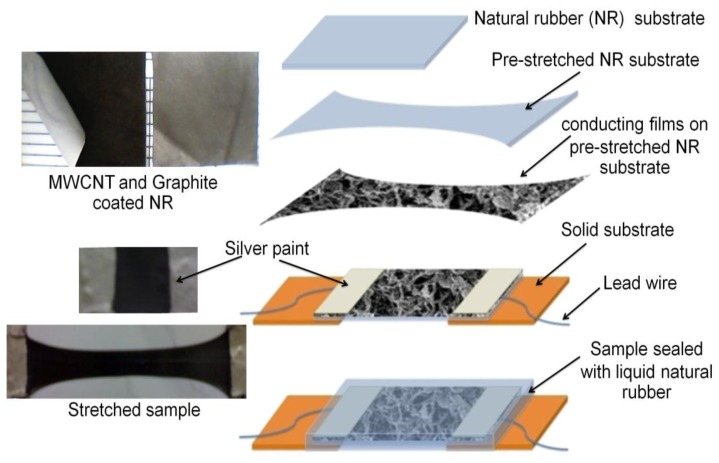
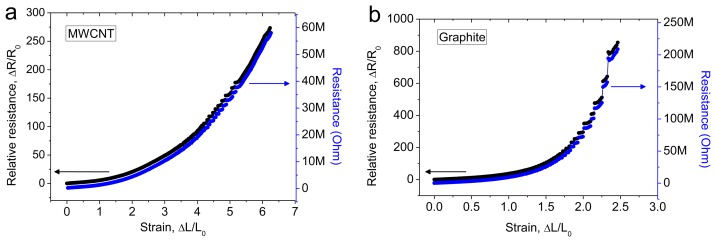
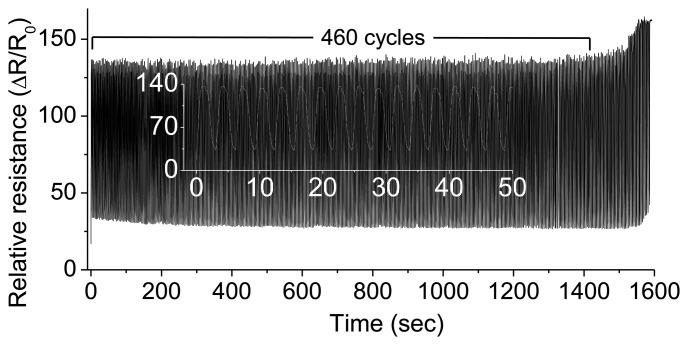
Conventional metallic strain sensors are flexible, but they can sustain maximum strains of only ~5%, so there is a need for sensors that can bear high strains for multifunctional applications. In this study, we report stretchable and flexible high-strain sensors that consist of entangled and randomly distributed multiwall carbon nanotubes or graphite flakes on a natural rubber substrate. Carbon nanotubes/graphite flakes were sandwiched in natural rubber to produce these high-strain sensors. Using field emission scanning electron microscopy, the morphology of the films for both the carbon nanotube and graphite sensors were assessed under different strain conditions (0% and 400% strain). As the strain was increased, the films fractured, resulting in an increase in the electrical resistance of the sensor; this change was reversible. Strains of up to 246% (graphite sensor) and 620% (carbon nanotube sensor) were measured; these values are respectively ~50 and ~120 times greater than those of conventional metallic strain sensors.
传统的金属应变传感器具有柔韧性,但它们只能承受最大约5%的应变,因此需要能够承受高应变的传感器以用于多功能应用。在本研究中,我们报告了一种可拉伸且灵活的高应变传感器,该传感器由天然橡胶基底上缠结且随机分布的多壁碳纳米管或石墨薄片组成。碳纳米管/石墨薄片夹在天然橡胶中以制造这些高应变传感器。使用场发射扫描电子显微镜,在不同应变条件(0%和400%应变)下评估了碳纳米管和石墨传感器薄膜的形态。随着应变增加,薄膜破裂,导致传感器电阻增加;这种变化是可逆的。测量到的应变高达246%(石墨传感器)和620%(碳纳米管传感器);这些值分别比传统金属应变传感器的值大50倍和120倍。