Department of Psychology, University of Iowa, Iowa City IA, USA.
Front Psychol. 2013 Dec 24;4:967. doi: 10.3389/fpsyg.2013.00967. eCollection 2013.
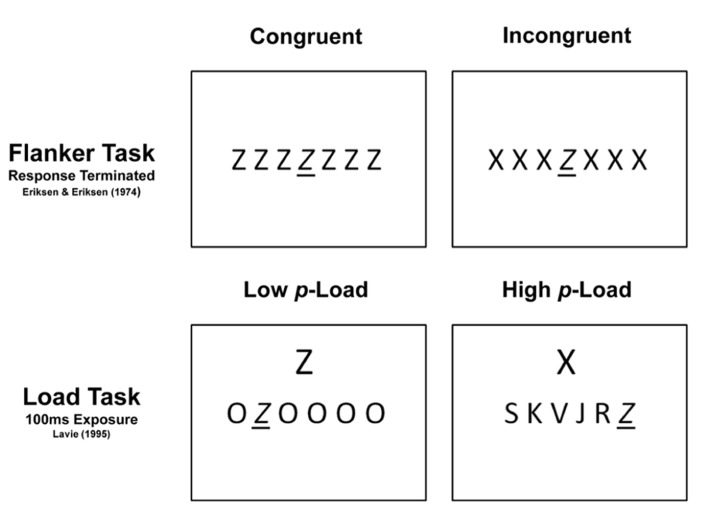
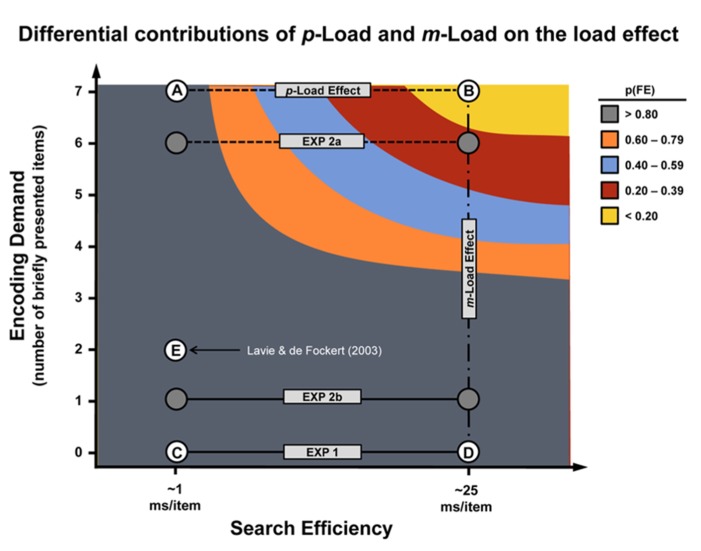
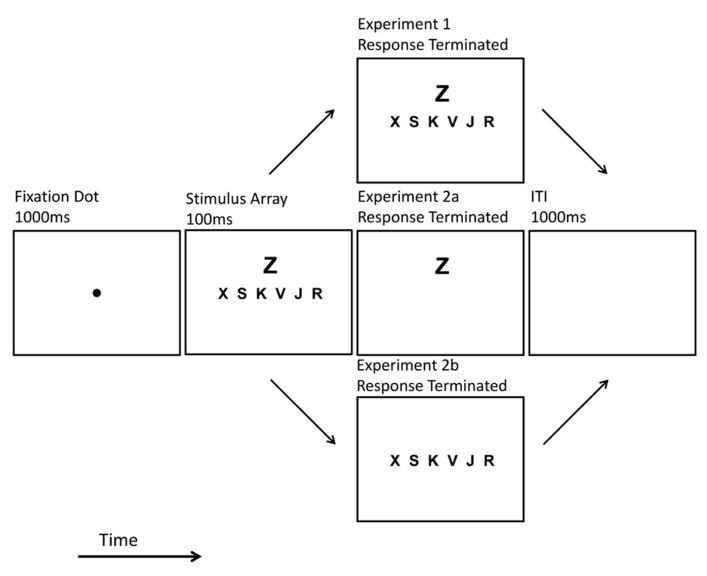
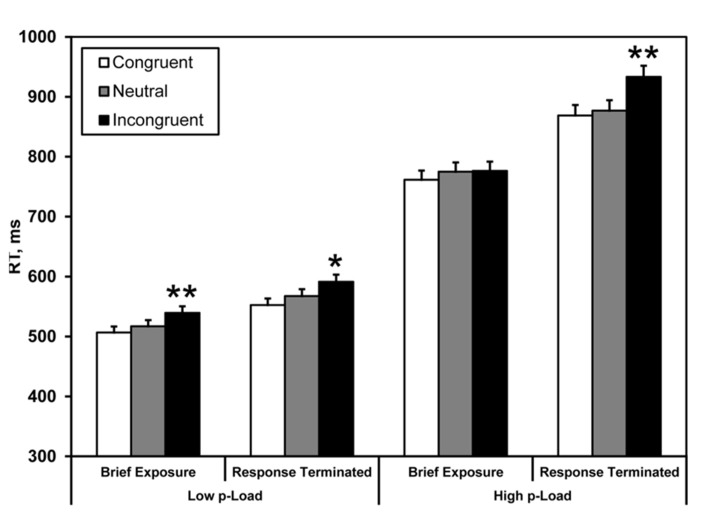
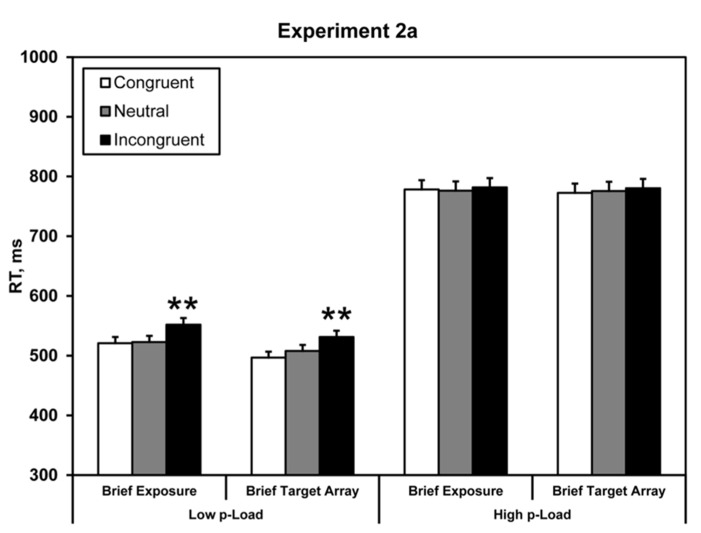
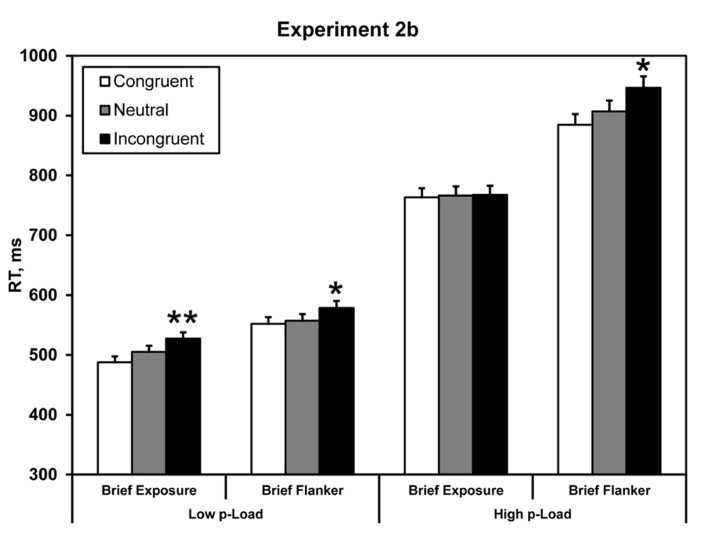
Perceptual load theory successfully replaced the early vs. late selection debate by appealing to adaptive control over the efficiency of selective attention. Early selection is observed unless perceptual load (p-Load) is sufficiently low to grant attentional "spill-over" to task-irrelevant stimuli. Many studies exploring load theory have used limited display durations that perhaps impose artificial limits on encoding processes. We extended the exposure duration in a classic p-Load task to alleviate temporal encoding demands that may otherwise tax mnemonic consolidation processes. If the load effect arises from perceptual demands alone, then freeing-up available mnemonic resources by extending the exposure duration should have little effect. The results of Experiment 1 falsify this prediction. We observed a reliable flanker effect under high p-Load, response-terminated displays. Next, we orthogonally manipulated exposure duration and task-relevance. Counter-intuitively, we found that the likelihood of observing the flanker effect under high p-Load resides with the duration of the task-relevant array, not the flanker itself. We propose that stimulus and encoding demands interact to produce the load effect. Our account clarifies how task parameters differentially impinge upon cognitive processes to produce attentional "spill-over" by appealing to visual short-term memory as an additional processing bottleneck when stimuli are briefly presented.
知觉负载理论通过呼吁对选择性注意的效率进行适应性控制,成功取代了早期选择与晚期选择的争论。除非知觉负载(p-Load)足够低,从而允许注意力“溢出”到与任务无关的刺激上,否则会观察到早期选择。许多探索负载理论的研究使用了有限的显示持续时间,这可能对编码过程施加了人为的限制。我们在经典的 p-Load 任务中延长了暴露持续时间,以减轻可能会影响记忆巩固过程的时间编码需求。如果负载效应仅源于知觉需求,那么通过延长暴露持续时间来释放可用的记忆资源应该没有什么影响。实验 1 的结果否定了这一预测。我们在高 p-Load、反应终止显示下观察到了可靠的侧翼效应。接下来,我们正交地操纵了暴露持续时间和任务相关性。出人意料的是,我们发现,在高 p-Load 下观察到侧翼效应的可能性取决于任务相关数组的持续时间,而不是侧翼本身。我们提出,刺激和编码需求的相互作用产生了负载效应。我们的解释通过将视觉短期记忆作为另一个处理瓶颈,当刺激短暂呈现时,阐明了任务参数如何通过吸引注意力“溢出”来对认知过程产生不同的影响。