Pharmaceutical Health Services Research Department, School of Pharmacy, University of Maryland, Baltimore, Maryland.
Cancer Med. 2013 Dec;2(6):907-15. doi: 10.1002/cam4.143. Epub 2013 Oct 10.
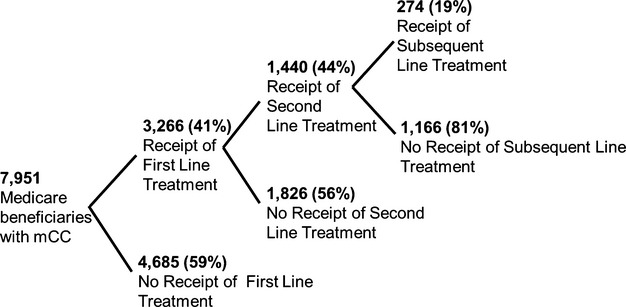
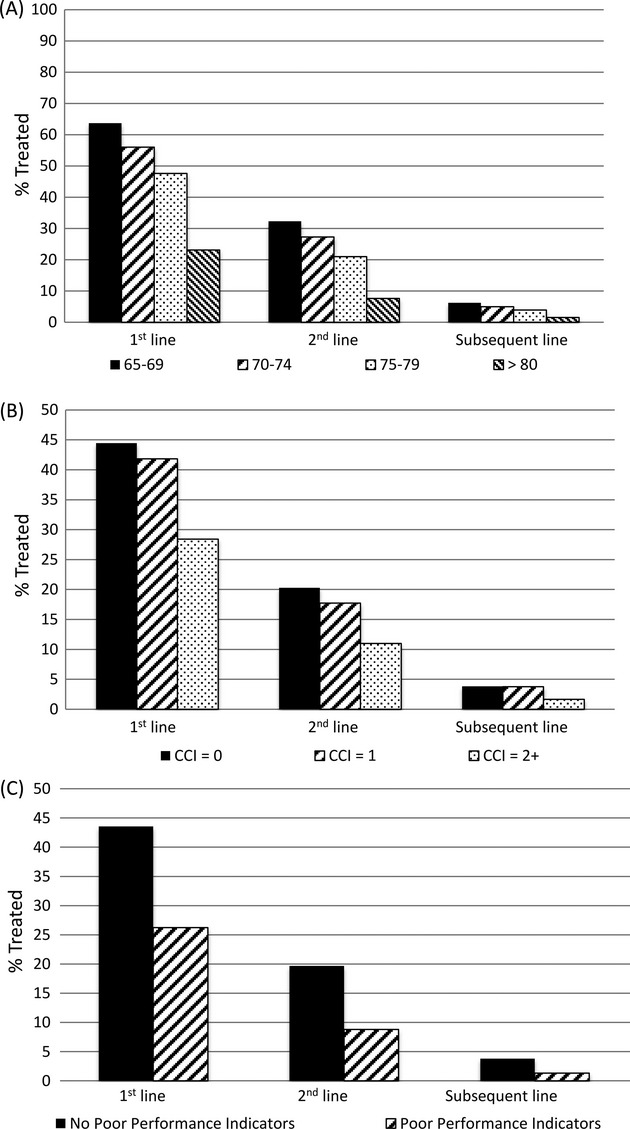
Among older individuals diagnosed with metastatic colon cancer (mCC) there is limited evidence available that describes the characteristics associated with advancing to second- and subsequent lines of treatment with chemotherapy/biologics. Our objective was to describe the trends and lines of treatment received among elderly mCC patients. Elderly beneficiaries diagnosed with mCC from 2003 to 2007 were identified in the Surveillance, Epidemiology and End Results (SEER)-Medicare dataset. Beneficiaries were followed up until death or censoring. Treatment lines were classified in combinations of chemotherapies and biologics. Modified Poisson regression was used to predict receipt of lines of treatment. Analyses controlled for age, race/ethnicity, gender, marital status, state buy-in during diagnosis year, SEER-registry site, Charlson comorbidity index (CCI), poor performance indicators, surgery of primary site, and surgery of regional/distal sites. Among 7951 Medicare beneficiaries identified with mCC, 3266 initiated therapy. Of these, 1440 advanced to second-line treatment. Of these, 274 advanced to a subsequent-line treatment. Surgeries of the primary tumor site and of the regional/distal sites and marital status were the most significant variables associated with advancing through second- and subsequent-line treatments. Greater than 80 years of age, African American race, SEER-registry area, less than 6 months state buy-in assistance in mCC diagnosis year, and having poor performance indicators were inversely associated with receipt of second- or subsequent-line treatments. Among elderly individuals diagnosed with mCC, we identified demographic, clinical, and regional factors associated with receipt of second- and subsequent-line chemotherapy/biologics. Additional research is warranted to understand the role of physician versus patient preferences as well as geographic differences explaining why patients advance through lines of chemotherapy.
在被诊断患有转移性结直肠癌 (mCC) 的老年人中,可用的证据有限,这些证据描述了与接受化疗/生物制剂的二线和后续治疗相关的特征。我们的目的是描述老年 mCC 患者的趋势和接受的治疗方法。在 Surveillance, Epidemiology and End Results (SEER)-Medicare 数据集中,确定了 2003 年至 2007 年间被诊断患有 mCC 的老年受益人的数据。受益人的随访时间截止到死亡或截止日期。治疗线被归类为化疗和生物制剂的组合。采用修正泊松回归预测治疗线的接受情况。分析控制了年龄、种族/民族、性别、婚姻状况、诊断年度的州参与、SEER 登记处地点、Charlson 合并症指数 (CCI)、较差的表现指标、原发部位的手术和区域性/远处部位的手术。在确定的 7951 名患有 mCC 的 Medicare 受益人中,有 3266 人开始接受治疗。其中,1440 人接受二线治疗。其中,274 人接受了后续治疗线。原发肿瘤部位和区域性/远处部位的手术以及婚姻状况是与二线和后续线治疗进展最相关的最重要变量。年龄大于 80 岁、非裔美国人、SEER 登记区、mCC 诊断年度的州参与援助不足 6 个月以及表现指标较差与二线或后续线治疗的接受呈负相关。在被诊断患有 mCC 的老年人中,我们确定了与接受二线和后续化疗/生物制剂治疗相关的人口统计学、临床和区域性因素。需要进一步的研究来了解医生与患者偏好以及解释为什么患者接受化疗线的地理差异的作用。