Department of Clinical Haematology, Alfred Hospital, Australian Centre for Blood Diseases, Monash University, Melbourne, Victoria, Australia.
Australian Centre for Blood Diseases, Biotechnology Division, Eastern Clinical Research Unit, Monash University, Melbourne, Victoria, Australia.
Blood Cancer J. 2014 Jan 10;4(1):e170. doi: 10.1038/bcj.2013.68.
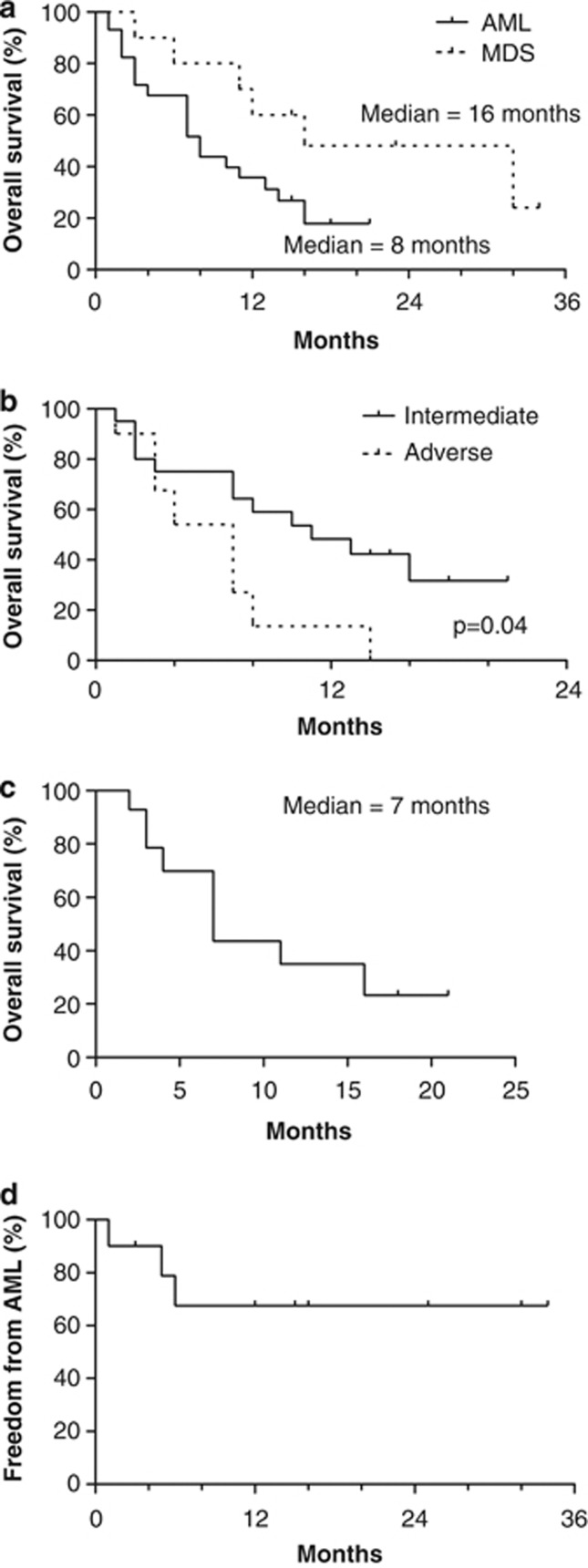
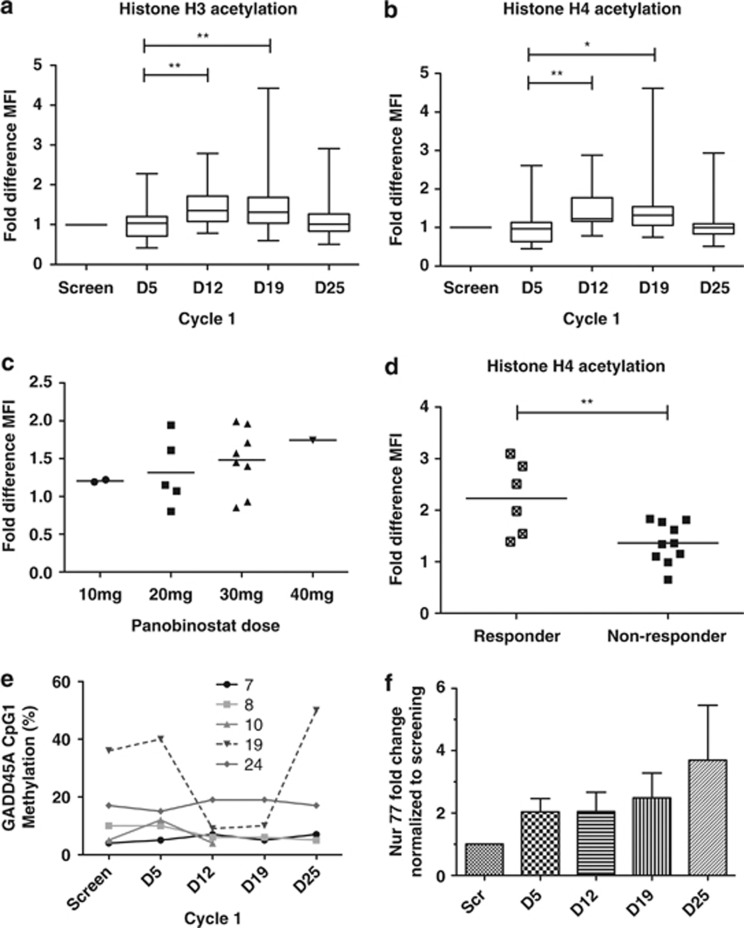
Therapeutic options are limited for elderly patients with acute myeloid leukemia (AML). A phase Ib/II study was undertaken to evaluate the maximum-tolerated dose (MTD) and preliminary efficacy of the pan-histone deacetylase inhibitor panobinostat (LBH589) in combination with azacitidine in patients with AML or high-risk myelodysplastic syndrome (MDS) naïve to intensive chemotherapy. Thirty-nine patients (AML=29, MDS=10) received azacitidine 75 mg/m(2) subcutaneously (days 1-5) and oral panobinostat (starting on day 5, thrice weekly for seven doses) in 28-day cycles until toxicity or disease progression. Dose-limiting toxicities during the phase Ib stage were observed in 0/4 patients receiving 10 mg panobinostat, in 1/7 patients (fatigue) receiving 20 mg, in 1/6 patients (fatigue) receiving 30 mg and in 4/5 patients (fatigue, syncope, hyponatremia and somnolence) receiving 40 mg. In phase II, an additional 17 patients received panobinostat at a MTD of 30 mg. The overall response rate (ORR=CR+CRi+PR) in patients with AML was 31% (9/29) and that in patients with MDS was 50% (5/10). After a median follow-up of 13 months, the median overall survival was 8 and 16 months in patients with AML and MDS, respectively. Increased histone H3 and H4 acetylation was a useful early biomarker of clinical response. Combining panobinostat with azacitidine was tolerable and clinically active in high-risk MDS/AML patients, warranting further exploration.
对于老年急性髓系白血病 (AML) 患者,治疗选择有限。进行了一项 Ib/II 期研究,以评估泛组蛋白去乙酰化酶抑制剂帕比司他 (LBH589) 与阿扎胞苷联合用于未经强化化疗的 AML 或高危骨髓增生异常综合征 (MDS) 患者的最大耐受剂量 (MTD) 和初步疗效。39 名患者(AML=29,MDS=10)接受阿扎胞苷 75mg/m² 皮下注射(第 1-5 天)和口服帕比司他(第 5 天开始,每周 3 次,共 7 剂),每 28 天为一个周期,直至出现毒性或疾病进展。Ib 期观察到 4 名接受 10mg 帕比司他、7 名接受 20mg(疲劳)、6 名接受 30mg(疲劳)和 5 名接受 40mg(疲劳、晕厥、低钠血症和昏睡)的患者出现剂量限制毒性。在 II 期,另外 17 名患者接受了 30mg 的 MTD 帕比司他。AML 患者的总体缓解率 (ORR=CR+CRi+PR) 为 31%(29/9),MDS 患者为 50%(10/5)。在中位随访 13 个月后,AML 和 MDS 患者的中位总生存期分别为 8 个月和 16 个月。组蛋白 H3 和 H4 乙酰化的增加是临床反应的有用早期生物标志物。帕比司他联合阿扎胞苷在高危 MDS/AML 患者中耐受良好且具有临床活性,值得进一步探索。