Abramson Family Cancer Research Institute, Perelman School of Medicine, University of Pennsylvania, Philadelphia, PA.
Cancer Immunol Res. 2014 Jan;2(1):19-26. doi: 10.1158/2326-6066.CIR-13-0152.
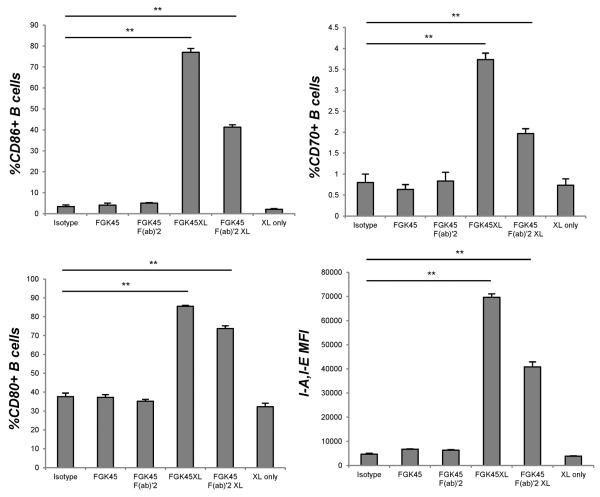
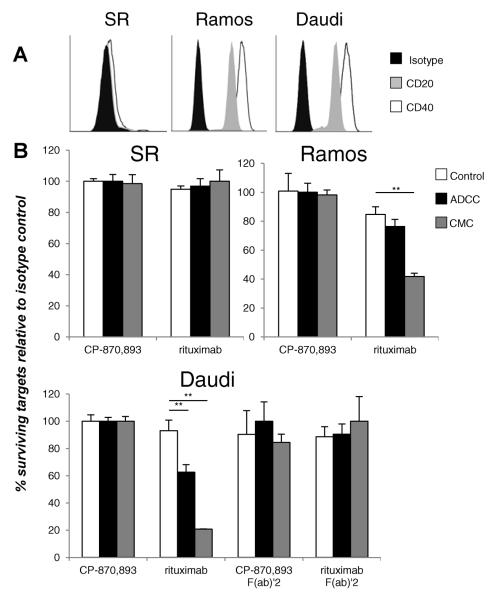
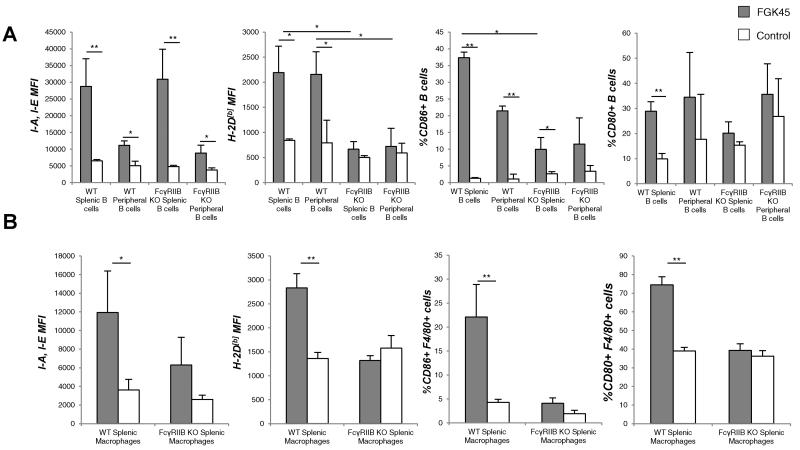
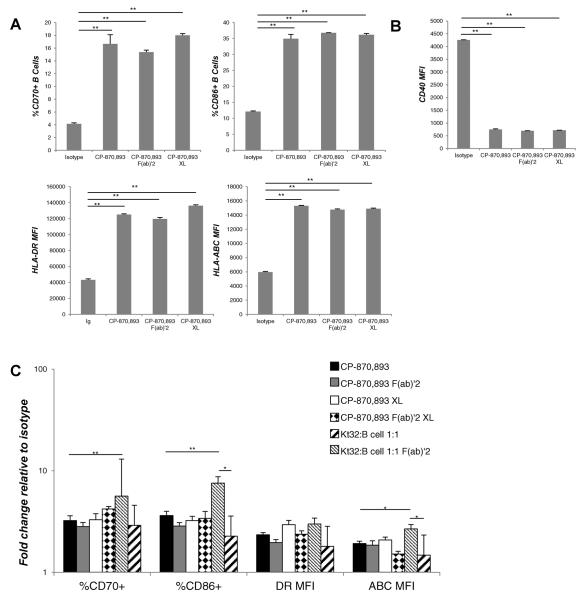
Agonists of the TNF superfamily of receptors hold promise as novel therapy for cancer. Recent data on agonistic anti-murine TNF receptors (TNFR) such as CD40 suggest that the specific engagement of Fc-receptor (FcR) is required for optimal antitumor effects, prompting calls to engineer anti-human CD40 and other TNFR mAb accordingly. CP-870,893 is a fully human anti-CD40 mAb, selected in part because it is an IgG2 which is presumed to have poor reactivity with FcR; however, CP-870,893 has been evaluated in multiple clinical trials with beneficial activity in patients with melanoma, pancreatic and other cancers. Here, we confirmed that the activity of anti-murine CD40 mAb was dependent on FcγRIIB engagement, was decreased significantly in FcγRIIB (-/-) mice, and upon Fc-crosslinking anti-mouse CD40 mAb enhanced the activation of antigen presenting cells. In contrast, the CP-870,893-mediated activation of human B cells was not enhanced with anti-IgG-crosslinking nor abrogated when used as an F(ab)'2 reagent. Crosslinking of CP-870,893 using the CD32-expressing K562 cells yielded an Fc-dependent modest increase in the expression of some activation markers relative to that of the soluble CP-870,893 mAb. Classic Fc-dependent functions such as antibody-dependent cellular cytotoxicity (ADCC) and complement-mediated cytotoxicity (CMC) were minimal for CP-870,893 as compared to the IgG1 anti-CD20 mAb rituximab, which mediated both ADCC and CMC in parallel assays. Anti-mouse CD40 mAb competed for the CD40 ligand binding site, but CP-870,893 did not. Thus, Fc-crosslinking is not an essential requirement for agonistic anti-human CD40 mAb, whose potency is more dependent on the CD40 epitope recognized and the strength of the signal achieved.
肿瘤坏死因子(TNF)超家族受体激动剂有望成为癌症的新型治疗方法。最近关于激动型抗鼠 TNF 受体(TNFR)如 CD40 的数据表明,为了获得最佳的抗肿瘤效果,需要特异性地结合 Fc 受体(FcR),这促使人们相应地设计抗人 CD40 和其他 TNFR mAb。CP-870,893 是一种完全人源化抗 CD40 mAb,部分原因是它是 IgG2,据推测与 FcR 的反应性较差;然而,CP-870,893 已在多个临床试验中进行了评估,在黑色素瘤、胰腺癌和其他癌症患者中具有有益的活性。在这里,我们证实抗鼠 CD40 mAb 的活性依赖于 FcγRIIB 的结合,在 FcγRIIB(-/-)小鼠中显著降低,并且通过 Fc 交联抗鼠 CD40 mAb 增强了抗原呈递细胞的激活。相比之下,CP-870,893 介导的人 B 细胞的激活不能通过抗 IgG 交联增强,也不能在用作 F(ab')2 试剂时被阻断。使用表达 CD32 的 K562 细胞交联 CP-870,893 导致与可溶性 CP-870,893 mAb 相比,一些激活标志物的表达适度增加,这依赖于 Fc。与 IgG1 抗 CD20 mAb 利妥昔单抗相比,CP-870,893 的经典 Fc 依赖性功能(如抗体依赖性细胞毒性(ADCC)和补体依赖性细胞毒性(CMC))最小,利妥昔单抗在平行测定中同时介导 ADCC 和 CMC。抗鼠 CD40 mAb 竞争 CD40 配体结合位点,但 CP-870,893 不竞争。因此,Fc 交联不是激动型抗人 CD40 mAb 的必要条件,其效力更依赖于所识别的 CD40 表位和所达到的信号强度。