
玉米伸长节间细胞壁组成和转录谱的空间梯度。
Spatial gradients in cell wall composition and transcriptional profiles along elongating maize internodes.
机构信息
Australian Research Council Centre of Excellence in Plant Cell Walls, School of Agriculture, Food and Wine, University of Adelaide, 5064 Adelaide, South Australia, Australia.
出版信息
BMC Plant Biol. 2014 Jan 14;14:27. doi: 10.1186/1471-2229-14-27.
BACKGROUND
The elongating maize internode represents a useful system for following development of cell walls in vegetative cells in the Poaceae family. Elongating internodes can be divided into four developmental zones, namely the basal intercalary meristem, above which are found the elongation, transition and maturation zones. Cells in the basal meristem and elongation zones contain mainly primary walls, while secondary cell wall deposition accelerates in the transition zone and predominates in the maturation zone.
RESULTS
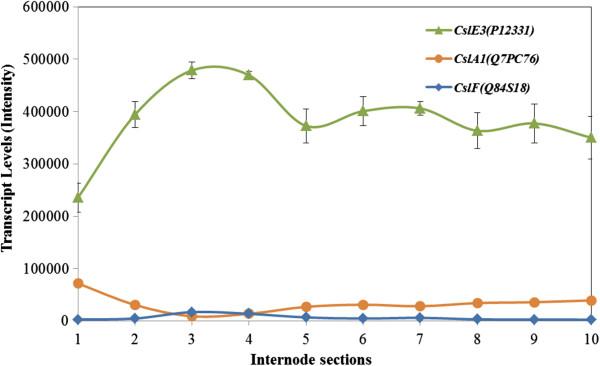
The major wall components cellulose, lignin and glucuronoarabinoxylan (GAX) increased without any abrupt changes across the elongation, transition and maturation zones, although GAX appeared to increase more between the elongation and transition zones. Microarray analyses show that transcript abundance of key glycosyl transferase genes known to be involved in wall synthesis or re-modelling did not match the increases in cellulose, GAX and lignin. Rather, transcript levels of many of these genes were low in the meristematic and elongation zones, quickly increased to maximal levels in the transition zone and lower sections of the maturation zone, and generally decreased in the upper maturation zone sections. Genes with transcript profiles showing this pattern included secondary cell wall CesA genes, GT43 genes, some β-expansins, UDP-Xylose synthase and UDP-Glucose pyrophosphorylase, some xyloglucan endotransglycosylases/hydrolases, genes involved in monolignol biosynthesis, and NAM and MYB transcription factor genes.
CONCLUSIONS
The data indicated that the enzymic products of genes involved in cell wall synthesis and modification remain active right along the maturation zone of elongating maize internodes, despite the fact that corresponding transcript levels peak earlier, near or in the transition zone.
背景
伸长的玉米节间代表了一个有用的系统,可用于研究禾本科植物营养细胞细胞壁的发育。伸长的节间可以分为四个发育区,即基部居间分生组织,其上方是伸长区、过渡区和成熟区。基部分生组织和伸长区的细胞主要含有初生壁,而次生细胞壁的沉积在过渡区加速,并在成熟区占主导地位。
结果
主要细胞壁成分纤维素、木质素和半乳阿拉伯木聚糖(GAX)在伸长、过渡和成熟区没有任何明显的变化增加,尽管 GAX 似乎在伸长和过渡区之间增加更多。微阵列分析表明,参与细胞壁合成或重塑的关键糖基转移酶基因的转录丰度与纤维素、GAX 和木质素的增加不匹配。相反,这些基因中的许多基因在分生组织和伸长区的转录水平较低,在过渡区和成熟区的下部迅速增加到最大值,而在成熟区的上部则普遍降低。具有这种模式转录谱的基因包括次生细胞壁 CesA 基因、GT43 基因、一些β-扩张蛋白、UDP-木糖合酶和 UDP-葡萄糖焦磷酸化酶、一些木葡聚糖内转糖基酶/水解酶、参与单酚生物合成的基因以及 NAM 和 MYB 转录因子基因。
结论
数据表明,尽管相应的转录水平在过渡区附近或在过渡区达到峰值,但参与细胞壁合成和修饰的基因的酶产物在伸长玉米节间的成熟区一直保持活跃。




 Zotero 插件