Guillaumie Sabine, Goffner Deborah, Barbier Odile, Martinant Jean-Pierre, Pichon Magalie, Barrière Yves
INRA, Unité de Génétique et d'Amélioration des Plantes Fourragères, BP6, F-86600 Lusignan, France.
BMC Plant Biol. 2008 Jun 26;8:71. doi: 10.1186/1471-2229-8-71.
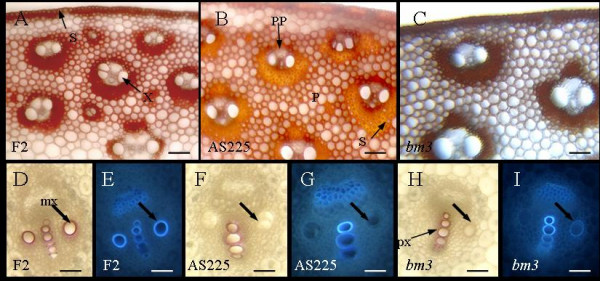
Silage maize is a major forage and energy resource for cattle feeding, and several studies have shown that lignin content and structure are the determining factors in forage maize feeding value. In maize, four natural brown-midrib mutants have modified lignin content, lignin structure and cell wall digestibility. The greatest lignin reduction and the highest cell wall digestibility were observed in the brown-midrib-3 (bm3) mutant, which is disrupted in the caffeic acid O-methyltransferase (COMT) gene.
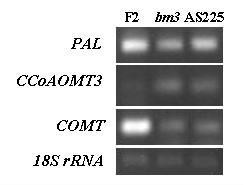
Expression of cell wall related genes was investigated in basal and ear internodes of normal, COMT antisens (AS225), and bm3 maize plants of the INRA F2 line. A cell wall macro-array was developed with 651 gene specific tags of genes specifically involved in cell wall biogenesis. When comparing basal (older lignifying) and ear (younger lignifying) internodes of the normal line, all genes known to be involved in constitutive monolignol biosynthesis had a higher expression in younger ear internodes. The expression of the COMT gene was heavily reduced, especially in the younger lignifying tissues of the ear internode. Despite the fact that AS225 transgene expression was driven only in sclerenchyma tissues, COMT expression was also heavily reduced in AS225 ear and basal internodes. COMT disruption or down-regulation led to differential expressions of a few lignin pathway genes, which were all over-expressed, except for a phenylalanine ammonia-lyase gene. More unexpectedly, several transcription factor genes, cell signaling genes, transport and detoxification genes, genes involved in cell wall carbohydrate metabolism and genes encoding cell wall proteins, were differentially expressed, and mostly over-expressed, in COMT-deficient plants.
Differential gene expressions in COMT-deficient plants highlighted a probable disturbance in cell wall assembly. In addition, the gene expressions suggested modified chronology of the different events leading to cell expansion and lignification with consequences far beyond the phenylpropanoid metabolism. The reduced availability of monolignols and S units in bm3 or AS225 plants led to plants also differing in cell wall carbohydrate, and probably protein, composition. Thus, the deficiency in a key-enzyme of the lignin pathway had correlative effects on the whole cell wall metabolism. Furthermore, the observed differential expression between bm3 and normal plants indicated the possible involvement in the maize lignin pathway of genes which up until now have not been considered to play this role.
青贮玉米是牛饲料的主要草料和能量来源,多项研究表明木质素含量和结构是青贮玉米饲用价值的决定因素。在玉米中,四个天然棕色中脉突变体改变了木质素含量、木质素结构和细胞壁消化率。在棕色中脉-3(bm3)突变体中观察到最大程度的木质素减少和最高的细胞壁消化率,该突变体的咖啡酸O-甲基转移酶(COMT)基因发生了破坏。
对法国国家农业研究院(INRA)F2品系的正常、COMT反义(AS225)和bm3玉米植株的基部节间和穗节间中细胞壁相关基因的表达进行了研究。利用651个与细胞壁生物合成特异性相关基因的基因特异性标签构建了一个细胞壁宏阵列。比较正常品系的基部(正在木质化的较老节间)和穗部(正在木质化的较年轻节间)节间时,所有已知参与组成型木质醇生物合成的基因在较年轻的穗部节间中表达较高。COMT基因的表达大幅降低,尤其是在穗部节间正在木质化的较年轻组织中。尽管AS225转基因仅在厚壁组织中表达,但在AS225的穗部和基部节间中COMT表达也大幅降低。COMT的破坏或下调导致一些木质素途径基因的差异表达,除了一个苯丙氨酸解氨酶基因外,其他基因均过度表达。更出乎意料的是,一些转录因子基因、细胞信号基因、转运和解毒基因、参与细胞壁碳水化合物代谢的基因以及编码细胞壁蛋白的基因在COMT缺陷型植株中差异表达,且大多过度表达。
COMT缺陷型植株中的差异基因表达突出了细胞壁组装可能受到的干扰。此外,基因表达表明导致细胞扩张和木质化的不同事件的时间顺序发生了改变,其影响远远超出了苯丙烷代谢。bm3或AS225植株中木质醇和S单元的可用性降低导致植株在细胞壁碳水化合物以及可能的蛋白质组成上也存在差异。因此,木质素途径关键酶的缺陷对整个细胞壁代谢产生了相关影响。此外,在bm3和正常植株之间观察到的差异表达表明,一些迄今为止未被认为在玉米木质素途径中起作用的基因可能参与其中。