Virus Reference Department, Public Health England, London, UK.
Virus Reference Department, Public Health England, London, UK.
Vaccine. 2014 Feb 26;32(10):1139-46. doi: 10.1016/j.vaccine.2014.01.008. Epub 2014 Jan 15.
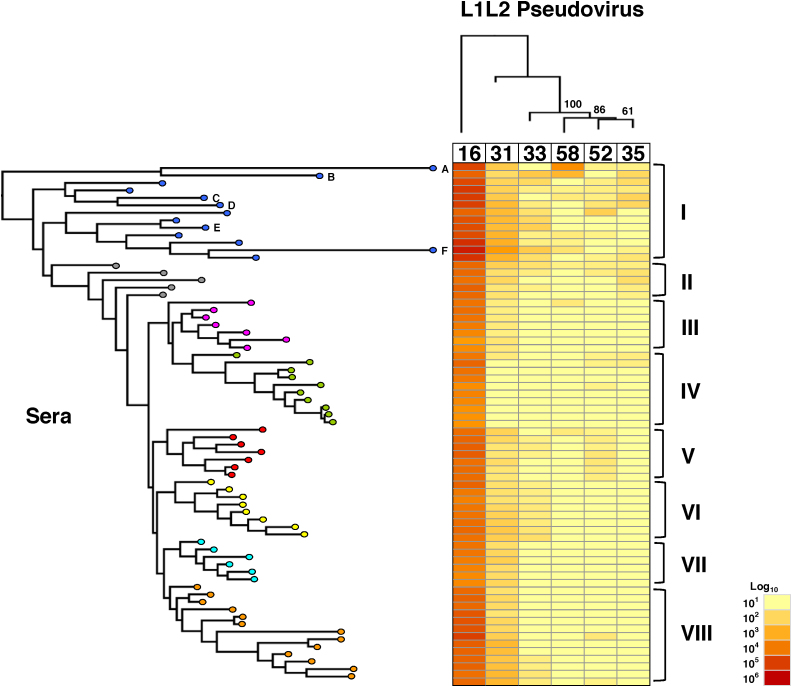
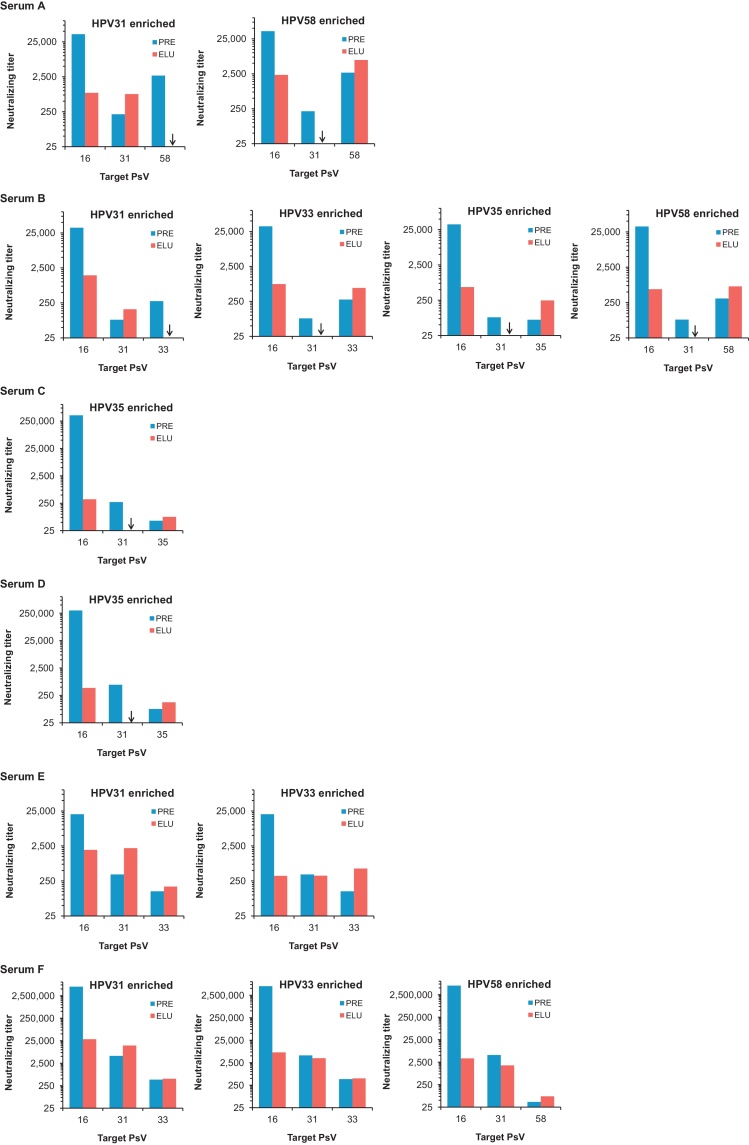
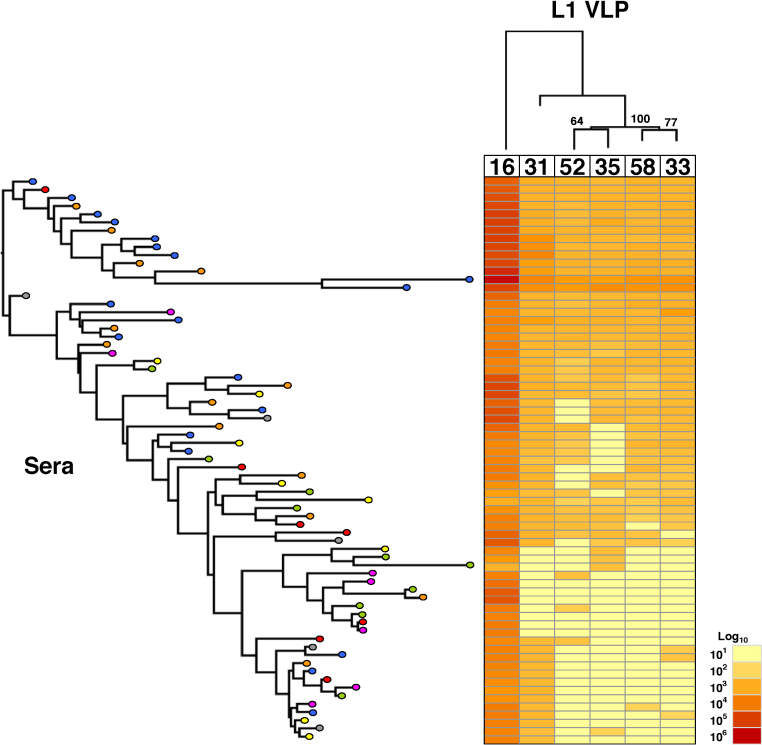
The highly efficacious human papillomavirus (HPV) vaccines contain virus-like particles (VLP) representing genotypes HPV16 and HPV18, which together account for approximately 70% of cervical cancer cases. Vaccine-type protection is thought to be mediated by high titer, type-specific neutralizing antibodies. The vaccines also confer a degree of cross-protection against some genetically-related types from the Alpha-9 (HPV16-like: HPV31, HPV33, HPV35, HPV52, HPV58) and Alpha-7 (HPV18-like: HPV39, HPV45, HPV59, HPV68) species groups. Cross-protection is coincident with the detection of low titer serum responses against non-vaccine types by vaccinees. Such antibodies may be the effectors of cross-protection or their detection may be useful as a correlate or surrogate. This study evaluated whether cross-neutralization of HPV types from the Alpha-9 species group is mediated by antibodies with a predominantly type-restricted specificity for HPV16 that nevertheless exhibit low affinity interactions with non-vaccine types, or by antibody specificities that demonstrate similar recognition of vaccine and non-vaccine types but are present at very low levels. Antibodies generated following Cervarix® vaccination of 13-14 year old girls were evaluated by pseudovirus neutralization, VLP ELISA and by enrichment of target antigen specificity using VLP-immobilized beads. Two-dimensional hierarchical clustering of serology data demonstrated that the antibody specificity profile generated by VLP ELISA was both quantitatively and qualitatively different from the neutralizing antibody specificity profile. Target-specific antibody enrichment demonstrated that cross-neutralization of non-vaccine types was due to a minority of antibodies rather than by the weak interactions of a predominantly type-restricted HPV16 antibody specificity. Furthermore, cross-neutralization of non-vaccine types appeared to be mediated by multiple antibody specificities, recognizing single and multiple non-vaccine types, and whose specificities were not predictable from examination of the serum neutralizing antibody profile. These data contribute to our understanding of the antibody specificities elicited following HPV vaccination and have potential implications for vaccine-induced cross-protection.
高度有效的人乳头瘤病毒 (HPV) 疫苗包含代表 HPV16 和 HPV18 基因型的病毒样颗粒 (VLP),这两种基因型约占宫颈癌病例的 70%。疫苗型保护被认为是由高滴度、型特异性中和抗体介导的。疫苗还对来自 Alpha-9(HPV16 样型:HPV31、HPV33、HPV35、HPV52、HPV58)和 Alpha-7(HPV18 样型:HPV39、HPV45、HPV59、HPV68)种组的一些遗传相关类型提供一定程度的交叉保护。在接种疫苗的人群中检测到针对非疫苗类型的低滴度血清反应时,就会出现交叉保护。这些抗体可能是交叉保护的效应物,或者它们的检测可能作为相关性或替代物有用。本研究评估了 Alpha-9 种组的 HPV 型的交叉中和是否由针对 HPV16 的主要型特异性抗体介导,这些抗体尽管与非疫苗类型具有低亲和力相互作用,但具有类似的疫苗和非疫苗类型的识别特异性,但存在非常低的水平。通过对 13-14 岁女孩进行 Cervarix® 疫苗接种产生的抗体通过假病毒中和、VLP ELISA 以及使用 VLP 固定珠富集目标抗原特异性进行评估。血清学数据的二维层次聚类表明,VLP ELISA 产生的抗体特异性谱在数量和质量上均与中和抗体特异性谱不同。针对特定目标的抗体富集表明,非疫苗类型的交叉中和是由少数抗体引起的,而不是由主要型特异性 HPV16 抗体特异性的弱相互作用引起的。此外,非疫苗类型的交叉中和似乎是由多种抗体特异性介导的,这些特异性识别单个和多个非疫苗类型,并且其特异性不能从血清中和抗体谱的检查中预测。这些数据有助于我们了解 HPV 疫苗接种后引起的抗体特异性,并对疫苗诱导的交叉保护具有潜在影响。