Metcalf R L, Fry D J, Swindell R, McGurk A, Clamp A R, Jayson G C, Hasan J
Department of Medical Oncology, The Christie NHS Foundation Trust, Wilmslow Road, Manchester M20 4BX, UK.
Br J Cancer. 2014 Mar 4;110(5):1118-24. doi: 10.1038/bjc.2014.3. Epub 2014 Jan 21.
Thrombotic events are common in cancer patients and have been associated with an adverse prognosis in large registry-based studies.
A retrospective cohort of 417 patients with ovarian cancer treated at a tertiary cancer centre between 2006 and 2009 was studied to identify the incidence and risk factors for thrombotic events and the prognostic impact of thrombosis. Patient outcomes were evaluated against a matched control group without thrombosis.
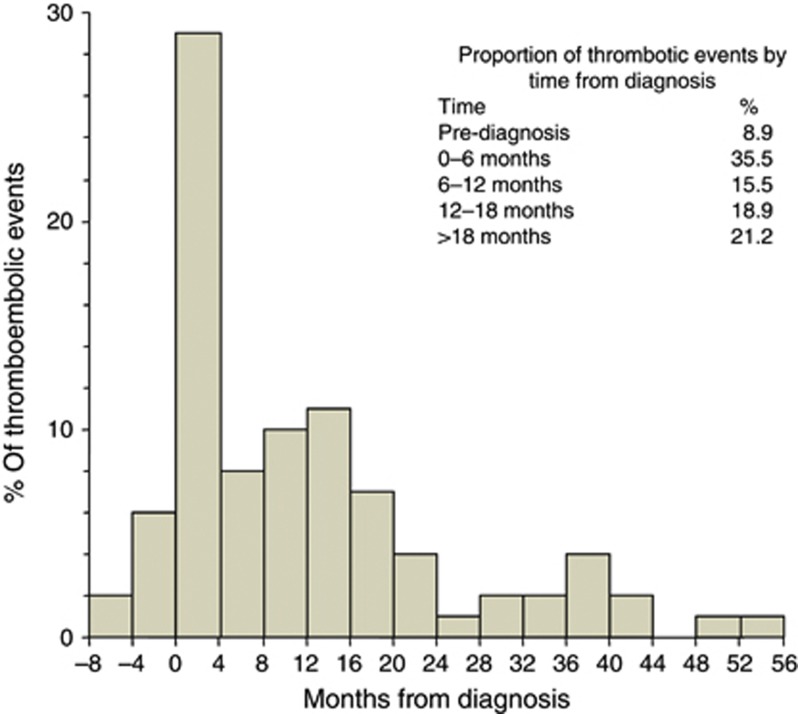
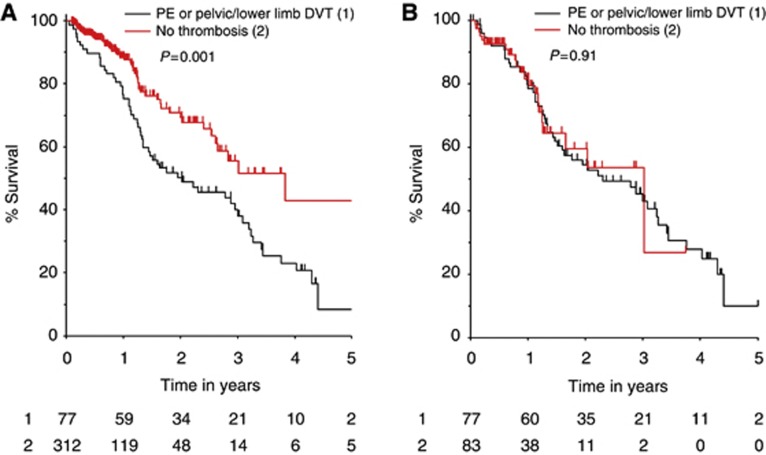
Ninety-nine thrombotic events occurred in 90 patients (21.6%) from 8 months before diagnosis to 56 months following diagnosis, peaking in the 4 months following diagnosis. Patients with thrombosis were older (mean 65 vs 61 years, P=0.007), had a worse performance status (PS ≥2: 29.9% vs 9.5%, P<0.0001) and had a more advanced FIGO stage (FIGO III/IV 75.6% vs 56.9%, P<0.0001) than patients without thrombosis. Shorter overall survival was seen in patients with pulmonary embolism and pelvic/lower limb deep vein thrombosis than without thrombosis (P=0.001). When the control group was matched for stage and PS, no survival difference was seen (P=0.91).
Ovarian cancer patients with thrombotic events had a shorter survival. However, when matched for prognostic factors (PS and FIGO stage), thrombosis did not impact upon prognosis.
血栓形成事件在癌症患者中很常见,在基于大型登记处的研究中已发现其与不良预后相关。
对2006年至2009年在一家三级癌症中心接受治疗的417例卵巢癌患者进行回顾性队列研究,以确定血栓形成事件的发生率和危险因素以及血栓形成的预后影响。将患者的结局与无血栓形成的匹配对照组进行评估。
从诊断前8个月至诊断后56个月,90例患者(21.6%)发生了99次血栓形成事件,在诊断后4个月达到高峰。与无血栓形成的患者相比,有血栓形成的患者年龄更大(平均65岁对61岁,P=0.007),体能状态更差(PS≥2:29.9%对9.5%,P<0.0001),国际妇产科联盟(FIGO)分期更晚(FIGO III/IV期:75.6%对56.9%,P<0.0001)。有肺栓塞和盆腔/下肢深静脉血栓形成的患者总生存期比无血栓形成的患者短(P=0.001)。当对照组按分期和PS进行匹配时,未观察到生存差异(P=0.91)。
发生血栓形成事件的卵巢癌患者生存期较短。然而,在按预后因素(PS和FIGO分期)进行匹配后,血栓形成并不影响预后。