Gurel Michelle H, Bruening Paul R, Rhodes Christine, Lomax Kathleen G
Neuroendocrine Clinical Center, Massachusetts General Hospital, Boston, MA, USA.
Nicholas Research Associates International, New York, NY, USA.
Patient Prefer Adherence. 2014 Jan 9;8:53-62. doi: 10.2147/PPA.S56740.
Acromegaly is a chronic condition resulting from a growth hormone-secreting pituitary tumor that can substantially impact patients' physical and emotional well-being. We sought to understand the impact of acromegaly on disease-related concerns and treatment choices from the patient perspective. The path to diagnosis, current disease management, interactions with the treating health care providers (HCPs), and support networks were also assessed.
Acromegaly patients were recruited primarily from a patient support group (Acromegaly Community). In Phase I, ten patients participated over the course of 5 days in a moderated online discussion board and they answered questions about their disease. In Phase II, a separate nine-patient cohort participated in face-to-face interviews conducted during an acromegaly patient conference. Data were summarized qualitatively by grouping similar answers and quotations.
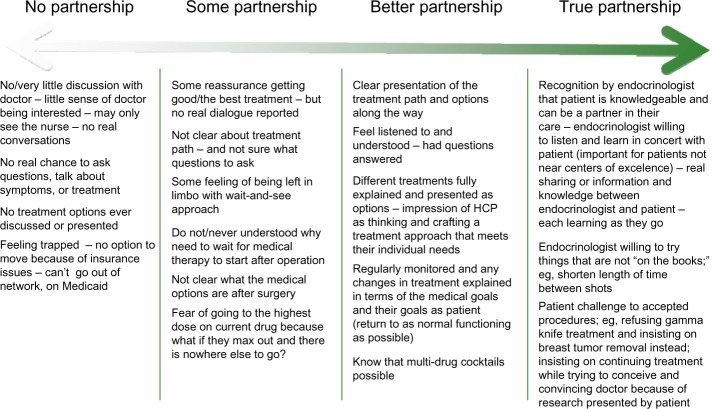
Nineteen acromegaly patients were recruited across the two cohorts, and both groups shared similar concerns. They demonstrated a notable interest in understanding their disease and its treatment. Patients were focused on the impact of the disease on their life, and they expressed a desire to get beyond reminders of their disease. The patients described long journeys to a correct diagnosis and relief at having a name for their condition. Many shared a sense of shock at needing pituitary surgery and felt unsatisfied by the treatment decision process, motivating them to discuss it with other patients. Patients not connected to a patient support group reported feeling helpless and lonely. Most patients shared a desire to improve their general knowledge about acromegaly to spare others their protracted diagnostic period. Patients also reported hesitancy in asking questions or sharing details about the disease's impact on their lives with their HCPs.
Acromegaly can be a life-changing diagnosis with profound, ongoing effects on patients' lives. Patients struggle with many issues they fail to openly share with their HCPs, but may discuss these issues more easily with other acromegaly patients. Better collaboration between patients and care providers could lead to increased patient satisfaction.
肢端肥大症是一种由分泌生长激素的垂体肿瘤引起的慢性疾病,会对患者的身心健康产生重大影响。我们试图从患者角度了解肢端肥大症对疾病相关问题及治疗选择的影响。同时还评估了诊断途径、当前疾病管理、与治疗医护人员(HCPs)的互动以及支持网络。
肢端肥大症患者主要从一个患者支持小组(肢端肥大症社区)招募。在第一阶段,10名患者在5天时间里参与了一个有主持人的在线讨论板,并回答了有关其疾病的问题。在第二阶段,另一组9名患者队列参加了在肢端肥大症患者会议期间进行的面对面访谈。通过对相似答案和引述进行分组,对数据进行定性总结。
两个队列共招募了19名肢端肥大症患者,两组有相似的担忧。他们对了解自己的疾病及其治疗表现出显著兴趣。患者关注疾病对其生活的影响,并表示希望摆脱疾病的困扰。患者描述了漫长的确诊过程,确诊后感到宽慰。许多人对需要垂体手术感到震惊,对治疗决策过程不满意,促使他们与其他患者讨论。未加入患者支持小组的患者表示感到无助和孤独。大多数患者希望提高对肢端肥大症的一般认识,以免他人经历漫长的诊断期。患者还表示在向其HCPs询问问题或分享疾病对其生活影响的细节时犹豫不决。
肢端肥大症的诊断可能改变生活,对患者生活产生深远且持续的影响。患者在许多问题上难以与HCPs公开分享,但可能更容易与其他肢端肥大症患者讨论这些问题。患者与护理人员之间更好的合作可能会提高患者满意度。