UCD School of Biomolecular and Biomedical Science, Conway Institute, University College Dublin, Belfield, Dublin, Ireland.
INRA UMR1319 Micalis, AgroParisTech, Jouy-en-Josas, France ; CNRS, Micalis, Jouy-en-Josas, France.
PLoS Genet. 2014 Jan;10(1):e1004076. doi: 10.1371/journal.pgen.1004076. Epub 2014 Jan 16.
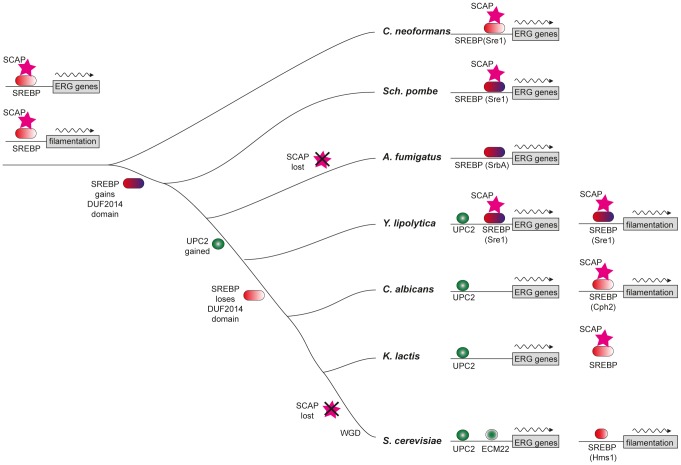
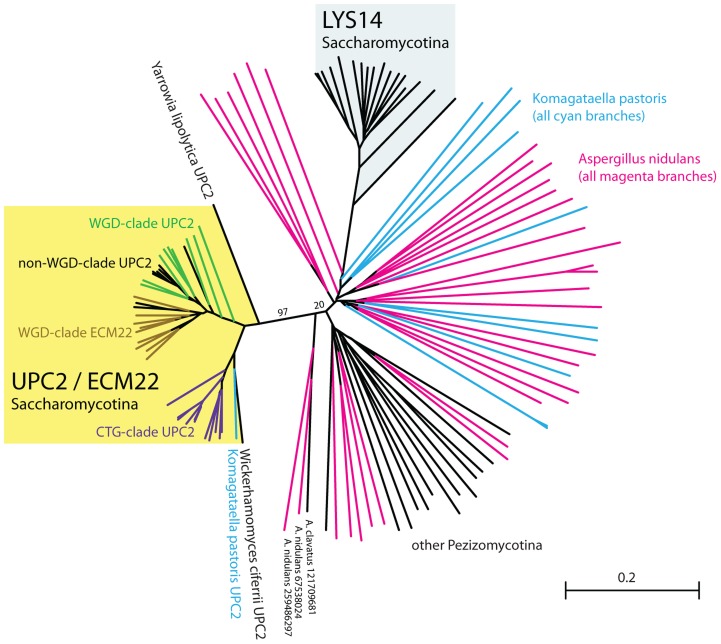
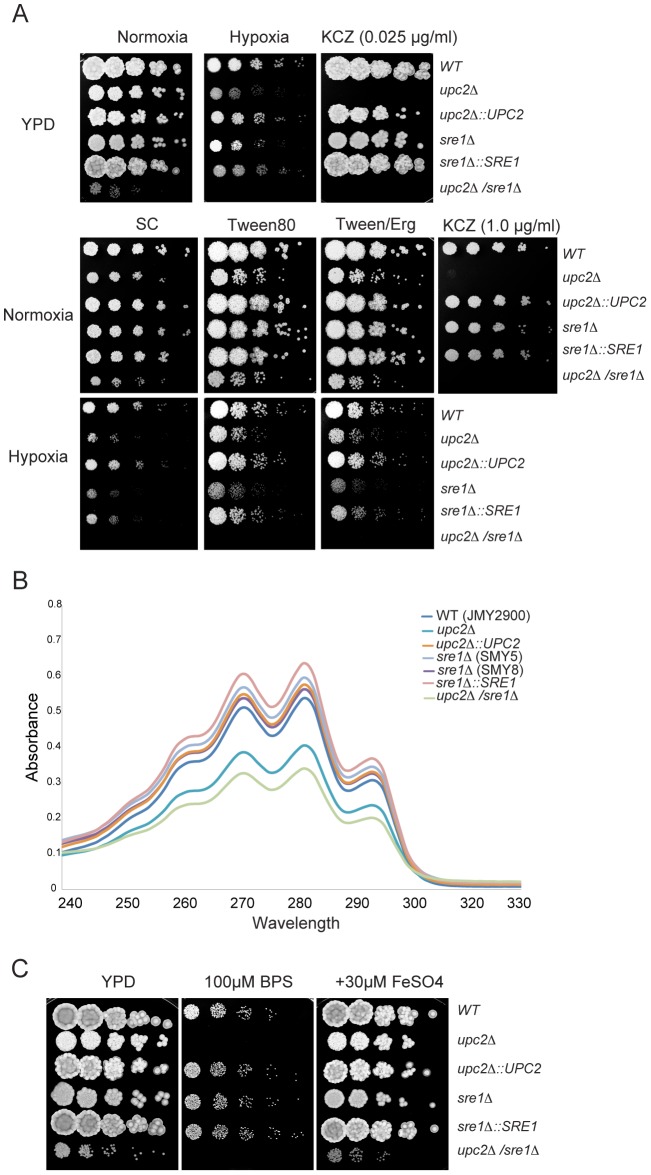
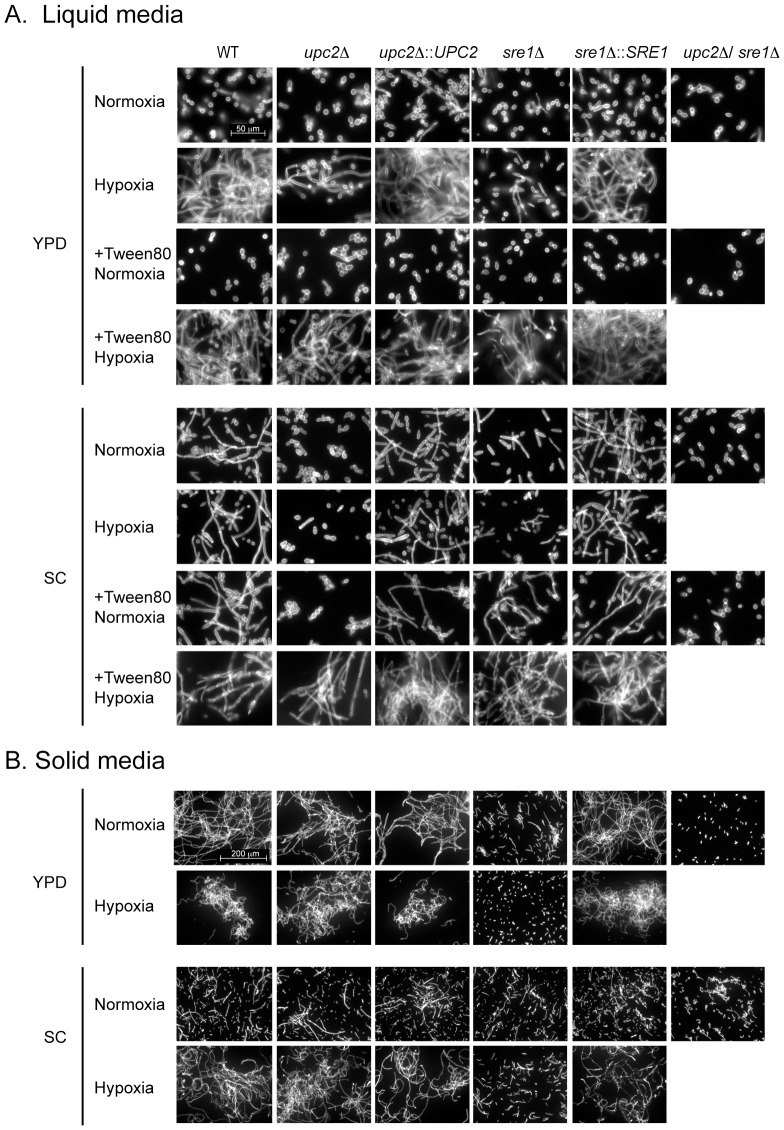
In most eukaryotes, including the majority of fungi, expression of sterol biosynthesis genes is regulated by Sterol-Regulatory Element Binding Proteins (SREBPs), which are basic helix-loop-helix transcription activators. However, in yeasts such as Saccharomyces cerevisiae and Candida albicans sterol synthesis is instead regulated by Upc2, an unrelated transcription factor with a Gal4-type zinc finger. The SREBPs in S. cerevisiae (Hms1) and C. albicans (Cph2) have lost a domain, are not major regulators of sterol synthesis, and instead regulate filamentous growth. We report here that rewiring of the sterol regulon, with Upc2 taking over from SREBP, likely occurred in the common ancestor of all Saccharomycotina. Yarrowia lipolytica, a deep-branching species, is the only genome known to contain intact and full-length orthologs of both SREBP (Sre1) and Upc2. Deleting YlUPC2, but not YlSRE1, confers susceptibility to azole drugs. Sterol levels are significantly reduced in the YlUPC2 deletion. RNA-seq analysis shows that hypoxic regulation of sterol synthesis genes in Y. lipolytica is predominantly mediated by Upc2. However, YlSre1 still retains a role in hypoxic regulation; growth of Y. lipolytica in hypoxic conditions is reduced in a Ylupc2 deletion and is abolished in a Ylsre1/Ylupc2 double deletion, and YlSre1 regulates sterol gene expression during hypoxia adaptation. We show that YlSRE1, and to a lesser extent YlUPC2, are required for switching from yeast to filamentous growth in hypoxia. Sre1 appears to have an ancestral role in the regulation of filamentation, which became decoupled from its role in sterol gene regulation by the arrival of Upc2 in the Saccharomycotina.
在大多数真核生物中,包括大多数真菌,固醇生物合成基因的表达受固醇调节元件结合蛋白(SREBPs)调控,SREBPs 是碱性螺旋-环-螺旋转录激活因子。然而,在酵母如酿酒酵母和白色念珠菌中,固醇合成则由 Upc2 调控,Upc2 是一种与 SREBP 无关的转录因子,具有 Gal4 型锌指。酿酒酵母中的 SREBPs(Hms1)和白色念珠菌中的 Cph2 失去了一个结构域,不是固醇合成的主要调节剂,而是调节丝状生长。我们在这里报告称,固醇调控网络的重新布线,即 Upc2 取代 SREBP,可能发生在所有 Saccharomycotina 的共同祖先中。深枝酵母属的解脂耶氏酵母是唯一已知含有完整和全长 SREBP(Sre1)和 Upc2 直系同源物的基因组。敲除 YlUPC2,但不敲除 YlSRE1,会使酵母对唑类药物敏感。YlUPC2 缺失会导致固醇水平显著降低。RNA-seq 分析表明,在解脂耶氏酵母中,低氧对固醇合成基因的调控主要由 Upc2 介导。然而,YlSre1 仍然在低氧调控中发挥作用;在 Ylupc2 缺失时,解脂耶氏酵母在低氧条件下的生长受到抑制,在 Ylsre1/Ylupc2 双缺失时则完全被抑制,YlSre1 在低氧适应过程中调节固醇基因的表达。我们表明,YlSRE1,在较低程度上 YlUPC2,是在低氧条件下从酵母切换到丝状生长所必需的。Sre1 似乎在调控丝状生长方面具有古老的作用,而随着 Upc2 在 Saccharomycotina 中的出现,它与固醇基因调控的作用分离。