Coiffier Bertrand, Pro Barbara, Prince H Miles, Foss Francine, Sokol Lubomir, Greenwood Matthew, Caballero Dolores, Morschhauser Franck, Wilhelm Martin, Pinter-Brown Lauren, Padmanabhan Iyer Swaminathan, Shustov Andrei, Nielsen Tina, Nichols Jean, Wolfson Julie, Balser Barbara, Horwitz Steven
Hospices Civils de Lyon, Lyon, France.
J Hematol Oncol. 2014 Jan 23;7:11. doi: 10.1186/1756-8722-7-11.
Romidepsin is a structurally unique, potent, bicyclic class 1 selective histone deacetylase inhibitor approved by the US Food and Drug Administration for the treatment of patients with cutaneous T-cell lymphoma who have received ≥ 1 prior systemic therapy and patients with peripheral T-cell lymphoma (PTCL) who have received ≥ 1 prior therapy. Approval for PTCL was based on results (n = 130; median follow-up, 13.4 months) from the pivotal study of romidepsin for the treatment of relapsed/refractory PTCL. The objective is to present updated data (median follow-up, 22.3 months) and to characterize patients who achieved long-term responses (≥ 12 months) to romidepsin.
Patients with PTCL who relapsed from or were refractory to ≥ 1 prior systemic therapy received romidepsin 14 mg/m2 as a 4-hour intravenous infusion on days 1, 8, and 15 every 28 days for up to 6 cycles; patients with response or stable disease could continue romidepsin beyond 6 cycles. The primary endpoint was rate of confirmed/unconfirmed complete response (CR/CRu) determined by an Independent Review Committee. Secondary endpoints included objective response rate (ORR) and duration of response (DOR). For patients who achieved CR/CRu, baseline characteristics by DOR (≥ 12 vs < 12 months) were examined.
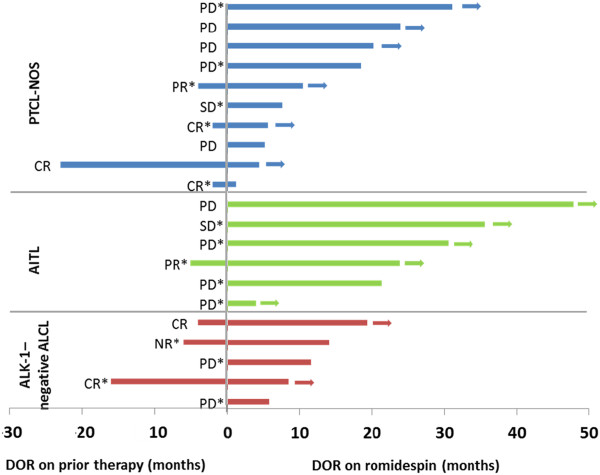
The ORR to romidepsin was 25%, including 15% with CR/CRu. The median DOR for all responders was 28 months (range, < 1-48+) and was not reached for those who achieved CR/CRu. Patients with lack of response or transient response to prior therapy achieved durable responses with romidepsin. Of the 19 patients who achieved CR/CRu, 10 had long-term (≥ 12 months) responses; none of the baseline characteristics examined-including heavy pretreatment, response to prior therapy, or advanced disease-precluded long-term responses to romidepsin. With a median progression-free survival of 29 months, patients who achieved CR/CRu for ≥ 12 months had significantly longer survival vs those with CR/CRu for < 12 months or < CR/CRu. Extended treatment and longer follow-up did not affect the reported safety profile of romidepsin.
Treatment with romidepsin leads to highly durable responses in a subset of patients with relapsed/refractory PTCL, with responses ongoing as long as 48 months.
罗米地辛是一种结构独特、强效的双环1类选择性组蛋白脱乙酰酶抑制剂,已获美国食品药品监督管理局批准,用于治疗接受过≥1次既往全身治疗的皮肤T细胞淋巴瘤患者以及接受过≥1次既往治疗的外周T细胞淋巴瘤(PTCL)患者。PTCL的批准基于罗米地辛治疗复发/难治性PTCL的关键研究结果(n = 130;中位随访时间为13.4个月)。目的是展示更新数据(中位随访时间为22.3个月)并描述对罗米地辛实现长期缓解(≥12个月)的患者特征。
既往接受过≥1次全身治疗后复发或难治的PTCL患者,每28天在第1、8和15天接受14 mg/m²罗米地辛静脉滴注4小时,共6个周期;有反应或疾病稳定的患者可在6个周期后继续使用罗米地辛治疗。主要终点是由独立审查委员会确定的确认/未确认完全缓解(CR/CRu)率。次要终点包括客观缓解率(ORR)和缓解持续时间(DOR)。对于达到CR/CRu的患者,按DOR(≥12个月与<12个月)检查基线特征。
罗米地辛的ORR为25%,其中CR/CRu为15%。所有缓解者的中位DOR为28个月(范围为<1 - 48 +),达到CR/CRu的患者未达到中位DOR。对既往治疗无反应或短暂反应的患者使用罗米地辛获得了持久缓解。在19例达到CR/CRu的患者中,10例有长期(≥12个月)缓解;所检查的基线特征,包括重度预处理、对既往治疗的反应或晚期疾病,均不排除对罗米地辛的长期缓解。达到CR/CRu≥12个月的患者中位无进展生存期为29个月,与CR/CRu<12个月或未达到CR/CRu的患者相比,生存期显著更长。延长治疗和更长时间的随访未影响所报告的罗米地辛安全性。
罗米地辛治疗可使一部分复发/难治性PTCL患者获得高度持久的缓解,缓解持续时间长达48个月。