Ákos Zsuzsa, Beck Róbert, Nagy Máté, Vicsek Tamás, Kubinyi Enikő
Department of Biological Physics, Eötvös University, Budapest, Hungary.
Department of Biological Physics, Eötvös University, Budapest, Hungary ; Statistical and Biological Physics Research Group of the Hungarian Academy of Sciences, Budapest, Hungary ; Department of Zoology, University of Oxford, Oxford, United Kingdom.
PLoS Comput Biol. 2014 Jan;10(1):e1003446. doi: 10.1371/journal.pcbi.1003446. Epub 2014 Jan 23.
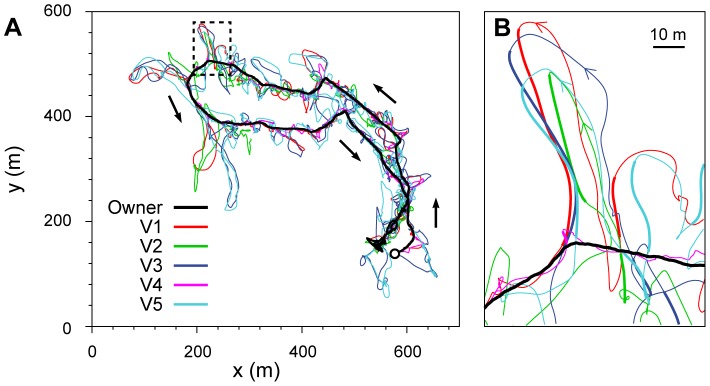
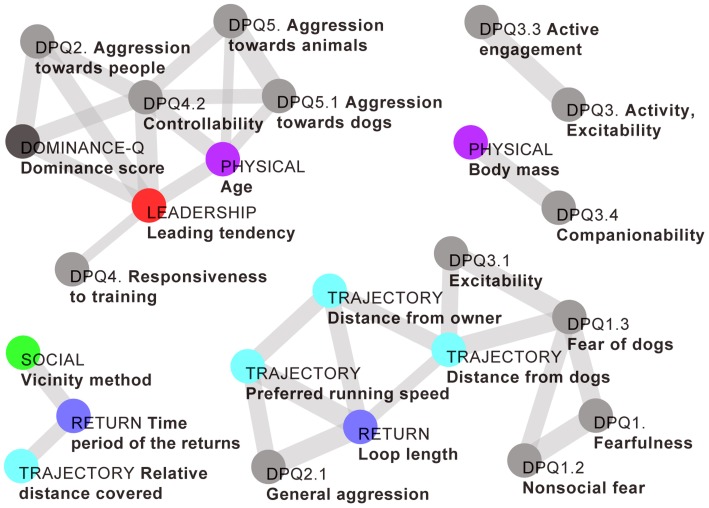
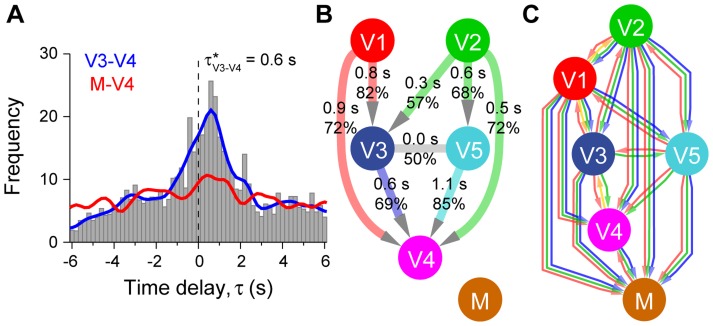
Movement interactions and the underlying social structure in groups have relevance across many social-living species. Collective motion of groups could be based on an "egalitarian" decision system, but in practice it is often influenced by underlying social network structures and by individual characteristics. We investigated whether dominance rank and personality traits are linked to leader and follower roles during joint motion of family dogs. We obtained high-resolution spatio-temporal GPS trajectory data (823,148 data points) from six dogs belonging to the same household and their owner during 14 30-40 min unleashed walks. We identified several features of the dogs' paths (e.g., running speed or distance from the owner) which are characteristic of a given dog. A directional correlation analysis quantifies interactions between pairs of dogs that run loops jointly. We found that dogs play the role of the leader about 50-85% of the time, i.e. the leader and follower roles in a given pair are dynamically interchangable. However, on a longer timescale tendencies to lead differ consistently. The network constructed from these loose leader-follower relations is hierarchical, and the dogs' positions in the network correlates with the age, dominance rank, trainability, controllability, and aggression measures derived from personality questionnaires. We demonstrated the possibility of determining dominance rank and personality traits of an individual based only on its logged movement data. The collective motion of dogs is influenced by underlying social network structures and by characteristics such as personality differences. Our findings could pave the way for automated animal personality and human social interaction measurements.
群体中的运动互动及潜在社会结构在许多群居物种中都具有相关性。群体的集体运动可能基于一种“平等主义”决策系统,但实际上它往往受到潜在社会网络结构和个体特征的影响。我们研究了在家庭犬类共同运动过程中,优势等级和个性特征是否与领导者和跟随者角色相关联。我们从同一家庭的六只犬及其主人在14次30至40分钟的无绳散步过程中获取了高分辨率的时空GPS轨迹数据(823,148个数据点)。我们识别出了犬类路径的几个特征(例如,奔跑速度或与主人的距离),这些特征是特定犬类所特有的。方向相关性分析量化了共同奔跑形成环路的犬对之间的互动。我们发现犬类在大约50%至85%的时间里扮演领导者角色,即在给定的一对犬中,领导者和跟随者角色是动态可互换的。然而,在较长时间尺度上,主导倾向始终存在差异。由这些松散的领导者-跟随者关系构建的网络是分层的,并且犬类在网络中的位置与从个性问卷中得出的年龄、优势等级、可训练性、可控性和攻击性指标相关。我们证明了仅根据个体记录的运动数据来确定其优势等级和个性特征的可能性。犬类的集体运动受到潜在社会网络结构和个性差异等特征的影响。我们的研究结果可能为自动测量动物个性和人类社会互动铺平道路。