Gu Xiao-Jing, Hu Ming, Li Bing, Hu Xin-Tian
State Key Laboratory of Brain and Cognitive Science, Institute of Biophysics, Chinese Academy of Sciences, Beijing, China ; University of Chinese Academy of Sciences, Beijing, China.
Department of Neurobiology and Anatomy, University of Texas-Houston Medical School, Houston, Texas, United States of America.
PLoS One. 2014 Jan 22;9(1):e86542. doi: 10.1371/journal.pone.0086542. eCollection 2014.
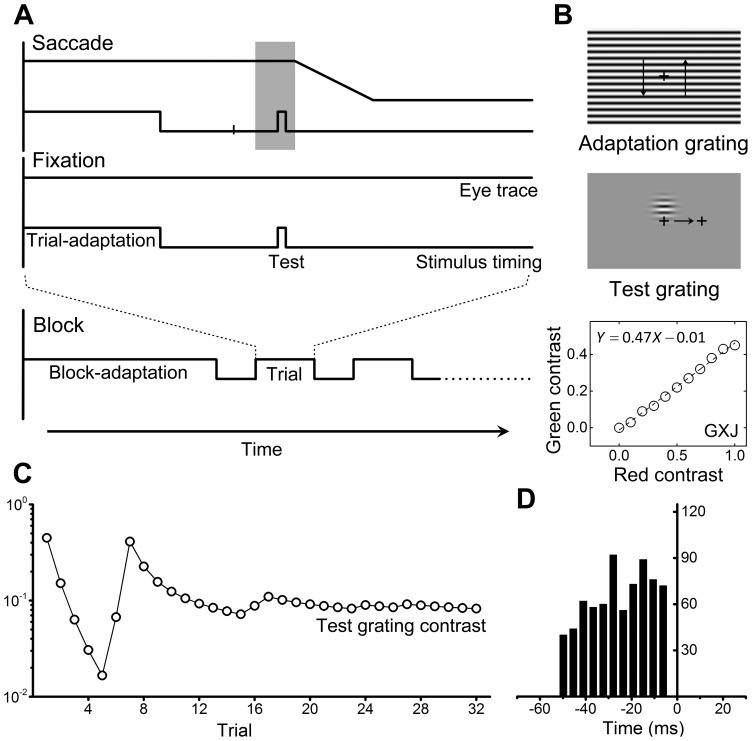
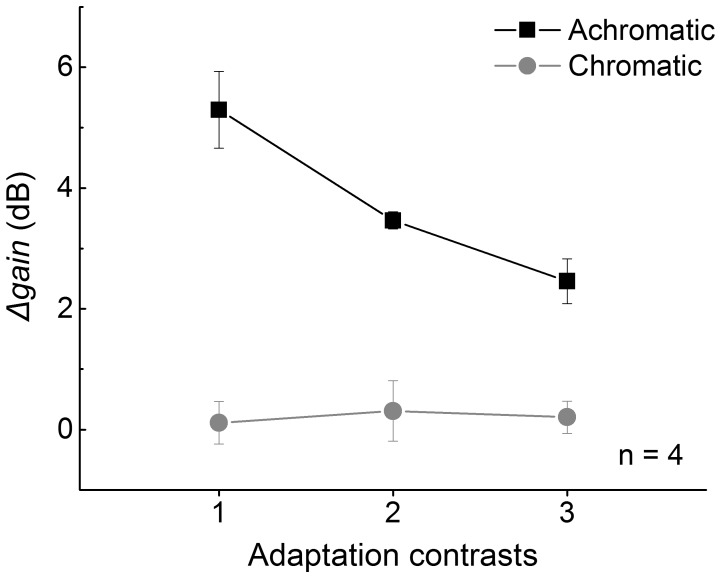
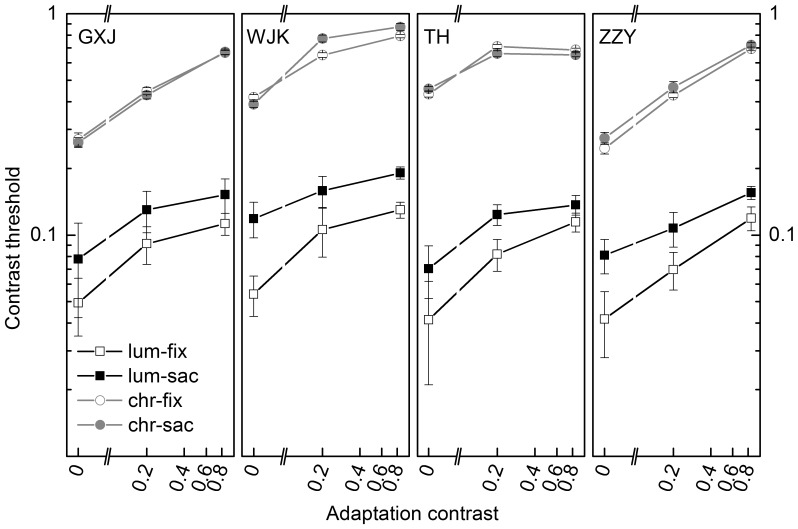
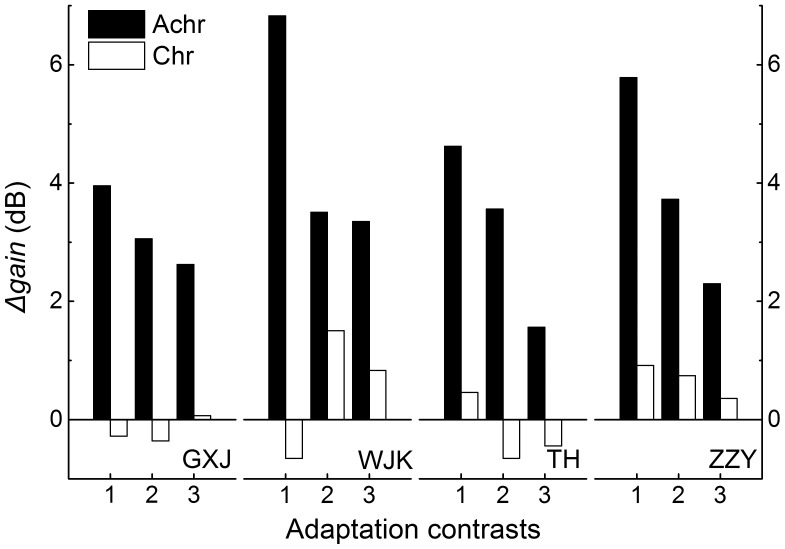
The idea of retinal and ex-retinal sources of saccadic suppression has long been established in previous studies. However, how they are implemented in local circuit remains unknown. Researchers have suggested that saccadic suppression was probably achieved by contrast gain control, but this possibility has never been directly tested. In this study, we manipulated contrast gain control by contrast-adapting observers with sinusoidal gratings of different contrasts. Presaccadic and fixational contrast thresholds were measured and compared to give estimates of saccadic suppression at different adaptation states. Our results reconfirmed the selective saccadic suppression in achromatic condition, and further showed that, achromatic saccadic suppression diminished as contrast adaptation was accentuated, whereas no significant chromatic saccadic suppression was induced by greater contrast adaptation. Our data provided evidence for the involvement of contrast gain control in saccadic suppression in achromatic channel. We also discussed how the negative correlation between contrast adaptation and saccadic suppression could be interpreted with contrast gain control.
以往的研究早已确立了扫视抑制的视网膜和视网膜外来源的观点。然而,它们在局部回路中是如何实现的仍不清楚。研究人员提出,扫视抑制可能是通过对比度增益控制实现的,但这种可能性从未得到直接验证。在本研究中,我们通过用不同对比度的正弦光栅对观察者进行对比度适应来操纵对比度增益控制。测量并比较扫视前和注视时的对比度阈值,以估计不同适应状态下的扫视抑制。我们的结果再次证实了消色差条件下的选择性扫视抑制,并进一步表明,随着对比度适应的增强,消色差扫视抑制减弱,而更大的对比度适应并未诱导出明显的彩色扫视抑制。我们的数据为对比度增益控制参与消色差通道的扫视抑制提供了证据。我们还讨论了如何用对比度增益控制来解释对比度适应与扫视抑制之间的负相关。