State Key Laboratory of Cognitive Neuroscience and Learning, Beijing Normal University Beijing, China ; International Data Group/McGovern Institute for Brain Research, Beijing Normal University Beijing, China.
State Key Laboratory of Cognitive Neuroscience and Learning, Beijing Normal University Beijing, China ; International Data Group/McGovern Institute for Brain Research, Beijing Normal University Beijing, China ; Center for Collaboration and Innovation in Brain and Learning Sciences, Beijing Normal University Beijing, China.
Front Psychol. 2014 Jan 16;4:1024. doi: 10.3389/fpsyg.2013.01024. eCollection 2013.
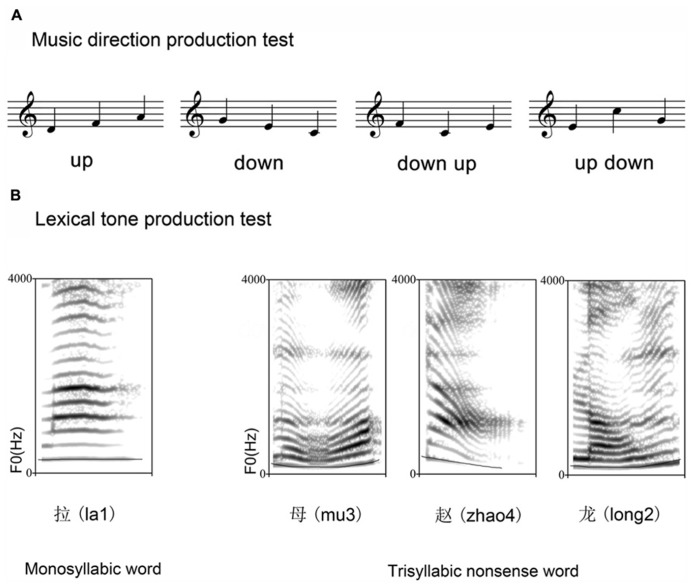
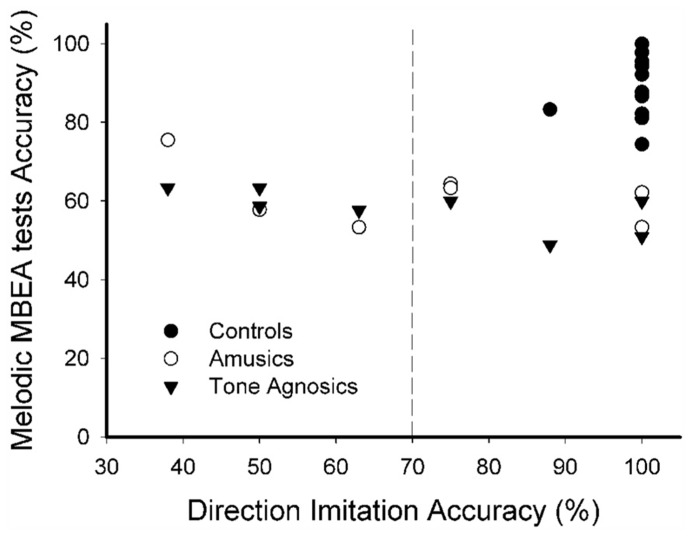
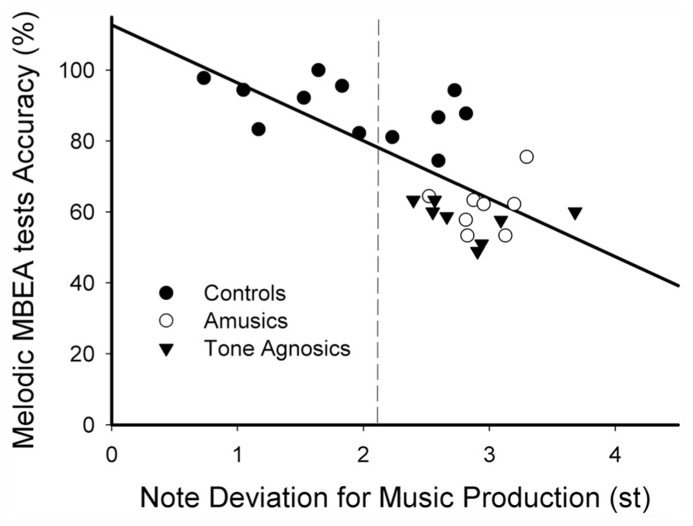
Congenital amusia is a musical disorder that mainly affects pitch perception. Among Mandarin speakers, some amusics also have difficulties in processing lexical tones (tone agnosics). To examine to what extent these perceptual deficits may be related to pitch production impairments in music and Mandarin speech, eight amusics, eight tone agnosics, and 12 age- and IQ-matched normal native Mandarin speakers were asked to imitate music note sequences and Mandarin words of comparable lengths. The results indicated that both the amusics and tone agnosics underperformed the controls on musical pitch production. However, tone agnosics performed no worse than the amusics, suggesting that lexical tone perception deficits may not aggravate musical pitch production difficulties. Moreover, these three groups were all able to imitate lexical tones with perfect intelligibility. Taken together, the current study shows that perceptual musical pitch and lexical tone deficits might coexist with musical pitch production difficulties. But at the same time these perceptual pitch deficits might not affect lexical tone production or the intelligibility of the speech words that were produced. The perception-production relationship for pitch among individuals with perceptual pitch deficits may be, therefore, domain-dependent.
先天性失乐症是一种主要影响音高感知的音乐障碍。在普通话使用者中,一些失乐症患者也难以处理词汇声调(音高失认症)。为了研究这些感知缺陷在多大程度上可能与音乐和普通话语音中的音高产生障碍有关,我们要求 8 名失乐症患者、8 名音高失认症患者和 12 名年龄和智商匹配的正常母语普通话使用者模仿音乐音符序列和长度相当的普通话单词。结果表明,失乐症患者和音高失认症患者在音乐音高产生方面的表现均逊于对照组。然而,音高失认症患者的表现并不比失乐症患者差,这表明词汇声调感知缺陷可能不会加重音乐音高产生的困难。此外,这三组人都能够以完美的可懂度模仿词汇声调。综上所述,本研究表明,感知性音乐音高和词汇声调缺陷可能与音乐音高产生困难共存。但同时,这些感知性音高缺陷可能不会影响词汇声调产生或所产生的言语词的可懂度。因此,对于感知性音高缺陷个体而言,音高的感知-产生关系可能是领域依赖的。