
我们将再次相聚:揭示社会接触的分布和时间模式。
We'll meet again: revealing distributional and temporal patterns of social contact.
机构信息
Center for Adaptive Rationality, Max Planck Institute for Human Development, Berlin, Germany.
Center for Adaptive Behavior and Cognition, Max Planck Institute for Human Development, Berlin, Germany.
出版信息
PLoS One. 2014 Jan 27;9(1):e86081. doi: 10.1371/journal.pone.0086081. eCollection 2014.
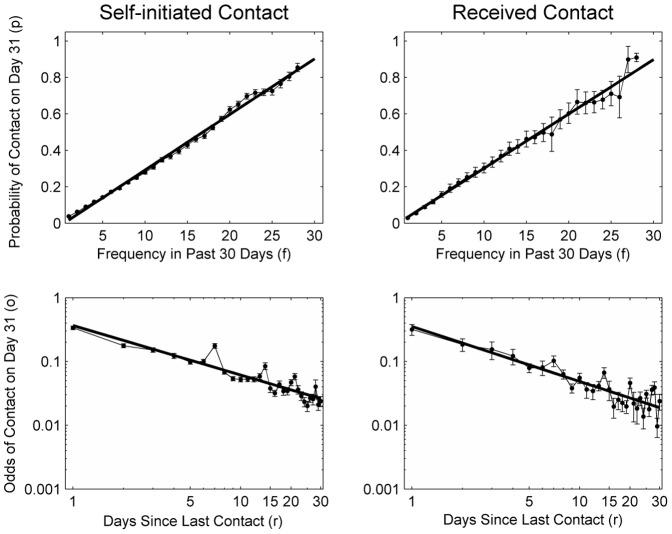
What are the dynamics and regularities underlying social contact, and how can contact with the people in one's social network be predicted? In order to characterize distributional and temporal patterns underlying contact probability, we asked 40 participants to keep a diary of their social contacts for 100 consecutive days. Using a memory framework previously used to study environmental regularities, we predicted that the probability of future contact would follow in systematic ways from the frequency, recency, and spacing of previous contact. The distribution of contact probability across the members of a person's social network was highly skewed, following an exponential function. As predicted, it emerged that future contact scaled linearly with frequency of past contact, proportionally to a power function with recency of past contact, and differentially according to the spacing of past contact. These relations emerged across different contact media and irrespective of whether the participant initiated or received contact. We discuss how the identification of these regularities might inspire more realistic analyses of behavior in social networks (e.g., attitude formation, cooperation).
社交接触的动态和规律是什么?如何预测一个人社交网络中的接触?为了描述接触概率的分布和时间模式,我们要求 40 名参与者连续 100 天记录他们的社交接触情况。我们使用以前用于研究环境规律的记忆框架,预测未来接触的概率将从之前接触的频率、最近一次接触的时间和间隔的系统性方式来预测。社交网络中成员的接触概率分布高度偏态,呈指数函数关系。正如预测的那样,未来接触与过去接触的频率呈线性关系,与过去接触的最近一次时间呈幂函数关系,并且与过去接触的间隔不同。这些关系出现在不同的接触媒介中,与参与者发起或接收接触无关。我们讨论了识别这些规律如何启发对社交网络中行为的更现实的分析(例如,态度形成、合作)。


 Zotero 插件