Nowak Martin A
Program for Evolutionary Dynamics, Department of Organismic and Evolutionary Biology, and Department of Mathematics, Harvard University, Cambridge, MA 02138, USA.
Science. 2006 Dec 8;314(5805):1560-3. doi: 10.1126/science.1133755.
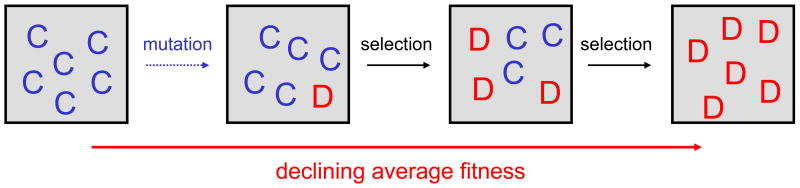
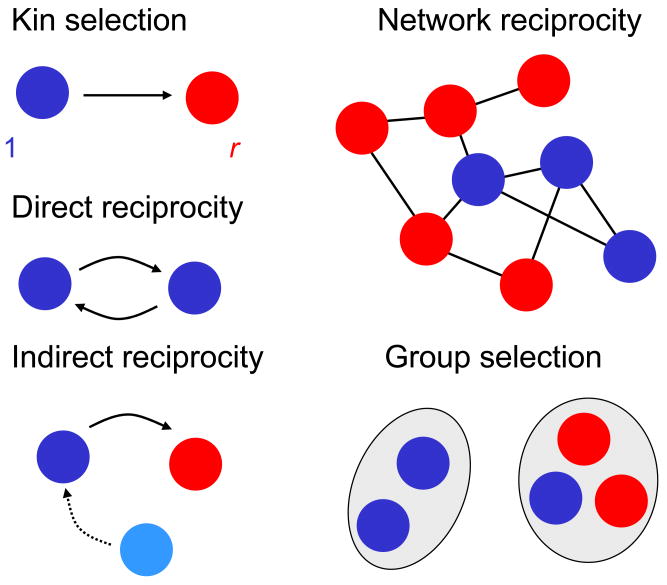
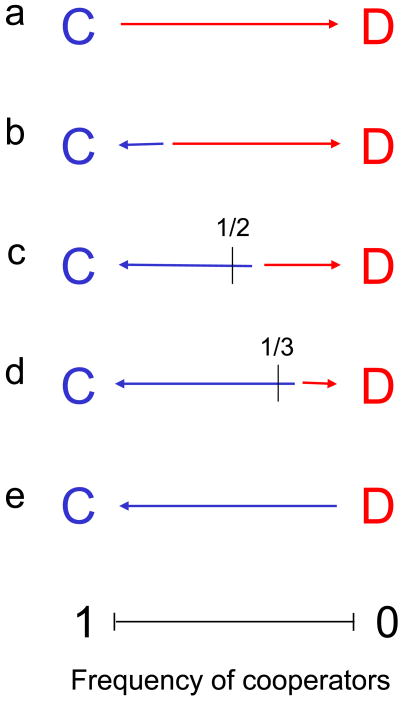
Cooperation is needed for evolution to construct new levels of organization. Genomes, cells, multicellular organisms, social insects, and human society are all based on cooperation. Cooperation means that selfish replicators forgo some of their reproductive potential to help one another. But natural selection implies competition and therefore opposes cooperation unless a specific mechanism is at work. Here I discuss five mechanisms for the evolution of cooperation: kin selection, direct reciprocity, indirect reciprocity, network reciprocity, and group selection. For each mechanism, a simple rule is derived that specifies whether natural selection can lead to cooperation.
进化需要合作来构建新的组织层次。基因组、细胞、多细胞生物、群居昆虫和人类社会都基于合作。合作意味着自私的复制因子会放弃一些繁殖潜力来相互帮助。但自然选择意味着竞争,因此除非有特定机制起作用,否则它会反对合作。在这里,我将讨论合作进化的五种机制:亲缘选择、直接互惠、间接互惠、网络互惠和群体选择。对于每种机制,都推导出了一个简单的规则,该规则规定了自然选择是否能导致合作。