Division of Cardiology, Department of Internal Medicine, Kaohsiung Medical University, Kaohsiung, Taiwan ; Faculty of Medicine, Kaohsiung Medical University, Kaohsiung, Taiwan.
Department of Pathology, Kaohsiung Medical University, Kaohsiung, Taiwan ; Kaohsiung Medical University Hospital, Department of Pathology, Kaohsiung Municipal Ta-Tung Hospital, Kaohsiung Medical University, Kaohsiung, Taiwan ; Faculty of Medicine, Kaohsiung Medical University, Kaohsiung, Taiwan.
PLoS One. 2014 Jan 27;9(1):e86287. doi: 10.1371/journal.pone.0086287. eCollection 2014.
Matrix metalloproteinases play a role in regulating cardiac remodeling. We previously reported an association between tissue inhibitor of metalloproteinase 2 (TIMP-2) expression and mitral valve (MV) disease. However, the determinants and prognostic value of mitral TIMP2 after MV surgery are unknown.
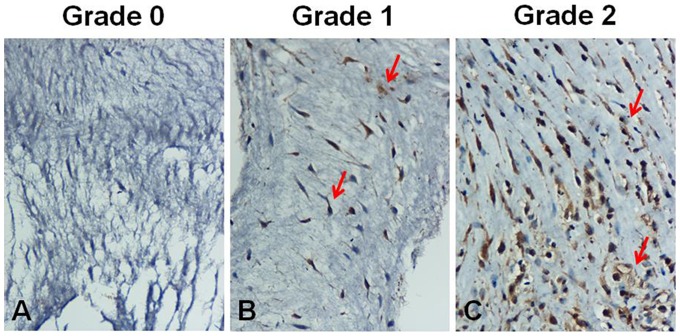
This retrospective study of 164 patients after MV surgery in a tertiary medical center in Taiwan assessed mitral TIMP2 on a semiquantitative scale (0-2) by immunohistochemical staining. The primary endpoints were the composite of cardiovascular death and heart failure admission.
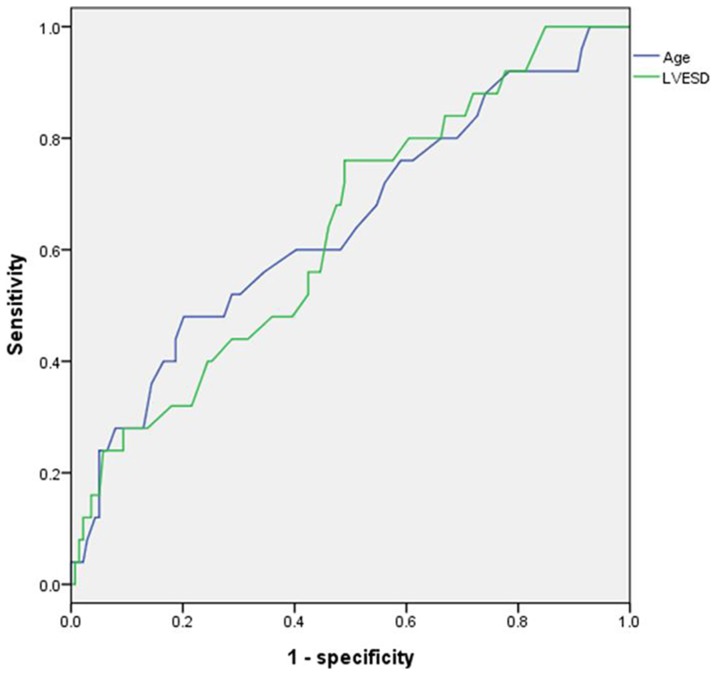
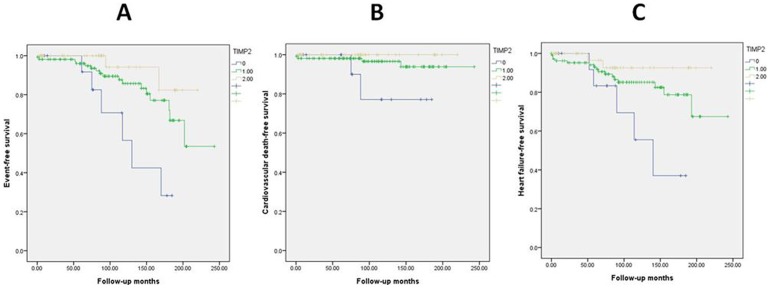
Mean age was 50.4±13.7 years. After a mean follow-up period of 101±59 months, primary endpoints had occurred in 25 (15.2%) subjects. Patients with and without primary endpoint events significantly differed in terms of age (56.6±14.4 vs. 49.2±13.4 years, respectively; p = 0.013) and left ventricular end-systolic diameter (LVESD) (39.7±8.2 vs. 35.5±7.5 mm, p = 0.010) at surgery. The TIMP2 had a significant dose-dependent association with development of a primary endpoint (p = 0.002). Kaplan-Meier analysis showed that TIMP2 expression has a significant positive association with primary endpoint-free survival (log-rank test; p = 0.004). Cox regression analysis showed that independent predictors of primary endpoints were TIMP2 (hazard ratio [HR] 0.28; 95% confidence interval [CI] 0.12-0.65; p = 0.003), age (HR 1.05; 95% CI 1.02-1.09; p = 0.003) and LVESD (HR 1.05; 95% CI 1.01-1.10; p = 0.020).
The lack of mitral TIMP2 expression is associated with increases in cardiovascular death and heart failure following MV surgery.
基质金属蛋白酶在调节心脏重构中起作用。我们之前报道过组织金属蛋白酶抑制剂 2(TIMP-2)表达与二尖瓣(MV)疾病之间的关联。然而,MV 手术后二尖瓣 TIMP2 的决定因素及其预后价值尚不清楚。
本研究回顾性分析了台湾一家三级医疗中心 164 例 MV 手术后患者的组织,通过免疫组织化学染色对二尖瓣 TIMP2 进行半定量评分(0-2)。主要终点是心血管死亡和心力衰竭入院的复合终点。
平均年龄为 50.4±13.7 岁。平均随访 101±59 个月后,25 例(15.2%)患者发生主要终点事件。发生和未发生主要终点事件的患者在年龄(56.6±14.4 岁比 49.2±13.4 岁,p=0.013)和手术时左心室收缩末期直径(LVESD)(39.7±8.2 毫米比 35.5±7.5 毫米,p=0.010)方面有显著差异。TIMP2 与主要终点的发生呈显著剂量依赖性相关(p=0.002)。Kaplan-Meier 分析显示,TIMP2 表达与主要终点无事件生存率呈显著正相关(对数秩检验;p=0.004)。Cox 回归分析显示,主要终点的独立预测因素是 TIMP2(风险比 [HR] 0.28;95%置信区间 [CI] 0.12-0.65;p=0.003)、年龄(HR 1.05;95% CI 1.02-1.09;p=0.003)和 LVESD(HR 1.05;95% CI 1.01-1.10;p=0.020)。
MV 手术后二尖瓣 TIMP2 表达缺失与心血管死亡和心力衰竭的增加有关。